Candlestick
ca. 1250 (made)
| Artist/Maker | |
| Place of origin |
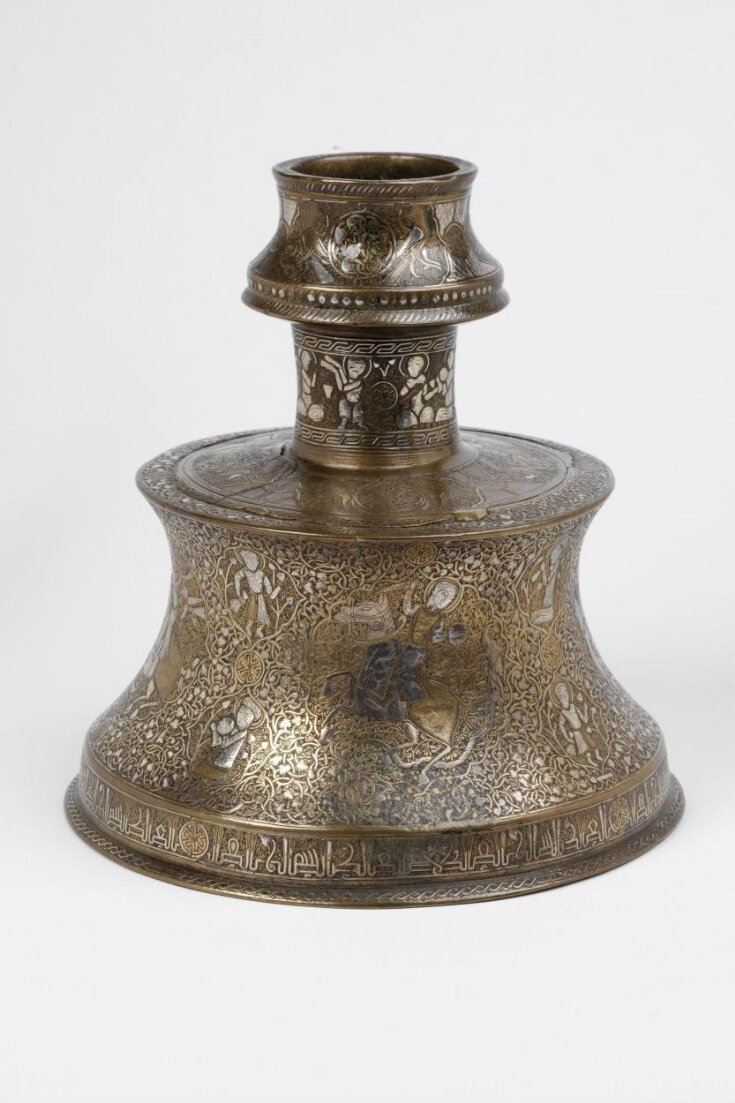
This candlestick comes from an area in south-east Turkey with a strong tradition of casting in bronze. When inlaid decoration was introduced from Iran, local metalworkers applied it to objects that had been cast rather than formed from sheet brass. Here the inlay has been used to create medallions with scenes of hunting and revelry interspersed with key-patterns, figures of animals and birds and plant ornament.
For larger motifs metalworkers chiselled out small areas of the surface and filled them with thin sheets of silver, gold and copper. They added details by chasing the surface of the softer metals. They created contrast with a black filler. The results were, for metalwork, an unusually graphic form of decoration, often of great quality.
For larger motifs metalworkers chiselled out small areas of the surface and filled them with thin sheets of silver, gold and copper. They added details by chasing the surface of the softer metals. They created contrast with a black filler. The results were, for metalwork, an unusually graphic form of decoration, often of great quality.
Object details
| Categories | |
| Object type | |
| Materials and techniques | Bronze, cast and turned on a lathe, engraved and inlaid with black composition |
| Brief description | Bronze candlestick with inlaid decoration, south-east Turkey (probably Siirt), ca. 1250. |
| Physical description | Leaded bronze candlestick, cast and turned; engraved and (partly) inlaid with decoration including medallions with scenes of hunting and revelry, interspersed with key-patterns, animal- and bird-figures, and vegetal ornament. |
| Dimensions |
|
| Gallery label | Jameel Gallery
Bronze Candlestick
South-east Turkey, probably Siirt
About 1250
This candlestick comes from an area with a strong tradition of casting in bronze. When inlaid decoration was introduced from Iran, it was applied to objects that had been cast rather than formed from sheet brass, as in the case of the 12-sided candlestick.
Bronze inlaid with silver, gold and a black composition
Museum no. M.711-1910. Bequest of George Salting(Jameel Gallery) |
| Object history | Salting bequest, 23 December 1909. |
| Production | One of a group of candlesticks attributed to the Sultanate of Rum, which had its capital at Konya (Turkey) and dependencies in Armenia. |
| Subjects depicted | |
| Summary | This candlestick comes from an area in south-east Turkey with a strong tradition of casting in bronze. When inlaid decoration was introduced from Iran, local metalworkers applied it to objects that had been cast rather than formed from sheet brass. Here the inlay has been used to create medallions with scenes of hunting and revelry interspersed with key-patterns, figures of animals and birds and plant ornament. For larger motifs metalworkers chiselled out small areas of the surface and filled them with thin sheets of silver, gold and copper. They added details by chasing the surface of the softer metals. They created contrast with a black filler. The results were, for metalwork, an unusually graphic form of decoration, often of great quality. |
| Bibliographic references |
|
| Collection | |
| Accession number | M.711-1910 |
About this object record
Explore the Collections contains over a million catalogue records, and over half a million images. It is a working database that includes information compiled over the life of the museum. Some of our records may contain offensive and discriminatory language, or reflect outdated ideas, practice and analysis. We are committed to addressing these issues, and to review and update our records accordingly.
You can write to us to suggest improvements to the record.
Suggest feedback
You can write to us to suggest improvements to the record.
Suggest feedback
| Record created | October 24, 2003 |
| Record URL |
Download as: JSONIIIF Manifest
