St John the Evangelist
Panel
1440-1460 (made)
1440-1460 (made)
| Artist/Maker | |
| Place of origin |
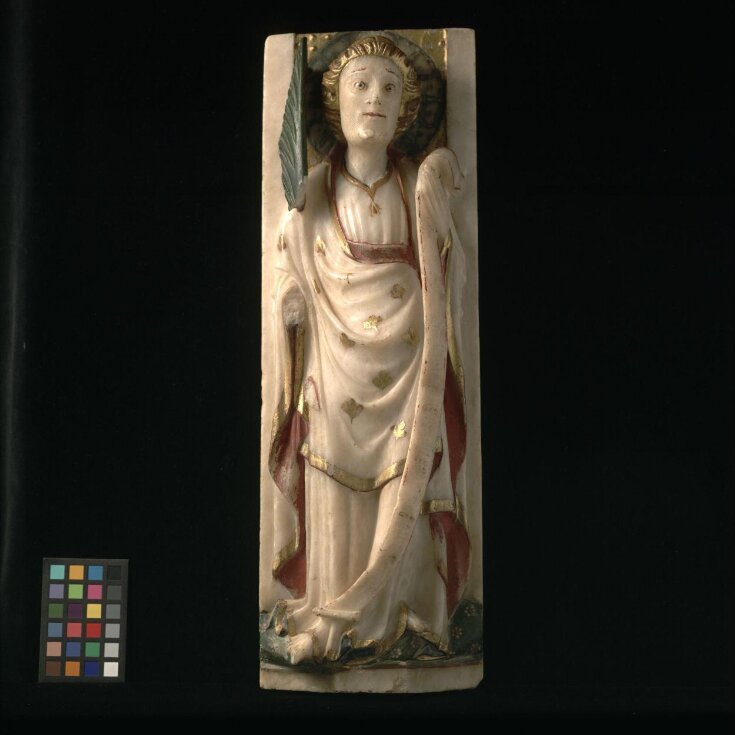
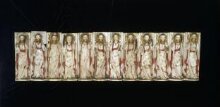
This Apostle probably comes from the upper part of a rood-screen and is one of twelve panels held in the Museum said to have come from a church in the town or province of Zamora, Spain (inv.nos. A.148 to 159-1922). The Apostles would have stood in a line just below the rood (a large figure of the crucified Christ). Each figure is identified by the inscription on his scroll and by a specific attribute, or symbol. Here st John the Evangelist carries the palm given to him by the Virgin Mary to carry before her funeral bier.
The carving of alabaster, mostly quarried in Tutbury and Chellaston near Nottingham, took on industrial proportions in England between the middle of the 14th and the early 16th centuries. The market for altarpieces and smaller devotional images was a large one. It included not only religious foundations but also the merchant classes. Many hundreds of English alabasters were exported, some as far afield as Iceland and Santiago de Compostela in north-west Spain.
Alabaster - a form of gypsum - is a comparatively soft material and is therefore easy to carve. It can also be polished. Its natural colour was especially useful for the representation of faces and flesh, which would normally remain unpainted.
The carving of alabaster, mostly quarried in Tutbury and Chellaston near Nottingham, took on industrial proportions in England between the middle of the 14th and the early 16th centuries. The market for altarpieces and smaller devotional images was a large one. It included not only religious foundations but also the merchant classes. Many hundreds of English alabasters were exported, some as far afield as Iceland and Santiago de Compostela in north-west Spain.
Alabaster - a form of gypsum - is a comparatively soft material and is therefore easy to carve. It can also be polished. Its natural colour was especially useful for the representation of faces and flesh, which would normally remain unpainted.
Object details
| Categories | |
| Object type | |
| Title | St John the Evangelist (generic title) |
| Materials and techniques | Carved, painted and gilt alabaster |
| Brief description | Alabaster panel depicting St James the Greater, English, 1440-1460 |
| Physical description | The panel has a plain border on each vertical side, and a base showing three facets in front. The haloed figure of St John the Evangelist, with a beard and wearing a gown and a cloak. |
| Dimensions |
|
| Style | |
| Gallery label | Gothic
The Twelve Apostles
About 1450
The Apostles probably come from the upper part of a rood-screen. They would have stood in a line just below the rood (a large figure of the crucified Christ). Each figure is identified by the inscription on his scroll and by a specific attribute, or symbol.
Alabaster, with substantial traces of painting and gilding.
V&A: A.148 to 159-1922. Gift of the National Art Collections Fund
Cat. 267(2003) |
| Credit line | Given by Art Fund |
| Object history | From a church either in the town of Zamora in Spain or in the province of Zamora. One of the 12 panels of the Apostles' Creed Altarpiece. Latterly in the possession of G. Thomas. Gift of the National Art Collections Fund in 1922. |
| Subjects depicted | |
| Summary | This Apostle probably comes from the upper part of a rood-screen and is one of twelve panels held in the Museum said to have come from a church in the town or province of Zamora, Spain (inv.nos. A.148 to 159-1922). The Apostles would have stood in a line just below the rood (a large figure of the crucified Christ). Each figure is identified by the inscription on his scroll and by a specific attribute, or symbol. Here st John the Evangelist carries the palm given to him by the Virgin Mary to carry before her funeral bier. The carving of alabaster, mostly quarried in Tutbury and Chellaston near Nottingham, took on industrial proportions in England between the middle of the 14th and the early 16th centuries. The market for altarpieces and smaller devotional images was a large one. It included not only religious foundations but also the merchant classes. Many hundreds of English alabasters were exported, some as far afield as Iceland and Santiago de Compostela in north-west Spain. Alabaster - a form of gypsum - is a comparatively soft material and is therefore easy to carve. It can also be polished. Its natural colour was especially useful for the representation of faces and flesh, which would normally remain unpainted. |
| Associated objects |
|
| Bibliographic references |
|
| Collection | |
| Accession number | A.151-1922 |
About this object record
Explore the Collections contains over a million catalogue records, and over half a million images. It is a working database that includes information compiled over the life of the museum. Some of our records may contain offensive and discriminatory language, or reflect outdated ideas, practice and analysis. We are committed to addressing these issues, and to review and update our records accordingly.
You can write to us to suggest improvements to the record.
Suggest feedback
You can write to us to suggest improvements to the record.
Suggest feedback
| Record created | October 6, 2003 |
| Record URL |
Download as: JSONIIIF Manifest
