| Categories | |
| Object type | |
| Title | Window framework |
| Materials and techniques | Oak |
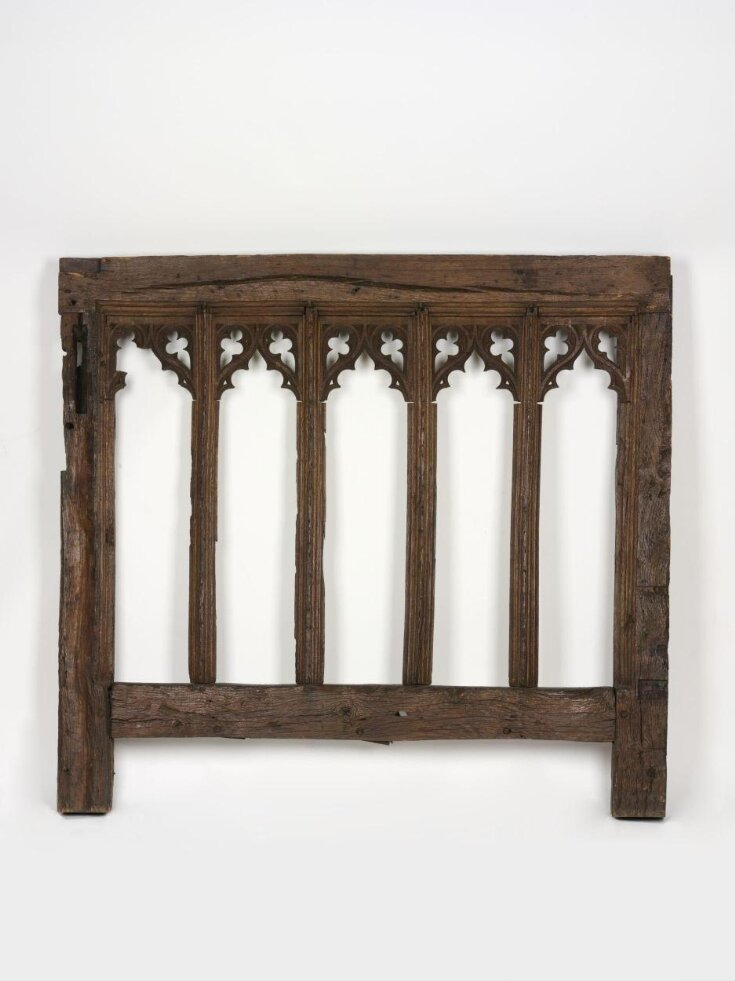
| Brief description | Window-frame, consisting of a framework of heavy oak beams enclosing five lights, England, 1475-1500 |
| Physical description | Window-frame, consisting of a framework of heavy beams enclosing five lights divided by mullions moulded on front and back; the top of each light is occupied by an ogee arch with openwork tracery. On the inside face there are still traces of decorated plaster-work.
For detailed drawings and measurements see Diehl. |
| Dimensions | - Height: 180cm
- Width: 198cm
- Depth: 16cm
- Weight: 108kg
Measured for the Medieval and Renaissance Galleries |
| Styles | |
| Gallery label | Window frame
1400-1500
The window is carved with fashionable Gothic tracery. Although exceptionally elaborate, it would probably never have been glazed . The weather was kept out simply by shutters, possibly both inside and out.
Oak
From Hadleigh, Suffolk
V&A: W.59-1913
Ex. Cat.(2003) |
| Credit line | |
| Object history | Given by A.H. Fass, Esq., Giffords Hall, Wickhambrook, Newmarket (RF 135128 M)
From a house in Hadleigh, Suffolk.
This window must have always been intended to be unglazed. The tracery on both sides is carved and the mullions moulded.On the inside face there are still traces of decorated plaster-work. The rebates on the interior faces must have been for shutters. It has been pointed out (Cescinsky and Gribble 1922, 52-53) that these window-frames again demonstrate that ceilinged rooms at this time must have been very low, even in timber houses of the more elaborate kind. The height of this exceptionally fine window is less than 1.8m. Even allowing for the cutting of the lower parts of the up-rights, where they rested in the wall-plate, the total height of the room cannot have been more than 2.1m. Fifteenth century doors made for secular timber-framed houses are rarely over 1.8m in height. |
| Historical context | See Salzman, Building in England down to 1540 (Oxford 1952), chapter 17 Doors, Shutters, panelling, screens |
| Production | From a house in Hadleigh, Suffolk |
| Summary | This window frame is carved with fashionable Gothic tracery. It is very elaborate, but there was never any intention to glaze it. The weather was kept out simply by shutters, possibly both inside and out. This window frame shows that ceilinged rooms at the time must have been very low, even in timber houses of the more elaborate kind. The total height of the room from which this window came must have been less than 2.1 metres. |
| Bibliographic references | - Charles Tracy, English Medieval Furniture and Woodwork (London, 1988), cat. no. 245.
'WINDOW-FRAME, consisting of a framework of heavy beams enclosing five lights divided by mullions moulded on front and back; the top of each light is occupied by an ogee arch with openwork tracery (PL.79).
From a house in Hadleigh, Suffolk
Given By Mr A. H. Fass
Oak. Late 15th century
18 x 22 cm
Mus. No. W.59-1913
This window must have always been intended to be unglazed. The tracery on both sides is carved and the mullions moulded. On the inside face there are still traces of decorated plaster-work. The rebates on the interior faces must have been for shutters. It has been pointed out (H. Cescinsky and E.R. Gribble, Early English Furniture and Woodwork, 2 vols, London, 1922, p.52-53) that these Window-frames again demonstrate (compare the Bury St Edmund’s corner-posts, Mus. Nos W.6-1909 & W.7-1909) that ceilinged rooms at this time must have been very low even in timber houses of the more elaborate kind. The height of this exceptionally fine window is less than 1.8m. Even allowing for the cutting of the lower parts of the uprights, where they rested on the wall-plate, the total height of the room cannot have been more than 2.1m. Fifteenth-century doors made for secular timber-framed houses are rarely over 1.8m in height'.
- H. Clifford Smith, Catalogue of English Furniture & Woodwork. Vol. I – Gothic and Early Tudor (London, 1929), No. 213, Plate 27.
'WINDOW-FRAME, consisting of a framework of heavy beams enclosing five lights divided by mullions moulded on front and back; the top of each light is occupied by an ogee arch with openwork tracery. From a house in Hadleigh, Suffolk. Late 15th century. H.5 ft. 11 in., W. 7 ft.3 in. Given By Mr A. H. Fass. Plate 27. W.59-1913. Figured in Cescinsky & Gribble: Early English Furniture & Woodwork. Vol. I, Fig. 40 and 41. Illustrations of similar windows are exhibited in the Saffron Walden Museum, Essex.”
- CESCINSKY, Herbert & Ernest Gribble: Early English Furniture & Woodwork. Vol. I (London, 1922), p. 52-53, figs. 40, 41
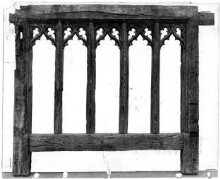
“The Same elaboration of traceried carving was often carried into the designing of the windows of these timber houses. Figs. 41 and 42 show the exterior and interior views of an oak window from an old house at Hadleigh in Essex, of the later fifteenth century. The fact is worthy of notice that there is no sign of a glazing rebate or fillet.
It is possible that sheets of parchment, or oiled linen, may have been nailed over the window apertures to keep out draught, but this window was originally made to be left open, as the tracery on both sides is carved and the mullions moulded. Interesting remains of decorated plaster-work can be seen on the inside face. The rebates shown on the interior faces are for shutters only.
Doors and door framings were treated on a similarly elaborate scale, but consideration of these must be deferred to a later chapter where the subject can be dealt with at greater length and detail.
It is obvious from a study of these half-timber houses, built for the moderately wealthy, that the low rooms which they contained must have limited the height of the furniture made for them, very severely. This low ceiling-pitch was, obviously, found desirable for two reasons. In the periods when the science of heating was very little comprehended, cosiness, or even stuffiness, was preferred to over-ventilation, and, also, in the designing of these gabled houses, it was found that a greater height than eight feet per story (as a maximum) made these houses, with their steeply pitched tiled roofs, disproportionately lofty.
The window framing from the old house at Hadleigh, Fig. 41, shows, in the same way as the Bury St. Edmunds corner-posts, that rooms must have been low in pitch, even in the timber-houses of the most elaborate kind. This window is fine and important, even for the fifteenth century, when the craft of the English woodworker was at its zenith, yet the total height is under six feet. If we allow for the cutting of the lower parts of the upright timbers, where they rested on the wall-plate, we cannot add much more than one foot, to give the total height of the room for which they were made. Doors also show, although not so convincingly, that they were intended for low ceilinged rooms. A fifteenth-century door made for a secular house of the timber kind, is rarely over six feet in height, and is usually less even than this.
A curious point suggests itself in this connection; has the stature of the English race grown since the fifteenth century, or were doors and ceilings kept purposely low ? An examination of suits of armour of this period,—the evidence of which must be beyond question, as armour must fit to a nicety,—will show, I think, that six feet was quite an exceptional height for an Englishman in the fourteenth and fifteenth centuries. Effigies on tombs suggest the same thing, but here the evidence is dubious, as the scale of these figures may be over or under life-size.”
- Daniel Diehl, Constructing Medieval Furniture - plans and instructions with historical notes (Mechanicsburg, PA, 1997), pp.111-118
- Murray Adams-Acton, Domestic Architecture & Old Furniture (1929) NAL32.G48
|
| Collection | |
| Accession number | |