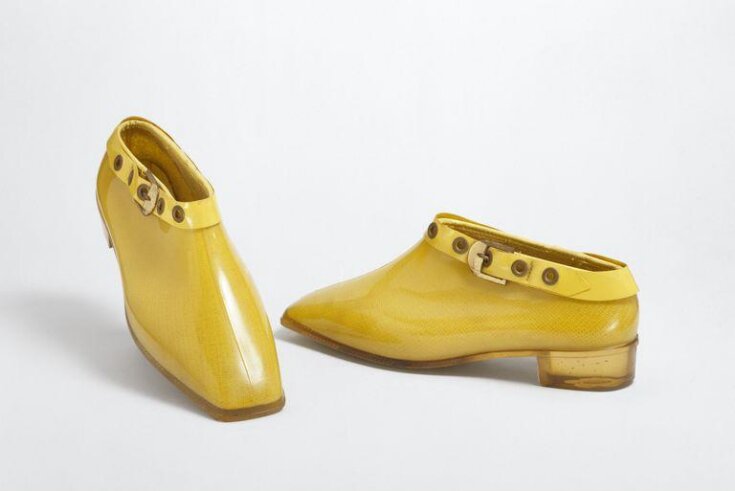

Pair of Ankle Boots
1967 (made)
| Artist/Maker | |
| Place of origin |
Plastic was one of the new materials used by trendsetting designers in the 1960s. These boots were produced for Mary Quant's footwear range, 'Quant Afoot', introduced in 1967. They are made from clear plastic over a coloured lining, and resemble the Chelsea boots with square heels and toes worn by the Beatles during the mid-1960s. The heels are moulded with Mary Quant's signature daisy motif. The wearer would leave a trail of daisy footprints behind her after walking through a puddle.
Delve deeper
Discover more about this object

Object details
| Categories | |
| Object type | |
| Parts | This object consists of 2 parts.
|
| Materials and techniques | Polyvinyl chloride (PVC) lined with cotton jersey |
| Brief description | Pair of women's PVC ankle boots with a cotton jersey lining, designed by Mary Quant, Great Britain, 1967 |
| Physical description | Pair of women's yellow polyvinyl chloride (PVC) ankle boots with a cotton jersey lining. Quant trademark daisy on the bottom of the heel. |
| Dimensions |
|
| Production type | Ready to wear |
| Marks and inscriptions | (Quant trademark daisy on the bottom of heel.) |
| Gallery label |
|
| Credit line | Given by Susanna Lob |
| Object history | Registered File number 1992/72. |
| Summary | Plastic was one of the new materials used by trendsetting designers in the 1960s. These boots were produced for Mary Quant's footwear range, 'Quant Afoot', introduced in 1967. They are made from clear plastic over a coloured lining, and resemble the Chelsea boots with square heels and toes worn by the Beatles during the mid-1960s. The heels are moulded with Mary Quant's signature daisy motif. The wearer would leave a trail of daisy footprints behind her after walking through a puddle. |
| Associated objects |
|
| Bibliographic references |
|
| Collection | |
| Accession number | T.59:1, 2-1992 |
About this object record
Explore the Collections contains over a million catalogue records, and over half a million images. It is a working database that includes information compiled over the life of the museum. Some of our records may contain offensive and discriminatory language, or reflect outdated ideas, practice and analysis. We are committed to addressing these issues, and to review and update our records accordingly.
You can write to us to suggest improvements to the record.
Suggest feedback
You can write to us to suggest improvements to the record.
Suggest feedback
| Record created | October 1, 2003 |
| Record URL |
Download as: JSON
