
Tray
1330-1360 (made)
| Artist/Maker | |
| Place of origin |
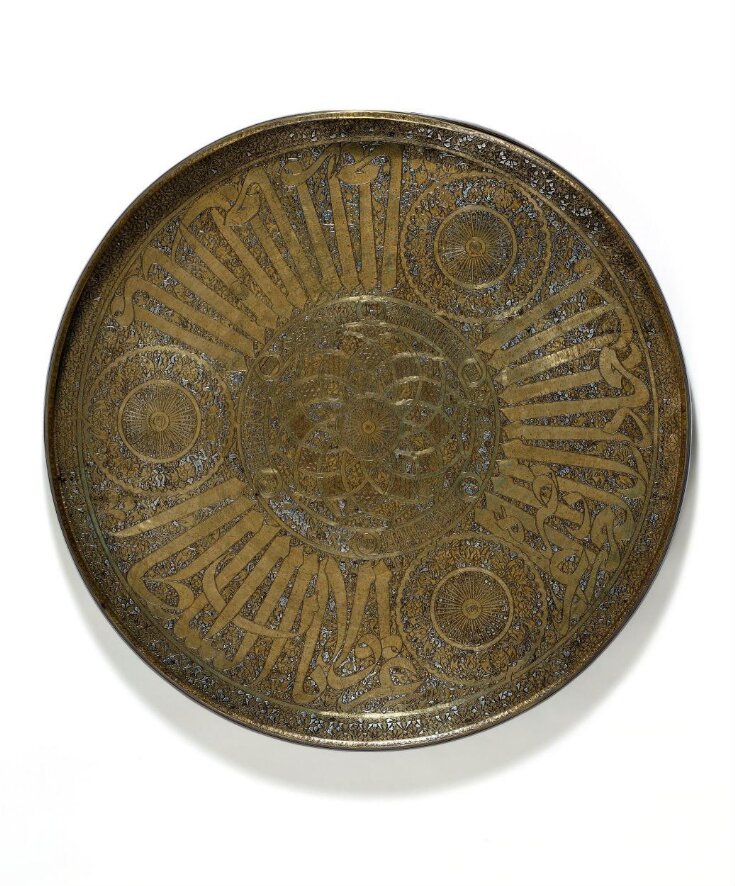
This tray is an outstanding example of Islamic art as it developed under the Mamluk dynasty in Egypt and Syria. Well-established techniques of metalwork were employed, such as inlaying silver into brass. But now these were used to create objects created with a new focus on spectacular inscriptions. These usually include the patron’s name and titles, along with laudatory phrases. The artists interspersed the inscriptions with abstract ornamentation, such as the roundels and central geometric pattern seen here.
The calligraphy of the tray is majestic. The inscription reads, ‘Glory to our lord the Sultan, the wise, the just, may his victory be glorious’.
The calligraphy of the tray is majestic. The inscription reads, ‘Glory to our lord the Sultan, the wise, the just, may his victory be glorious’.
Object details
| Categories | |
| Object type | |
| Materials and techniques | The tray is made of a copper alloy, most probably brass. It was hammered from sheet to form a flat, circular surface, to which a low, vertical rim was attached. The upper surface was engraved with a complex design, which was "inlaid" with gold and silver, most of which has been lost. The term "inlay" is conventionally used by art historians in the context of Islamic metalwork to describe a type of decoration that, in this case at least, probably involved the following procedure:
1. The surface of the brass was engraved with the design;
2. a black organic substance was used as infill in the areas where the gold or silver accents were to be placed; and
3. pieces of gold or silver foil, cut to shape, were stuck on to these filled areas, and the edges of the foil were then pushed down into lines already engraved in the brass.
The foil was held in place both by the black infill and by the way its edges were inserted into the engraved lines.
In its original condition, the overall effect of the decoration must have been magnificent, as almost the whole surface would have been covered with precious metal foil. It also seems that the details of the design were heightened by pushing the black organic infill into parts of the engraved design not overlaid with foil. To uninformed observers of such work, it would have appeared that the tray was inlaid with gold and silver rather than overlaid with foil over a black filler, and this is how the conventional description of "inlay" came about. |
| Brief description | Circular brass tray with inscriptions, Egypt (probably Cairo), 1320-1340. |
| Physical description | Large shallow brass tray, with engraved decoration originally inlaid in gold and silver, most of which has been lost. |
| Dimensions |
|
| Style | |
| Marks and inscriptions |
|
| Gallery label |
|
| Summary | This tray is an outstanding example of Islamic art as it developed under the Mamluk dynasty in Egypt and Syria. Well-established techniques of metalwork were employed, such as inlaying silver into brass. But now these were used to create objects created with a new focus on spectacular inscriptions. These usually include the patron’s name and titles, along with laudatory phrases. The artists interspersed the inscriptions with abstract ornamentation, such as the roundels and central geometric pattern seen here. The calligraphy of the tray is majestic. The inscription reads, ‘Glory to our lord the Sultan, the wise, the just, may his victory be glorious’. |
| Bibliographic references |
|
| Collection | |
| Accession number | 420-1854 |
About this object record
Explore the Collections contains over a million catalogue records, and over half a million images. It is a working database that includes information compiled over the life of the museum. Some of our records may contain offensive and discriminatory language, or reflect outdated ideas, practice and analysis. We are committed to addressing these issues, and to review and update our records accordingly.
You can write to us to suggest improvements to the record.
Suggest feedback
You can write to us to suggest improvements to the record.
Suggest feedback
| Record created | September 29, 2003 |
| Record URL |
Download as: JSONIIIF Manifest
