Pair of Stirrups
1546 (made)
| Artist/Maker | |
| Place of origin |
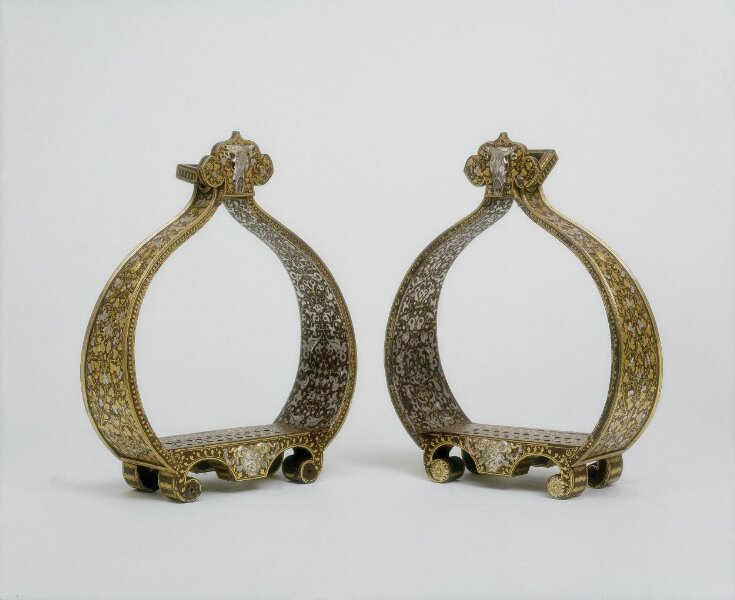
These stirrups may once once formed part of an armour in the Royal Armoury, Madrid that was made in 1546, probably by the Italian armourer and goldsmith Bartolomeo Campi, of Pesaro, for Duke Guidobaldo II of Urbino. According to tradition, this ceremonial armour was presented by the duke to the Spanish emperor, Charles V.
On the exterior, a decoration of vine-leaf tendrils is damascened in gold and silver – a technique named after metalworkers in Damascus, Syria, who developed this method of decorating metalwork with gold and silver wire. This differs markedly from the interior decoration, which is in an Islamic style with arabesques and half-palmettes. It is possible that the stirrups were decorated by two goldsmiths working in collaboration. This might explain the discrepancy between the initials B.C.F. (Bartolommeo Campi Fecit) on the armour and A.C.F. on the stirrups.
From the 16th century, arms and armour were included in antiquarian and aristocratic collections to evoke associations of a medieval chivalric past. In precisely such a collection in the early 19th century, these elaborately decorated stirrups were esteemed by former owner, George Salting, as examples of goldsmiths’ work and were accordingly placed alongside bronzes and porcelains in his collection.
On the exterior, a decoration of vine-leaf tendrils is damascened in gold and silver – a technique named after metalworkers in Damascus, Syria, who developed this method of decorating metalwork with gold and silver wire. This differs markedly from the interior decoration, which is in an Islamic style with arabesques and half-palmettes. It is possible that the stirrups were decorated by two goldsmiths working in collaboration. This might explain the discrepancy between the initials B.C.F. (Bartolommeo Campi Fecit) on the armour and A.C.F. on the stirrups.
From the 16th century, arms and armour were included in antiquarian and aristocratic collections to evoke associations of a medieval chivalric past. In precisely such a collection in the early 19th century, these elaborately decorated stirrups were esteemed by former owner, George Salting, as examples of goldsmiths’ work and were accordingly placed alongside bronzes and porcelains in his collection.
Object details
| Categories | |
| Object type | |
| Parts | This object consists of 2 parts.
|
| Materials and techniques | Iron, damascened and overlaid in silver and gold |
| Brief description | Pair of iron stirrups damascened and overlaid with gold and silver; each stirrup inlaid with the initials A.C.F., Italy (Pesaro), about 1546. |
| Physical description | Stirrups, iron damascened and overlaid with gold and silver with moresque designs. |
| Dimensions |
|
| Styles | |
| Marks and inscriptions | A.C.F. (1) Makers's mark; On both stirrups) |
| Gallery label | PAIR OF STIRRUPS
Iron, damascened and encrusted with gold and silver
By Bartolommeo Campi (d.1596)
Italian (Pesaro); signed A.C F(ecit); 1546
Salting Bequest
Part of a suit of armour in the Roman style made in 1546 for the Duke Guidobaldo II of Urbino and presented by him to the Emperor Charles V. Formerly in the Royal Armoury Madrid. |
| Credit line | Salting Bequest |
| Object history | These stirrups may once have formed part of an armour in the Royal Armoury, Madrid, that was made in 1546, probably by the Italian armourer and goldsmith Bartolomeo Campi of Pesaro, for Duke Guidobaldo II of Urbino. According to tradition, this ceremonial armour was presented by the duke to the Spanish emperor, Charles V. On the exterior, a decoration of vine-leaf tendrils is damascened in gold and silver - a technique named after metalworkers in Damascus, Syria, who developed this method of decorating metalwork with gold and silver wire. This differs markedly from the interior decoration, which is in an Islamic style with arabesques and half-palmettes. It is possible that the stirrups were decorated by two goldsmiths working in collaboration. This might explain the discrepancy between the initials B.C.F. (Bartolommeo Campi Fecit) on the armour and A.C.F. on the stirrups. The stirrups may have become separated from the armour in the 1830s when items were stolen from Madrid’s Royal Armoury and sold in Britain. They went first to the Warwick Castle collection and were later acquired by George Salting, who bequeathed them to the V&A in 1910. From the 16th century, arms and armour were included in antiquarian and aristocratic collections to evoke associations of a medieval chivalric past. In precisely such a collection in the early 19th century, these elaborately decorated stirrups were esteemed by Salting as examples of goldsmiths’ work and were accordingly placed alongside bronzes and porcelains in his collection. After Salting’s bequest to the Museum, the stirrups became part of a collection of decorated arms and armour, interpreted in terms of design, decoration and technique, rather than in terms of function or social significance. (Edited version of Anthony North's catalogue entry in Grand Design) |
| Production | See Pyhrr, Stuart W. and Godoy, José-A., Heroic Armor of the Italian Renaissance: Filippo Negroli and his Contemporaries, (Exhibition Catalogue, 08 October 1998 - 17 Januray 1999, The Metropolitan Museum of Art, New York, p. 285) where these stirrups are discussed and their attribution to Campi and association with the Duke of Urbino's roman armour in the Royal Armoury in Madrid are questioned. |
| Summary | These stirrups may once once formed part of an armour in the Royal Armoury, Madrid that was made in 1546, probably by the Italian armourer and goldsmith Bartolomeo Campi, of Pesaro, for Duke Guidobaldo II of Urbino. According to tradition, this ceremonial armour was presented by the duke to the Spanish emperor, Charles V. On the exterior, a decoration of vine-leaf tendrils is damascened in gold and silver – a technique named after metalworkers in Damascus, Syria, who developed this method of decorating metalwork with gold and silver wire. This differs markedly from the interior decoration, which is in an Islamic style with arabesques and half-palmettes. It is possible that the stirrups were decorated by two goldsmiths working in collaboration. This might explain the discrepancy between the initials B.C.F. (Bartolommeo Campi Fecit) on the armour and A.C.F. on the stirrups. From the 16th century, arms and armour were included in antiquarian and aristocratic collections to evoke associations of a medieval chivalric past. In precisely such a collection in the early 19th century, these elaborately decorated stirrups were esteemed by former owner, George Salting, as examples of goldsmiths’ work and were accordingly placed alongside bronzes and porcelains in his collection. |
| Bibliographic references |
|
| Collection | |
| Accession number | M.662&A-1910 |
About this object record
Explore the Collections contains over a million catalogue records, and over half a million images. It is a working database that includes information compiled over the life of the museum. Some of our records may contain offensive and discriminatory language, or reflect outdated ideas, practice and analysis. We are committed to addressing these issues, and to review and update our records accordingly.
You can write to us to suggest improvements to the record.
Suggest feedback
You can write to us to suggest improvements to the record.
Suggest feedback
| Record created | September 15, 2003 |
| Record URL |
Download as: JSONIIIF Manifest
