The Mill
Oil Painting
1830s (painted)
1830s (painted)
| Artist/Maker | |
| Place of origin |
Georges Michel (1763-1843) was born in Paris. In 1775 he was apprenticed to the history painter Leduc. He later travelled to Switzerland and Germany. In 1790 he probably met the painter Lazare Bruandet (1755-1804). Around 1800 he restored Flemish and Dutch paintings by Rembrandt, Ruisdael and Meindert Hobbema in the Musée du Louvre After 1820 until his death, Michel, who had little interest in fame, gradually withdrew from the art world.
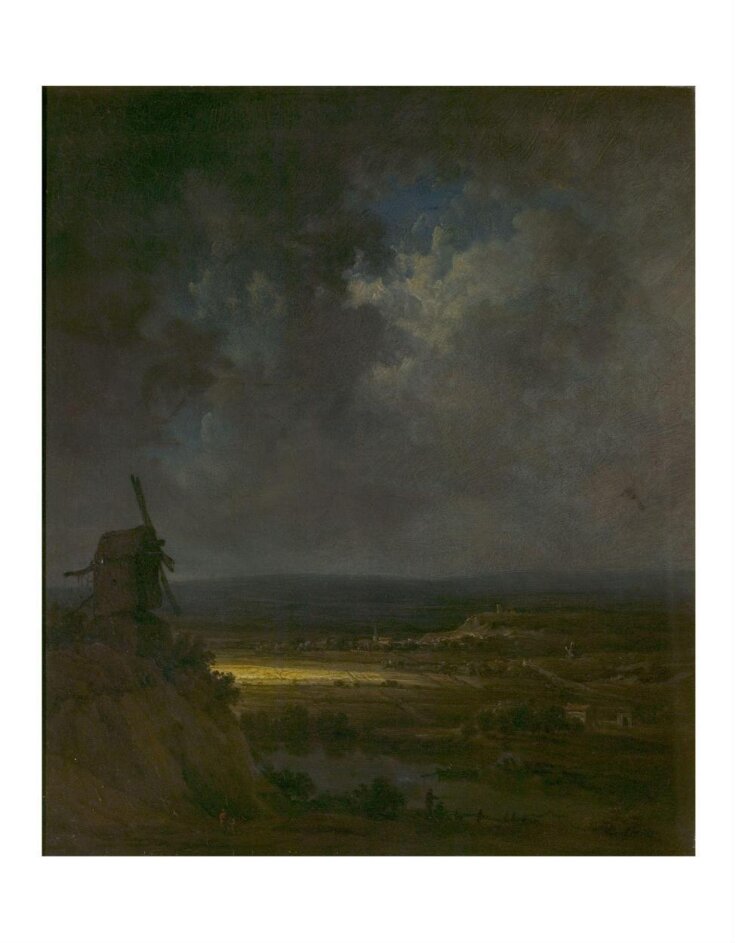
This painting is a fine example of George Michel’s production of landscape paintings reminiscent of 17th-century Dutch imagery. This painting shows a windmill, a typical Dutch feature, in a wide flat landscape under a stormy sky. The direct observation of nature and interest in atmospheric effect are characteristic of the Realist movement emerged in the 1840s in France. In this regard, Michel can be considered as a precursor of this new approach to art.
This painting is a fine example of George Michel’s production of landscape paintings reminiscent of 17th-century Dutch imagery. This painting shows a windmill, a typical Dutch feature, in a wide flat landscape under a stormy sky. The direct observation of nature and interest in atmospheric effect are characteristic of the Realist movement emerged in the 1840s in France. In this regard, Michel can be considered as a precursor of this new approach to art.
Object details
| Categories | |
| Object type | |
| Title | The Mill |
| Materials and techniques | oil on panel |
| Brief description | Oil painting, 'The Mill', Georges Michel, 1830s |
| Physical description | On the left, a mill on a height; beyond, a wide landscape under a stormy sky. |
| Dimensions |
|
| Style | |
| Credit line | Bequeathed by Constantine Alexander Ionides |
| Object history | Bequeathed by Constantine Alexander Ionides, 1900. Among the last paintings collected by Constantine Alexander Ionides, The Mill was purchased on 27 June 1892 for £84 (it bore in his inventory - private collection - the title 'Windsmill sweep of landscape'). Subsequently bequeathed to the Museum in 1900. Historical significance: Nicknamed 'Ruisdael of Montmartre', Georges Michel was an independent painter, partially self-taught, whose activity as a restorer of Netherlandish paintings in the Louvre gave him the capacity of mastering the 17th-century Dutch technique. The present painting is in this respect a fine example of this revived technique and is strongly reminiscent of one of Rembrandt's best known compositions at the time: The Mill, now in the National Gallery of Art, Washington. Rembrandt's painting was then in the collection of the Duc d'Orléans and only sold in London in 1792. Its design was also widely spread through numerous engravings. It is most likely that Michel had Rembrandt's composition in mind when it executed the present work. In a time dominated by Neo-classicism, Michel acted as an outsider and is considered as a precursor of the realist painter Theodore Rousseau. Two years after his death, the Barbizon painter Charles Jacque acquired several of his works. His role is today recognized by critics as crucial in the evolution of 19th- and 20th-century landscape paintingeven though literature on him remains sparse. Little interested in fame, Michel ussually did not sign his works. |
| Historical context | 19th-century Western art is marked by a succession of movements based on a more or less close relationship with nature. At the beginning of the century, Romantic artists were fascinated by nature they interpreted as a mirror of the mind. They investigated human nature and personality, the folk culture, the national and ethnic origins, the medieval era, the exotic, the remote, the mysterious and the occult. This movement was heralded in France by such painter as Eugène Delacroix (1798-1863). In its opposition to academic art and its demand for a modern style Realism continued the aims of the Romantics. They assumed that reality could be perceived without distortion or idealization, and sought after a mean to combine the perception of the individual with objectivity. This reaction in French painting against the Grand Manner is well represented by Gustave Courbet (1819-1877) who wrote a 'Manifesto of Realism', entitled Le Réalisme published in Paris in 1855. These ideas were challenged by the group of the Barbizon painters, who formed a recognizable school from the early 1830s to the 1870s and developed a free, broad and rough technique. They were mainly concerned by landscape painting and the rendering of light. The works of Narcisse Virgile Diaz de la Peña (1807-1876), Jules Dupré (1811-1889), Théodore Rousseau (1812-1867), Constant Troyon (1810-1865) and Jean-François Millet (1814-1875) anticipate somehow the plein-air landscapes of the Impressionists. |
| Subjects depicted | |
| Place depicted | |
| Summary | Georges Michel (1763-1843) was born in Paris. In 1775 he was apprenticed to the history painter Leduc. He later travelled to Switzerland and Germany. In 1790 he probably met the painter Lazare Bruandet (1755-1804). Around 1800 he restored Flemish and Dutch paintings by Rembrandt, Ruisdael and Meindert Hobbema in the Musée du Louvre After 1820 until his death, Michel, who had little interest in fame, gradually withdrew from the art world. This painting is a fine example of George Michel’s production of landscape paintings reminiscent of 17th-century Dutch imagery. This painting shows a windmill, a typical Dutch feature, in a wide flat landscape under a stormy sky. The direct observation of nature and interest in atmospheric effect are characteristic of the Realist movement emerged in the 1840s in France. In this regard, Michel can be considered as a precursor of this new approach to art. |
| Bibliographic references |
|
| Collection | |
| Accession number | CAI.67 |
About this object record
Explore the Collections contains over a million catalogue records, and over half a million images. It is a working database that includes information compiled over the life of the museum. Some of our records may contain offensive and discriminatory language, or reflect outdated ideas, practice and analysis. We are committed to addressing these issues, and to review and update our records accordingly.
You can write to us to suggest improvements to the record.
Suggest feedback
You can write to us to suggest improvements to the record.
Suggest feedback
| Record created | September 9, 2003 |
| Record URL |
Download as: JSONIIIF Manifest
