
Bucket
ca. 1475-1550 (made)
| Artist/Maker | |
| Place of origin |
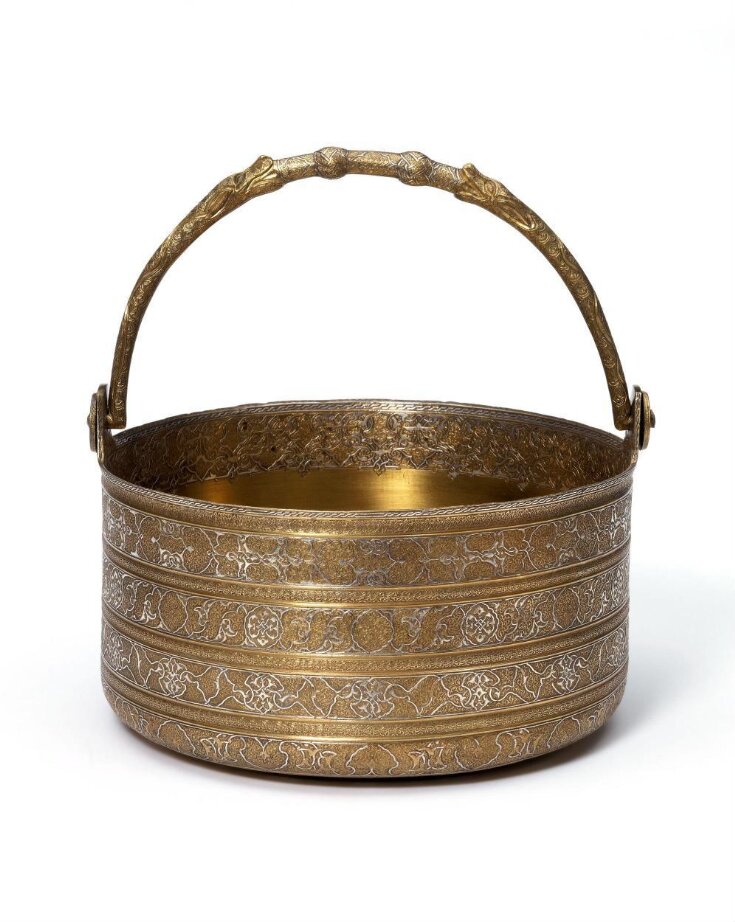
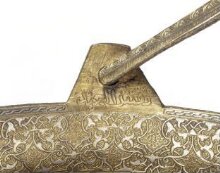
This brass bucket has been overlaid with silver to give it added prestige. It has an Arabic signature inside the flanges for the handle. It states that the bucket was decorated by Zayn al-Din, whose signature is found on several other pieces in the same style.
This type of richly decorated so-called ‘Veneto-Saracenic’ metalwork was once thought to have been made by Arabs living in Venice. It is now known that it was originally produced in Egypt or Syria, and only later copied in Italy.
In the medieval period, there was a ready market in Christian-ruled Europe for luxury goods from the Islamic Middle East. These imports enjoyed such prestige that luxury goods made in Europe were often decorated in Islamic styles. By the late 15th century, when this piece was made, intense trade across the Mediterranean makes the lines of influence difficult to unravel.
This type of richly decorated so-called ‘Veneto-Saracenic’ metalwork was once thought to have been made by Arabs living in Venice. It is now known that it was originally produced in Egypt or Syria, and only later copied in Italy.
In the medieval period, there was a ready market in Christian-ruled Europe for luxury goods from the Islamic Middle East. These imports enjoyed such prestige that luxury goods made in Europe were often decorated in Islamic styles. By the late 15th century, when this piece was made, intense trade across the Mediterranean makes the lines of influence difficult to unravel.
Object details
| Categories | |
| Object type | |
| Materials and techniques | Brass, spun, chased and overlaid with silver |
| Brief description | Brass bucket, made in southern Germany or northern Italy, with decoration added in Egypt or Syria and signed by Zayn al-Din, 1475-1550. |
| Physical description | Brass bucket with handle, spun, chased all over with floral designs and partly overlaid with silver. Signed inside the flanges for the handle by Zayn al-Din. |
| Dimensions |
|
| Styles | |
| Marks and inscriptions | signature (Arabic signature, Zayn al-Din.) |
| Gallery label |
|
| Object history | The shape of this bucket, with its straight walls and bail handle, bears similarities to Islamic examples dating back to the eighth century. A related shape with a more rounded body and at times a high splayed foot was fashionable in Iran during the twelfth and thirteenth centuries. The earliest dated example of the latter type is the celebrated Bobrinsky Kettle made in 1163. At least six other Veneto-Islamic buckets are known to exist, one of them is signed by Mahmud al-Kurdi. |
| Historical context | There is ongoing debate as to the provenance of what are known as Veneto-Saracenic wares. Trays, bowls, buckets, handwarmers and penboxes feature superimposed scrolls, one creating well-defined units and the other forming the background as their main characteristic. About thirty of these pieces bear the names of Muslim artists, including Muhammad, Muhammad Badr, Qasim, Umar, and Zayn al-Din. Some scholars feel the style was initiated by Timurid artists who immigrated to Venice at the end of the fifteenth century; while others point to the Mamluk tradition of Egypt and Syria as its source. Specific motifs seen on Veneto-Islamic pieces are related more closely to late Mamluk metalwork, and several bear the same Arabic inscriptions. Venetian metalworkers also worked in the Islamic tradition, calling themselves "al-Azzimina", after the Arabic word "al-ajam", meaning non-Arab. |
| Subject depicted | |
| Summary | This brass bucket has been overlaid with silver to give it added prestige. It has an Arabic signature inside the flanges for the handle. It states that the bucket was decorated by Zayn al-Din, whose signature is found on several other pieces in the same style. This type of richly decorated so-called ‘Veneto-Saracenic’ metalwork was once thought to have been made by Arabs living in Venice. It is now known that it was originally produced in Egypt or Syria, and only later copied in Italy. In the medieval period, there was a ready market in Christian-ruled Europe for luxury goods from the Islamic Middle East. These imports enjoyed such prestige that luxury goods made in Europe were often decorated in Islamic styles. By the late 15th century, when this piece was made, intense trade across the Mediterranean makes the lines of influence difficult to unravel. |
| Bibliographic references |
|
| Collection | |
| Accession number | 1826-1888 |
About this object record
Explore the Collections contains over a million catalogue records, and over half a million images. It is a working database that includes information compiled over the life of the museum. Some of our records may contain offensive and discriminatory language, or reflect outdated ideas, practice and analysis. We are committed to addressing these issues, and to review and update our records accordingly.
You can write to us to suggest improvements to the record.
Suggest feedback
You can write to us to suggest improvements to the record.
Suggest feedback
| Record created | September 1, 2003 |
| Record URL |
Download as: JSONIIIF Manifest
