
Epitaphios
1407 (made)
| Artist/Maker | |
| Place of origin |
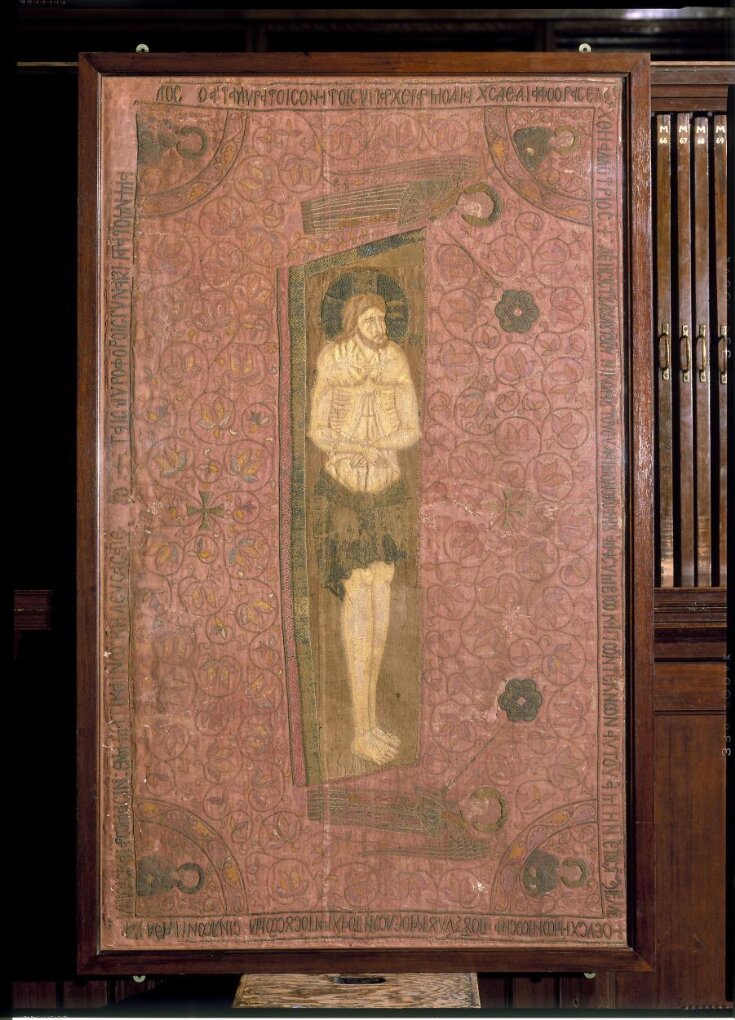
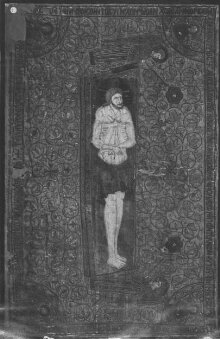
This embroidered crimson silk twill cloth is an epitaphios. An epitaphios is a large cloth carried in procession in the Good Friday services and for which the early term was Great Aër. The decoration, with the body of the dead Christ accompanied by angels with fans and with the symbols or figures of the evangelists in the corners, is of conventional form. In this example, the verses from the troparion emphasise the Good Friday theme. The dedication also mentions Prayer of the servant of God Nicholas Eudaimonoioannes with his wife and children in the year 6915 [1407]. The Nicholas mentioned here may well be the Nicholas Eudaimonoioannes who acted as Manuel II's ambassador to the Venetians in 1416 and was one of his delegates to the Council of Constantine in 1414-17.
The Eudaimonoioannes family held an important place in the history of the Morea (the Peloponnese), as archons of Monemvasia from the 13th century until the Turkish conquest. The epitaphios was probably commissioned for donation to a church in Nicholas' native Morea. It is likely to have been made somewhere in the Greek peninsula but was possibly a product of the capital, Constantinople.
The Eudaimonoioannes family held an important place in the history of the Morea (the Peloponnese), as archons of Monemvasia from the 13th century until the Turkish conquest. The epitaphios was probably commissioned for donation to a church in Nicholas' native Morea. It is likely to have been made somewhere in the Greek peninsula but was possibly a product of the capital, Constantinople.
Object details
| Categories | |
| Object type | |
| Materials and techniques | Embroidered silk and silver threads on silk ground; linen or canvas lining |
| Brief description | Large panel of crimson silk twill embroidered in gold, silver and coloured silks showing the dead Christ. |
| Physical description | Embroidered silk and silver threads on crimson silk ground. Linen or canvas lining. The dead Christ figure lying at the centre on a stone slab, two angels with liturgical fans to his left and right; in the corners, busts of the four Evangelists. A Greek inscription runs around the outside in gold thread. |
| Dimensions |
|
| Marks and inscriptions | (Greek inscription in gold thread around the outside of the cloth. Two of these sections are verses from the troparion for Good Friday.)
|
| Object history | The donors, the Eudaimonoioannes family, held an important place in the history of the Morea (the Peloponnese), as archons of Monemvasia from the 13th century until the Turkish conquest. The Nicholas mentioned here in the dedication may well be the Nicholas Eudaimonoioannes who acted as Manuel II's ambassador to the Venetians in 1416 and one of his delegates to the Council of Constantine in 1414-17. In 1756 recorded as being in the monastery of the Santi Apostoli in Naples. According to Cajetani, it had been brought to Naples in 1628 from 'Calata' in Sicily. |
| Production | Possibly belonged to Manuel II's ambassador to the Venetians Attribution note: Embroidered epitaphios or cloth showing the body of Christ which was carried in procession with other objects connected with the Eucharist. |
| Subject depicted | |
| Summary | This embroidered crimson silk twill cloth is an epitaphios. An epitaphios is a large cloth carried in procession in the Good Friday services and for which the early term was Great Aër. The decoration, with the body of the dead Christ accompanied by angels with fans and with the symbols or figures of the evangelists in the corners, is of conventional form. In this example, the verses from the troparion emphasise the Good Friday theme. The dedication also mentions Prayer of the servant of God Nicholas Eudaimonoioannes with his wife and children in the year 6915 [1407]. The Nicholas mentioned here may well be the Nicholas Eudaimonoioannes who acted as Manuel II's ambassador to the Venetians in 1416 and was one of his delegates to the Council of Constantine in 1414-17. The Eudaimonoioannes family held an important place in the history of the Morea (the Peloponnese), as archons of Monemvasia from the 13th century until the Turkish conquest. The epitaphios was probably commissioned for donation to a church in Nicholas' native Morea. It is likely to have been made somewhere in the Greek peninsula but was possibly a product of the capital, Constantinople. |
| Collection | |
| Accession number | 8278-1863 |
About this object record
Explore the Collections contains over a million catalogue records, and over half a million images. It is a working database that includes information compiled over the life of the museum. Some of our records may contain offensive and discriminatory language, or reflect outdated ideas, practice and analysis. We are committed to addressing these issues, and to review and update our records accordingly.
You can write to us to suggest improvements to the record.
Suggest feedback
You can write to us to suggest improvements to the record.
Suggest feedback
| Record created | August 29, 2003 |
| Record URL |
Download as: JSONIIIF Manifest
