Cabinet
1855 (made)
| Artist/Maker | |
| Place of origin |
Object Type
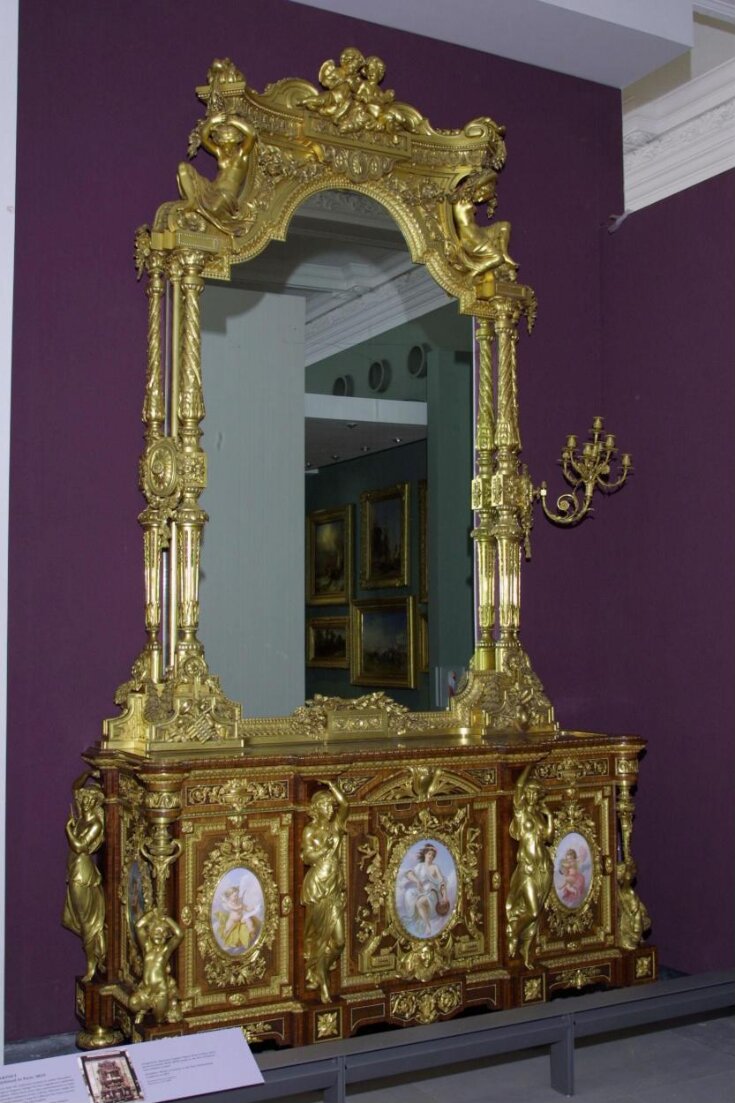
This cabinet was never intended to be used in a domestic setting. It was made to display the talents of the designer, and the skills of the craftsmen, who worked for the London firm of Jackson and Graham. The style of the cabinet looks back to 18th-century French design.
Materials & Making
The cabinet is of superb quality, as was noted in the Art Journal catalogue of the Paris International Exhibition of 1855. The catalogue remarks of this cabinet that 'the interior is finished with as much care as the exterior, being of satin-wood inlaid with tulip-wood and the fronts of the drawers inlaid with ivory and panelled, the panels being fitted with finely-chased and gilded metal-work'.
People
Alexandre EugŠne Prignot (born 1822) had been the principal designer for the firm of Jackson and Graham from 1849 to 1855, the year he designed this cabinet. Prignot was a pupil of Henri-Auguste Fourdinois (1830-1907) and Cic‚ri. This training suggests that he was familiar with the work of important contemporary French cabinet-makers, and the French tradition of spectacular exhibition pieces. Besides London, he also worked in his native Paris, the USA, Belgium, Russia and Spain. Prignot published photographic anthologies of his designs for furniture, decorations and upholstery.
This cabinet was never intended to be used in a domestic setting. It was made to display the talents of the designer, and the skills of the craftsmen, who worked for the London firm of Jackson and Graham. The style of the cabinet looks back to 18th-century French design.
Materials & Making
The cabinet is of superb quality, as was noted in the Art Journal catalogue of the Paris International Exhibition of 1855. The catalogue remarks of this cabinet that 'the interior is finished with as much care as the exterior, being of satin-wood inlaid with tulip-wood and the fronts of the drawers inlaid with ivory and panelled, the panels being fitted with finely-chased and gilded metal-work'.
People
Alexandre EugŠne Prignot (born 1822) had been the principal designer for the firm of Jackson and Graham from 1849 to 1855, the year he designed this cabinet. Prignot was a pupil of Henri-Auguste Fourdinois (1830-1907) and Cic‚ri. This training suggests that he was familiar with the work of important contemporary French cabinet-makers, and the French tradition of spectacular exhibition pieces. Besides London, he also worked in his native Paris, the USA, Belgium, Russia and Spain. Prignot published photographic anthologies of his designs for furniture, decorations and upholstery.
Object details
| Categories | |
| Object type | |
| Parts | This object consists of 13 parts.
|
| Materials and techniques | Marquetry of various woods, giltwood, porcelain plaques and marble inlay, surmounted by a mirror |
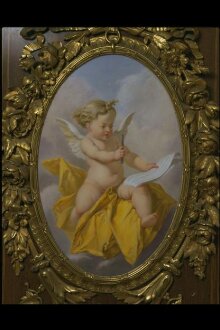
| Brief description | A cabinet in the Louis XIV style, with a mirror and candle branches, ornamented with marquetry, gilt brass figures and porcelain plaques painted with putti. Made by Jackson & Graham for the Paris International Exhibition of 1855. |
| Dimensions |
|
| Style | |
| Gallery label |
|
| Object history | The cabinet was made for the Paris International Exhibition of 1855 by Jackson & Graham and bought from the exhibition by the Museum. Historical significance: This cabinet won considerable acclaim for the English at the Paris International Exhibition of 1855, although the furniture and decoration classes of the international exhibitions had tended to be dominated by the French. It was described by Matthew Digby Wyatt in the official reports on the Exhibition as, 'good in composition and highly satisfactory in every detail of design. The only objection I have heard urged against it being that the frame of the glass which formed the upper portion of the piece of furniture was not quite so agreeable in form as the lower part'. The cabinet is of superb quality, as was noted in the Art Journal catalogue of the Exhibition, 'The interior is finished with as much care as the exterior, being of satin-wood inlaid with tulip-wood and the fronts of the drawers inlaid with ivory and panelled, the panels being fitted with finely-chased and gilded metal-work'. No less than forty designers, modellers, cabinet-makers, carvers, gilders and metal chasers worked on the cabinet in Jackson and Grahams workshops and in addition the bronze castings were made in Birmingham and the china plaques painted by Minton's of Stoke-on-Trent. |
| Historical context | Exhibitions were popular public entertainments from the 1840s onwards. The British Government began to purchase pieces for the collection of the Victoria and Albert Museum at the Paris Exhibition of 1844. The series of International Exhibitions which began with the International Exhibition of 1851 were on a much larger scale and the competition between nations encouraged the production of massive and elaborately decorated pieces of furniture. |
| Production | The porcelain plaques were painted by Mr Grey, of Marlborough House, after designs by Messrs Remon and Polish, and fired at Mintons in Stoke-upon-Trent. The brass mounts were made by Cope & Collinson and electrogilded by Elkingtons. |
| Subjects depicted | |
| Association | |
| Summary | Object Type This cabinet was never intended to be used in a domestic setting. It was made to display the talents of the designer, and the skills of the craftsmen, who worked for the London firm of Jackson and Graham. The style of the cabinet looks back to 18th-century French design. Materials & Making The cabinet is of superb quality, as was noted in the Art Journal catalogue of the Paris International Exhibition of 1855. The catalogue remarks of this cabinet that 'the interior is finished with as much care as the exterior, being of satin-wood inlaid with tulip-wood and the fronts of the drawers inlaid with ivory and panelled, the panels being fitted with finely-chased and gilded metal-work'. People Alexandre EugŠne Prignot (born 1822) had been the principal designer for the firm of Jackson and Graham from 1849 to 1855, the year he designed this cabinet. Prignot was a pupil of Henri-Auguste Fourdinois (1830-1907) and Cic‚ri. This training suggests that he was familiar with the work of important contemporary French cabinet-makers, and the French tradition of spectacular exhibition pieces. Besides London, he also worked in his native Paris, the USA, Belgium, Russia and Spain. Prignot published photographic anthologies of his designs for furniture, decorations and upholstery. |
| Bibliographic reference | [Aslin, Elizabeth. Nineteenth Century English Furniture. London: Faber and Faber, 1962.] |
| Collection | |
| Accession number | 7247:1 to 13-1860 |
About this object record
Explore the Collections contains over a million catalogue records, and over half a million images. It is a working database that includes information compiled over the life of the museum. Some of our records may contain offensive and discriminatory language, or reflect outdated ideas, practice and analysis. We are committed to addressing these issues, and to review and update our records accordingly.
You can write to us to suggest improvements to the record.
Suggest feedback
You can write to us to suggest improvements to the record.
Suggest feedback
| Record created | July 17, 1998 |
| Record URL |
Download as: JSONIIIF Manifest
