
Wedding Dress
1951 (made)
| Artist/Maker | |
| Place of origin |
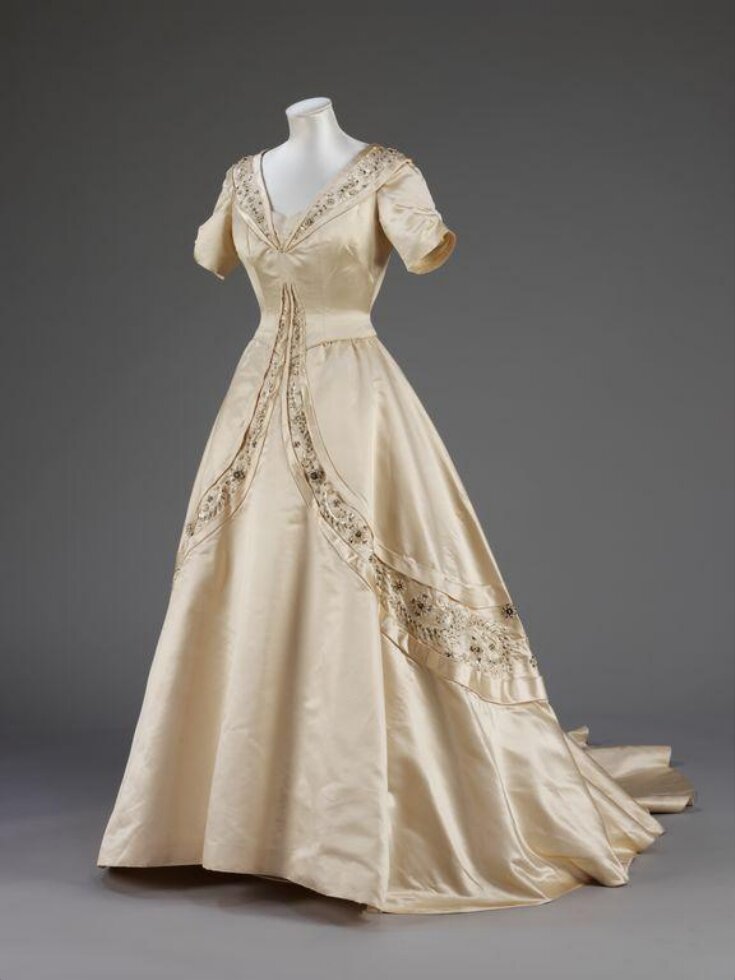
This wedding gown was created by the leading London couturier, Norman Hartnell. His workshops excelled in creating the rich embroideries which typify the designer's work. The pearl and silver embroidery bordering the deep V-neck of the dress is reflected in the sweeping band of embroidery on the skirt. To retain the line, the skirt is lined with buckram and weighted around the hem. Further support is provided by a stiffened petticoat.
Wedding dresses were often altered to become evening wear but fortunately this design survived intact. It was worn by Hermione Wills when she married Mervin Evans on 23 July 1951. The bride's mother, Mrs. Cecil Wills, was a good friend of Hartnell, and later became one of the directors of his fashion house.
Wedding dresses were often altered to become evening wear but fortunately this design survived intact. It was worn by Hermione Wills when she married Mervin Evans on 23 July 1951. The bride's mother, Mrs. Cecil Wills, was a good friend of Hartnell, and later became one of the directors of his fashion house.
Object details
| Categories | |
| Object type | |
| Parts | This object consists of 2 parts.
|
| Materials and techniques | Embroidered satin, pearls, silver, crystals and sequins, nylon net, taffeta |
| Brief description | Wedding dress of embroidered satin and taffeta petticoat, designed by Norman Hartnell, England, 1951 |
| Physical description | Wedding dress of embroidered satin and taffeta petticoat. Dress of pearl satin with a 'princess' neckline, short sleeves and full flared skirt. The collar and the skirt are trimmed with bands of embroidery, silver, pearls, crystals and sequins arranged in a floral design, contained by cross cut bands. The dress fastens with a zip at the centre back. The dress is mounted on a fairly coarse nylon net. With a train. Taffeta petticoat stiffened with two bands of nylon woven crinoline. |
| Dimensions | Dimensions taken by Conservation for Wedding Dress mounting, 2009 |
| Production type | Haute couture |
| Gallery label |
|
| Credit line | Given by Mrs H. S. Ball |
| Object history | Worn by the donor, then Miss Hermione Wills at her marriage to Mervyn Evans at St. Marks, N Audley Street on 23 July 1951. Her mother, Mrs Cecil Wills was an early friend and later a director of Norman Hartnell. The dress was specially designed by Hartnell for the bride. The embroidery and decoration on the front of the dress includes a bare spot of fabric between the bands of ornament on the neckline and skirt. This was designed specifically for a diamond brooch which is visible in the wedding photographs. When worn, the brooch connected the sweeping bands of embroidery and created an unbroken curve of sparkling ornamentation around the neckline and skirt. The bridesmaid's wore dresses which were also designed by Norman Hartnell. These dresses were of a very similar design to that of the wedding dress, except that these dresses had simple trims instead of the elaborate embroidery and set stones on the bride's dress. Hermione Wills met Merfyn Evans during a round-the-world voyage. He was the chief officer of a cargo boat called The Javanese Prince, and she was a paying passenger. They became engaged within 48 hours of their meeting. Sadly, Merfyn died a few years after the wedding. His widow remarried an Army man, Mr. Ball, and they lived in Malaysia. She wore a deep blue lace, long-sleeved, mid-calf length cocktail dress (also by Norman Hartnell) for the second wedding with a matching coat. The going-away costume, by Hartnell, was cafe-au-lait silk woven with velvet wavy-lines, with a darker cafe-au-lait coat. |
| Production | Originally attributed by the museum as 1957, the donor called in 1997 to correct the date to 1951 Reason For Production: Commission |
| Subject depicted | |
| Summary | This wedding gown was created by the leading London couturier, Norman Hartnell. His workshops excelled in creating the rich embroideries which typify the designer's work. The pearl and silver embroidery bordering the deep V-neck of the dress is reflected in the sweeping band of embroidery on the skirt. To retain the line, the skirt is lined with buckram and weighted around the hem. Further support is provided by a stiffened petticoat. Wedding dresses were often altered to become evening wear but fortunately this design survived intact. It was worn by Hermione Wills when she married Mervin Evans on 23 July 1951. The bride's mother, Mrs. Cecil Wills, was a good friend of Hartnell, and later became one of the directors of his fashion house. |
| Bibliographic reference | De la Haye, Amy (ed.). The Cutting Edge: 50 Years of British Fashion 1947- 1997. London, England: V&A Publications, 1997.
|
| Collection | |
| Accession number | T.217&A-1972 |
About this object record
Explore the Collections contains over a million catalogue records, and over half a million images. It is a working database that includes information compiled over the life of the museum. Some of our records may contain offensive and discriminatory language, or reflect outdated ideas, practice and analysis. We are committed to addressing these issues, and to review and update our records accordingly.
You can write to us to suggest improvements to the record.
Suggest feedback
You can write to us to suggest improvements to the record.
Suggest feedback
| Record created | August 21, 2003 |
| Record URL |
Download as: JSON
