Jug
10th century-11th century (made)
| Artist/Maker | |
| Place of origin |
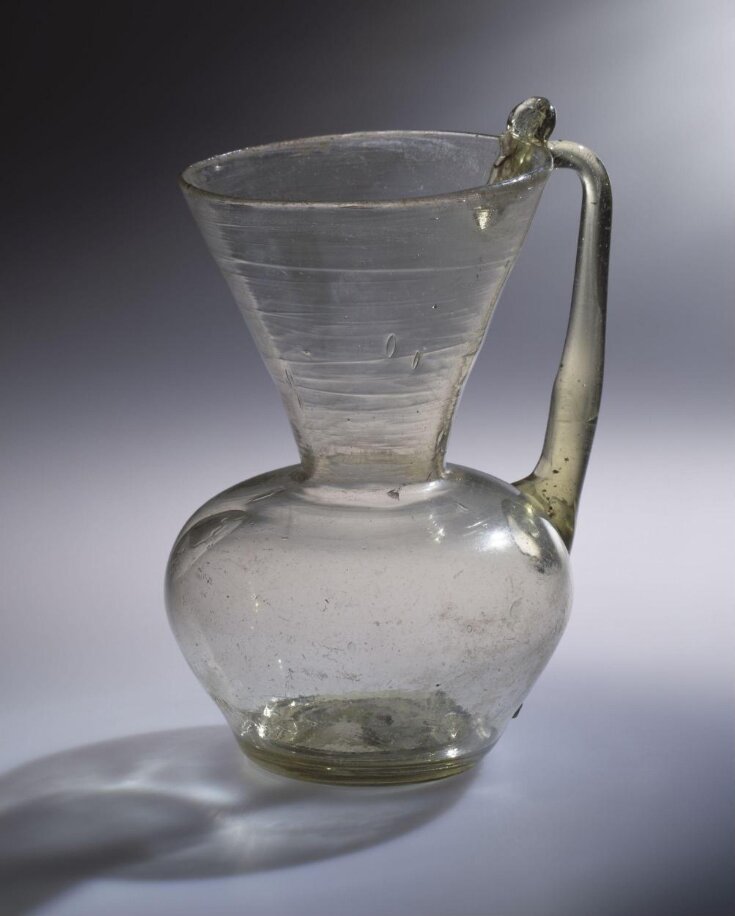
A glass blower made this jug of uncoloured transparent glass. It has no decoration.The maker trailed on the handle and tooled a small thumb-rest in the form of a disc. Examples of this type of jug were made in glass, metal and ceramic in the Middle East in the 10th and 11th centuries. It is difficult to identify more precisely where undecorated glassware was made. At one time experts thought that this jug might have been made in Egypt or Iran. The discovery of similar wares in an 11th-century shipwreck found near the Turkish coast has provided new evidence. It suggests that the jug was made in the East Mediterranean. We now think that this jug was possibly made in Egypt in the Fatimid period ( 969-1171).
Object details
| Categories | |
| Object type | |
| Materials and techniques | Transparent glass, blown, trailed and tooled |
| Brief description | Jug, blown glass with trailed handle and tooled thumbrest, Egypt, 900-1100 |
| Physical description | The bulbous body and flaring neck were blown from uncoloured transparent glass; the handle was trailed on; and a small thumb-rest was tooled in the form of a disc. |
| Dimensions |
|
| Style | |
| Gallery label | This shape, a simple water jug, is also found in metalwork and ceramics. |
| Summary | A glass blower made this jug of uncoloured transparent glass. It has no decoration.The maker trailed on the handle and tooled a small thumb-rest in the form of a disc. Examples of this type of jug were made in glass, metal and ceramic in the Middle East in the 10th and 11th centuries. It is difficult to identify more precisely where undecorated glassware was made. At one time experts thought that this jug might have been made in Egypt or Iran. The discovery of similar wares in an 11th-century shipwreck found near the Turkish coast has provided new evidence. It suggests that the jug was made in the East Mediterranean. We now think that this jug was possibly made in Egypt in the Fatimid period ( 969-1171). |
| Bibliographic reference | cf. shape C.164-1932 |
| Other number | 8231 - Glass gallery number |
| Collection | |
| Accession number | 338-1900 |
About this object record
Explore the Collections contains over a million catalogue records, and over half a million images. It is a working database that includes information compiled over the life of the museum. Some of our records may contain offensive and discriminatory language, or reflect outdated ideas, practice and analysis. We are committed to addressing these issues, and to review and update our records accordingly.
You can write to us to suggest improvements to the record.
Suggest feedback
You can write to us to suggest improvements to the record.
Suggest feedback
| Record created | December 13, 1997 |
| Record URL |
Download as: JSONIIIF Manifest
