
Doll's Hat
after 1785 (made)
| Artist/Maker | |
| Place of origin |
Object Type
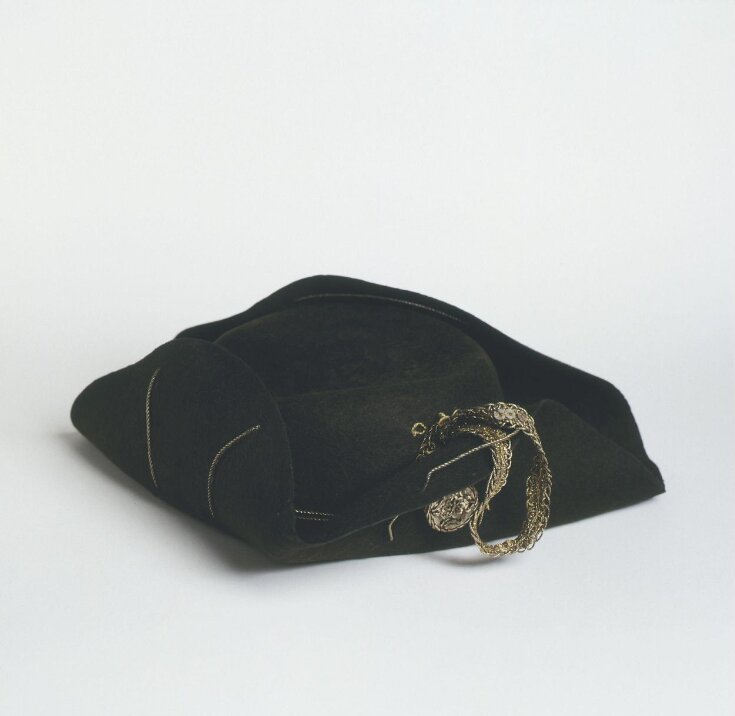
This hat was made for a doll, known as Lord Clapham, that is thought to have belonged to the Cockerell family, descendants of the diarist Samuel Pepys (1633-1703). The daughter of Pepys's nephew John Jackson (the son of his sister Pauline) married a Cockerell, who had a family home in Clapham, south London.
Designs & Designing
Lord Clapham offers a fine example of both formal and informal dress for a gentleman in the 1690s. His formal outfit includes a coat, waistcoat and breeches, while his informal dress is represented by the nightgown. Accessories such as the stockings, stock (a form of stiff, close-fitting neckcloth) and gloves are very valuable since very few items from this early period survive in museum collections. Equally important is the demonstration of how these clothes were worn together.
Ownership & Use
Dolls were widely produced in the 17th century, although very few survive, due to the wear and tear they usually undergo. The high quality of Lord Clapham and his clothes indicates that he would have been expensive. There is little evidence of use, which suggests that he was admired by adults rather than played with by children.
This hat was made for a doll, known as Lord Clapham, that is thought to have belonged to the Cockerell family, descendants of the diarist Samuel Pepys (1633-1703). The daughter of Pepys's nephew John Jackson (the son of his sister Pauline) married a Cockerell, who had a family home in Clapham, south London.
Designs & Designing
Lord Clapham offers a fine example of both formal and informal dress for a gentleman in the 1690s. His formal outfit includes a coat, waistcoat and breeches, while his informal dress is represented by the nightgown. Accessories such as the stockings, stock (a form of stiff, close-fitting neckcloth) and gloves are very valuable since very few items from this early period survive in museum collections. Equally important is the demonstration of how these clothes were worn together.
Ownership & Use
Dolls were widely produced in the 17th century, although very few survive, due to the wear and tear they usually undergo. The high quality of Lord Clapham and his clothes indicates that he would have been expensive. There is little evidence of use, which suggests that he was admired by adults rather than played with by children.
Object details
| Categories | |
| Object type | |
| Materials and techniques | Felt lined with silk, silver thread, trimmed with braid |
| Brief description | Doll's tricorne hat, made by T. Bourdillon, London, after 1785 |
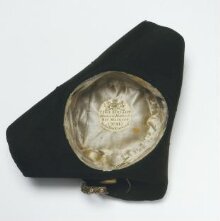
| Physical description | Doll's tricorne hat of black felt, with a low circular crown and a wide brim held up on three sides with silver thread. The brim is trimmed with a loop of silver braid and a silver passementerie button. The hat is lined with pale blue silk. |
| Dimensions |
|
| Marks and inscriptions | 'T. BOURDILLON [below coat of arms] / Hosier & Hatter [in italics] / HIS MAJESTY, / (No. 14) / Russel-Strt.Covt-Gardn.' (Circular label in the centre of the inside) |
| Gallery label | British Galleries:
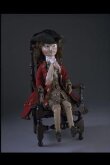
These dolls were named 'Lord and Lady' of the family home in Clapham, London by their owners, the Cockerell family. The outfits of the dolls are perfect miniatures of London fashions 1690-1700. Lord Clapham's coat, waistcoat and close-fitting breeches demonstrate the newly fashionable three-piece suit. At this period the suit was not expected to match. The neck-cloth is worn in fashionable, military style.
Doll of wood and wool, face gessoed and painted, wig of human hair; linen shirt; breeches of silver tissue lined with white flannel; waistcoat of silver tissue lined with silk; wool coat, lined with silk and trimmed with silver braid; muslin neckcloth; silk stockings; leather shoes with brass buckles; felt hat(27/03/2003) |
| Credit line | Purchased by public subscription |
| Object history | The doll and its partner are thought to have belonged to the Cockerell family, descendants of Samuel Pepys. The daughter of Pepys' nephew, John Jackson (son of his sister, Pauline) married a Cockerell. The doll and its partner were named 'Lord' and 'Lady' of the family home in Clapham. Historical significance: The doll and its partner are costume documents; their clothes being, in style, cut and material, perfect miniatures of the fashions of the late 17th century. Their importance is underlined by the almost total lack of other good visual material for this period, whether pictorial or in the form of surviving garments. In particular, the survival of accessories and the informal garments is extremely rare. |
| Historical context | Dolls were widely produced in the 17th century, although very few survive. It is most unlikely that these particular examples were the playthings of children. Their production is of a high quality, almost all the accessories survive and there is little wear and tear on the dolls and their garments. They were most probably purchased for the amusement of adults, and as a decorative accessory to a home. |
| Production | The hat is probably a later addition or replacement as T. Bourdillon is not known at Russel Street before 1785. |
| Summary | Object Type This hat was made for a doll, known as Lord Clapham, that is thought to have belonged to the Cockerell family, descendants of the diarist Samuel Pepys (1633-1703). The daughter of Pepys's nephew John Jackson (the son of his sister Pauline) married a Cockerell, who had a family home in Clapham, south London. Designs & Designing Lord Clapham offers a fine example of both formal and informal dress for a gentleman in the 1690s. His formal outfit includes a coat, waistcoat and breeches, while his informal dress is represented by the nightgown. Accessories such as the stockings, stock (a form of stiff, close-fitting neckcloth) and gloves are very valuable since very few items from this early period survive in museum collections. Equally important is the demonstration of how these clothes were worn together. Ownership & Use Dolls were widely produced in the 17th century, although very few survive, due to the wear and tear they usually undergo. The high quality of Lord Clapham and his clothes indicates that he would have been expensive. There is little evidence of use, which suggests that he was admired by adults rather than played with by children. |
| Associated object | T.846-1974 (Object) |
| Bibliographic reference | Hillier, Mary, Pollock's Dictionary of English Dolls, London: Robert Hale Ltd, 1982, 50-51, 202pp. ill |
| Collection | |
| Accession number | T.847M-1974 |
About this object record
Explore the Collections contains over a million catalogue records, and over half a million images. It is a working database that includes information compiled over the life of the museum. Some of our records may contain offensive and discriminatory language, or reflect outdated ideas, practice and analysis. We are committed to addressing these issues, and to review and update our records accordingly.
You can write to us to suggest improvements to the record.
Suggest feedback
You can write to us to suggest improvements to the record.
Suggest feedback
| Record created | August 11, 2003 |
| Record URL |
Download as: JSONIIIF Manifest
