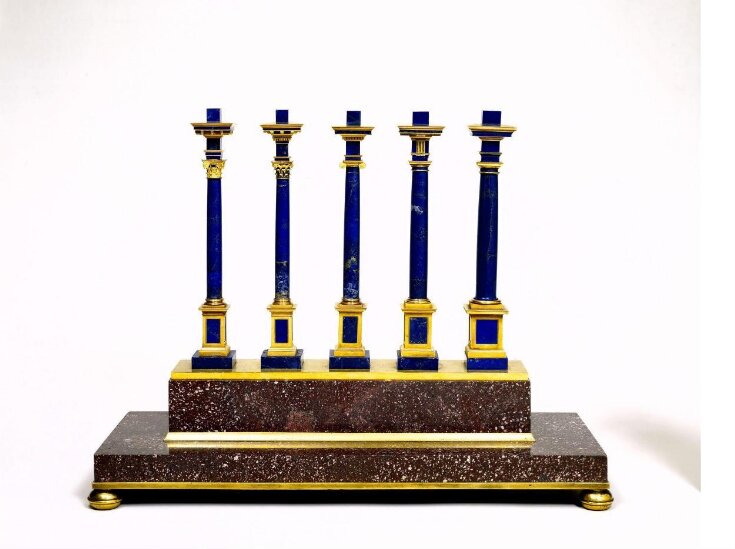
The Five Orders of Architecture
Model
ca. 1780 (made)
ca. 1780 (made)
| Artist/Maker | |
| Place of origin |
This precious, elegant object of a courtly type - the last word in luxury - has been associated with Marie Antoinette (1755-1793), queen of France as the wife of Louis XVI from 1774 to 1793, as it was listed in the Jones collection inventory, 15 May 1882, alongside furniture also supposedly linked with Marie Antoinette. Although there is no firm documentary evidence, the connection made in the Jones document at least indicates the importance attached by the collector and the Museum to such putative royal connections when collecting French decorative art. This miniature representation of the orders of architecture as defined by Vitruvius - Tuscan, Doric, Ionic, and Corinthian, with the later addition of Composite - continued to be described in label and publication texts as linked to the French queen. William Maskell's 1883 Jones collection handbook, for example, stated that the piece was "designed and made for Marie Antoinette, in order to teach her (it is said) something of the science". This information may have originated with Jones's manservant Arthur Habgood, who inherited Jones's house and probably assisted curators in compiling the inventory. Versailles curator Christian Baulez has recently found a reference to a payment made by the goldsmith R.-A. Drais in 1790 for a set of seven lapis columns that may or may not be related to this object.
Object details
| Categories | |
| Object type | |
| Title | The Five Orders of Architecture (generic title) |
| Materials and techniques | Lapis lazuli columns, mounted in gold; on a base of red porphyry mounted in ormolu |
| Brief description | Architectural model, 'The Five Orders of Architecture', lapis lazuli columns, mounted in silver gilt perhaps made by Robert Arnould Drais, France, ca.1780 |
| Physical description | Lapis lazuli columns, mounted in gold, on a base of red porphyry and in ormolu resting on ball feet. |
| Dimensions |
|
| Style | |
| Credit line | Bequeathed by John Jones |
| Object history | This object has been associated with Marie Antoinette, queen of France, wife of Louis XVI from 1774 to 1793. Latterly in the John Jones collection. |
| Subjects depicted | |
| Summary | This precious, elegant object of a courtly type - the last word in luxury - has been associated with Marie Antoinette (1755-1793), queen of France as the wife of Louis XVI from 1774 to 1793, as it was listed in the Jones collection inventory, 15 May 1882, alongside furniture also supposedly linked with Marie Antoinette. Although there is no firm documentary evidence, the connection made in the Jones document at least indicates the importance attached by the collector and the Museum to such putative royal connections when collecting French decorative art. This miniature representation of the orders of architecture as defined by Vitruvius - Tuscan, Doric, Ionic, and Corinthian, with the later addition of Composite - continued to be described in label and publication texts as linked to the French queen. William Maskell's 1883 Jones collection handbook, for example, stated that the piece was "designed and made for Marie Antoinette, in order to teach her (it is said) something of the science". This information may have originated with Jones's manservant Arthur Habgood, who inherited Jones's house and probably assisted curators in compiling the inventory. Versailles curator Christian Baulez has recently found a reference to a payment made by the goldsmith R.-A. Drais in 1790 for a set of seven lapis columns that may or may not be related to this object. |
| Bibliographic references |
|
| Collection | |
| Accession number | 853-1882 |
About this object record
Explore the Collections contains over a million catalogue records, and over half a million images. It is a working database that includes information compiled over the life of the museum. Some of our records may contain offensive and discriminatory language, or reflect outdated ideas, practice and analysis. We are committed to addressing these issues, and to review and update our records accordingly.
You can write to us to suggest improvements to the record.
Suggest feedback
You can write to us to suggest improvements to the record.
Suggest feedback
| Record created | August 5, 2003 |
| Record URL |
Download as: JSONIIIF Manifest
