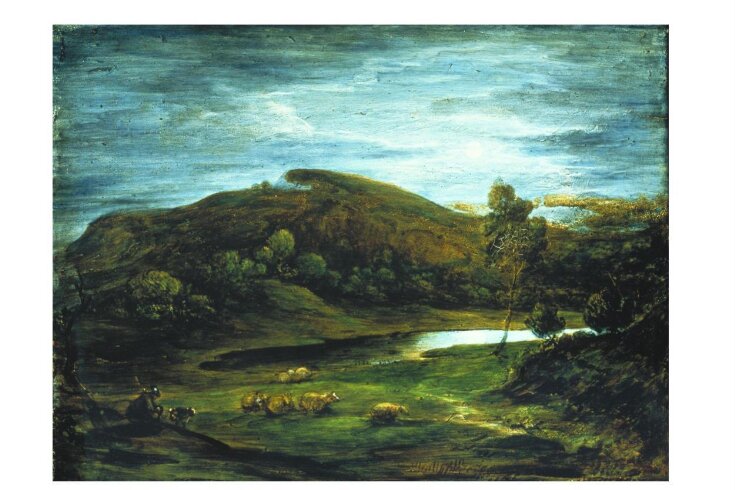

Open Landscape with Shepherd, Sheep, Pool and Distant Hills
Oil Painting
ca. 1786 (painted)
ca. 1786 (painted)
| Artist/Maker | |
| Place of origin |
A reflective expanse of water lit by moonlight dominates the centre of this landscape. Gainsborough also made a rough copy of this composition in reverse.
Object details
| Categories | |
| Object type | |
| Title | Open Landscape with Shepherd, Sheep, Pool and Distant Hills (popular title) |
| Materials and techniques | transparent oil on glass |
| Brief description | Oil painting on glass, 'Open Landscape with Shepherd, Sheep, Pool and Distant Hills', Thomas Gainsborough, ca. 1781-1782 |
| Physical description | This is catalogue no. 173 in John Hayes "The Landscape Paintings of Thomas Gainsborough: A Critical Text and Catalogue Raisonne" (1982). For a General Note on the series of transparencies and the display box, see "History 1", under "Historical Significance". For Provenance see "History 1", under "Object History Note". Notes from Hayes, cat. no. 173: There is a rapid and rather summary sketch in black and white chalk on buff paper which is a reverse version of this transparency (Tate Gallery, London; illustrated Hayes fig. 173a). It is likely that the drawing was made from the transparency rather than the other way round. The transparency includes a moonlight effect, which was exceptional in Gainsborough's work, but obviously especially suited to transparency painting. It is notable therefore that the drawing does not include the moonlight effect. |
| Dimensions |
|
| Style | |
| Credit line | Bequeathed by Ernest E. Cook through Art Fund |
| Object history | Hayes 1982, cat. no. 173, p. 555 "Provenance: Purchased from Margaret Gainsborough (1752-1820) by Dr Thomas Monro (1759-1833); Monro sale, Christie's, 26 June 1833 ff., 3rd day (28 June), lot 168, bt W. White, who bequeathed it to G.W. Reid; anon. [Buck Reid] sale, Christie's, 29 March 1890, lot 132, bt in; Leopold Hirsch; Hirsch sale, Christie's, 11 May 1934, lot 104, bt Gooden and Fox for Ernest E. Cook; bequeathed to the Victoria and Albert Museum, through the National Art-Collections Fund, 1955." Historical significance: General Note from Hayes, cat. no. 132, p. 497 Gainsborough was familiar with transparency painting, and had himself painted transparencies for the decoration of Bach and Abel's concert rooms in Hanover Square, London, opened in February 1775; but it seems to have been de Loutherbourg's Eidophusikon, first shown in February 1781, which inspired his own 'peep-show' for displaying his ideas for landscapes. Gainsborough's rather amateurish box [which is also in the V&A, museum number P.44-1955, illustrated in Hayes, pls 171, 172] consisted of a large storage space, containing twelve slats, to house his transparencies; a system of cords and pulleys to hoist the desired transparency into position; four slats behind this position, into anyone of which could be inserted a semi-transparent silk screen; and, at the back, five candle-holders. The spectator viewed the transparencies through a large round peep-hole, fitted with a magnifying lens, in the front of the box. The lens could be adjusted to between 25½ and 34½ inches of the projected transparency, thus producing an image with a magnification of between two-and-a-half and five times the size of the original, according to the length of adjustment. The light transmitted from the candles behind, albeit diffused through the silk screen, produced a luminosity close to that in nature impossible to achieve in oil painting on an opaque support. It is not known whether the transparencies were intended to be viewed with the painted surface facing the candle or the spectator; there is optical evidence to favour the former method, but this matter, and others connected with the box, require further investigation. Gainsborough must have painted numerous transparencies for showing in his box, but only ten survive [two further transparencies in the V&A, P.38-1955 and P.40-1955, were painted by another artist at a later date]. All ten are completely tonal in quality, executed in a range of blues, greens and browns, and Gainsborough's aim was clearly to heighten and dramatize his effects of light. |
| Subjects depicted | |
| Summary | A reflective expanse of water lit by moonlight dominates the centre of this landscape. Gainsborough also made a rough copy of this composition in reverse. |
| Bibliographic references |
|
| Collection | |
| Accession number | P.36-1955 |
About this object record
Explore the Collections contains over a million catalogue records, and over half a million images. It is a working database that includes information compiled over the life of the museum. Some of our records may contain offensive and discriminatory language, or reflect outdated ideas, practice and analysis. We are committed to addressing these issues, and to review and update our records accordingly.
You can write to us to suggest improvements to the record.
Suggest feedback
You can write to us to suggest improvements to the record.
Suggest feedback
| Record created | July 26, 2003 |
| Record URL |
Download as: JSONIIIF Manifest
