
Tile
ca. 1845 (designed)
| Artist/Maker | |
| Place of origin |
Object Type
Encaustic tiles were produced in large quantities from the mid-19th century. The principal market for the tiles was for churches, both new and restored.
Design & Designing
Thousands of British churches were restored or built during Queen Victoria's reign. Architects and manufacturers worked together to provide designs for items such as tiles and metalwork, developing new techniques of production to satisfy growing demand. These tiles were designed by Pugin specifically for the altar area of a church. The designs appear in his 'Glossary of Ecclesiastical Ornament' (1846).
Subjects Depicted
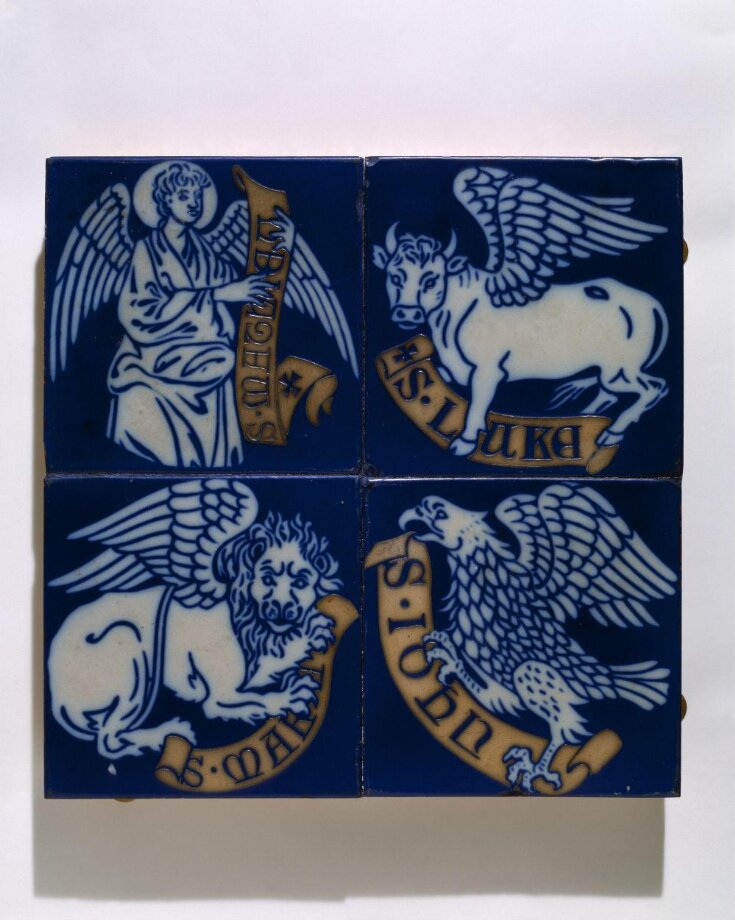
The four tiles bear symbolic representations of the Four Evangelists, Matthew, Mark, Luke and John, represented by an angel, a winged lion, a winged ox, and an eagle. These conventions had been established in the Medieval period, and are found regularly in Romanesque and Gothic art. Pugin's re-use of this symbolic imagery in the 19th century is yet another example of his re-working of Medieval religious themes.
Encaustic tiles were produced in large quantities from the mid-19th century. The principal market for the tiles was for churches, both new and restored.
Design & Designing
Thousands of British churches were restored or built during Queen Victoria's reign. Architects and manufacturers worked together to provide designs for items such as tiles and metalwork, developing new techniques of production to satisfy growing demand. These tiles were designed by Pugin specifically for the altar area of a church. The designs appear in his 'Glossary of Ecclesiastical Ornament' (1846).
Subjects Depicted
The four tiles bear symbolic representations of the Four Evangelists, Matthew, Mark, Luke and John, represented by an angel, a winged lion, a winged ox, and an eagle. These conventions had been established in the Medieval period, and are found regularly in Romanesque and Gothic art. Pugin's re-use of this symbolic imagery in the 19th century is yet another example of his re-working of Medieval religious themes.
Object details
| Categories | |
| Object type | |
| Materials and techniques | Earthenware with inlaid glazed decoration (encaustic) |
| Brief description | One of a set of four tiles with symbols of the evangelists |
| Dimensions |
|
| Gallery label | British Galleries:
These tiles, designed by the architect A.W.N. Pugin were specifically for the altar area of a church. Encaustic tiles also became popular for houses and public buildings.(27/03/2003) |
| Object history | Designed by A.W.N. Pugin (born in London, 1812, died in Ramsgate, Kent, 1852); made by Minton & Co., Stoke-on-Trent, Staffordshire |
| Subject depicted | |
| Summary | Object Type Encaustic tiles were produced in large quantities from the mid-19th century. The principal market for the tiles was for churches, both new and restored. Design & Designing Thousands of British churches were restored or built during Queen Victoria's reign. Architects and manufacturers worked together to provide designs for items such as tiles and metalwork, developing new techniques of production to satisfy growing demand. These tiles were designed by Pugin specifically for the altar area of a church. The designs appear in his 'Glossary of Ecclesiastical Ornament' (1846). Subjects Depicted The four tiles bear symbolic representations of the Four Evangelists, Matthew, Mark, Luke and John, represented by an angel, a winged lion, a winged ox, and an eagle. These conventions had been established in the Medieval period, and are found regularly in Romanesque and Gothic art. Pugin's re-use of this symbolic imagery in the 19th century is yet another example of his re-working of Medieval religious themes. |
| Collection | |
| Accession number | C.81C-1976 |
About this object record
Explore the Collections contains over a million catalogue records, and over half a million images. It is a working database that includes information compiled over the life of the museum. Some of our records may contain offensive and discriminatory language, or reflect outdated ideas, practice and analysis. We are committed to addressing these issues, and to review and update our records accordingly.
You can write to us to suggest improvements to the record.
Suggest feedback
You can write to us to suggest improvements to the record.
Suggest feedback
| Record created | July 23, 2003 |
| Record URL |
Download as: JSONIIIF Manifest
