King Vulture
Sculpture
ca. 1731 (made)
ca. 1731 (made)
| Artist/Maker | |
| Place of origin |
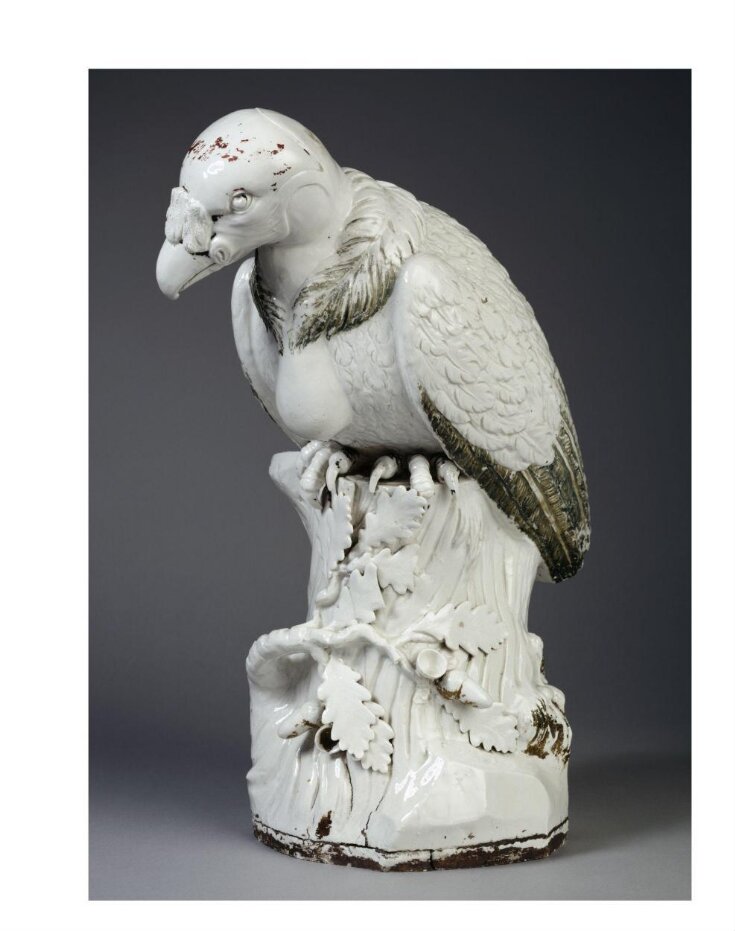
This extraordinary sculpture of a vulture is from the porcelain menagerie commissioned by Augustus the Strong, Elector of Saxony, for the 'Japanese Palace' in Dresden. This commission is one of the great landmarks in ceramic history. Nearly 600 life-size animals were planned, and at least 458 were made. Work began in 1730, only 20 years after Meissen had become the first European factory to make porcelain in the Chinese manner.
Augustus had specified that the animals should have their natural colours. Normally, this would be achieved by the use of enamels. However, the factory technicians thought it too risky to subject the largest models to the heat of an enamel firing. Instead they partly painted them in bright, unfired pigments. Such colours rarely survive, as they fade over time and have often been completely removed.
This King Vulture model exists in three different versions: some crouching, some with head down, and some standing upright. These variations were introduced by the 'repairer' (the skilled craftsman who assembled the separately moulded parts of the model prior to firing), probably in the interest of variety.
Augustus had specified that the animals should have their natural colours. Normally, this would be achieved by the use of enamels. However, the factory technicians thought it too risky to subject the largest models to the heat of an enamel firing. Instead they partly painted them in bright, unfired pigments. Such colours rarely survive, as they fade over time and have often been completely removed.
This King Vulture model exists in three different versions: some crouching, some with head down, and some standing upright. These variations were introduced by the 'repairer' (the skilled craftsman who assembled the separately moulded parts of the model prior to firing), probably in the interest of variety.
Delve deeper
Discover more about this object

Object details
| Categories | |
| Object type | |
| Title | King Vulture (generic title) |
| Materials and techniques | Hard-paste porcelain, painted in unfired colours |
| Brief description | Sculpture, hard-paste porcelain, painted in unfired colours, of a King Vulture, made at the Meissen porcelain factory, Germany, ca.1731 |
| Physical description | Sculpture, hard-paste porcelain, painted in unfired colours, of a King Vulture. The vulture is positioned crouching on an oak tree stump, with head turned slightly to one side. Much of the original colouring has now discoloured, and only traces of the original bright red remain on the head. |
| Dimensions |
|
| Marks and inscriptions | 'X' (the base bears the 'X' mark of the 'former' (factory craftsman) Andreas Shiefer.) |
| Gallery label | King Vulture
About 1731
This vulture was part of a porcelain menagerie in one of the Dresden palaces of Augustus the Strong, Elector of Saxony and King of Poland. It is one of nearly 600 life-size animal sculptures he commissioned in 1730. Firing porcelain of this size was very hazardous, and many of the surviving animals have prominent firing cracks. To avoid further damage, some, like this one, were painted in colours that did not require high temperatures to fix them.
Germany (Dresden)
Made at the Meissen factory
Modelled by Johann Joachim Kändler
Porcelain, partly painted in unfired pigments
Purchased with the assistance of the Heritage Lottery Fund, the Art Fund, and the Friends of the V&A
Family label for Europe 1600-1815:
This vulture was made for Augustus the Strong, King of Poland. He loved porcelain so much that he once swapped 600 soldiers and horses for 151 Chinese vases. He had hundreds of life-size porcelain animals like this vulture made for his palace. If you had a palace, what would you fill the rooms with?(09/12/2015) |
| Credit line | Purchased with the support of the National Lottery Heritage Fund, Art Fund, and the Friends of the V&A |
| Object history | Provenance. From the porcelain menagerie commissioned for the 'Japanese Palace', Dresden, by Augustus the Strong (1694/7-1733), Elector of Saxony and King of Poland. By repute given by a member of the Baring family to John Alexander, 4th Marquess of Bath (1831-1896), Longleat, and thence by descent (recorded in inventories of Longleat in 1869 as 'A white Dresden vulture', and in 1896 as '21 in. white porcelain vulture on a stump'). Sold Christies, London, 13 June 2002, lot 353. |
| Production | From the porcelain menagerie commissioned for the 'Japanese Palace', Dresden, by Augustus the Strong (1694/7-1733), Elector of Saxony and King of Poland. Probably modelled by Johann Joachim Kaendler (1706-1776), possibly in collaboration with Johann Gottlieb Kirchner (born 1706); painted in unfired pigments by the Dresden court lacquerer Christian Reinow; the base bears the 'X' mark of the 'former' (factory craftsman) Andreas Shiefer. |
| Subjects depicted | |
| Association | |
| Summary | This extraordinary sculpture of a vulture is from the porcelain menagerie commissioned by Augustus the Strong, Elector of Saxony, for the 'Japanese Palace' in Dresden. This commission is one of the great landmarks in ceramic history. Nearly 600 life-size animals were planned, and at least 458 were made. Work began in 1730, only 20 years after Meissen had become the first European factory to make porcelain in the Chinese manner. Augustus had specified that the animals should have their natural colours. Normally, this would be achieved by the use of enamels. However, the factory technicians thought it too risky to subject the largest models to the heat of an enamel firing. Instead they partly painted them in bright, unfired pigments. Such colours rarely survive, as they fade over time and have often been completely removed. This King Vulture model exists in three different versions: some crouching, some with head down, and some standing upright. These variations were introduced by the 'repairer' (the skilled craftsman who assembled the separately moulded parts of the model prior to firing), probably in the interest of variety. |
| Bibliographic reference | Samuel Wittwer, The Gallery of Meissen Animals: Augustus the Strong's Menagerie for the Japanese Palace in Dresden (2006), passim and pp. 357-358. |
| Collection | |
| Accession number | C.11-2003 |
About this object record
Explore the Collections contains over a million catalogue records, and over half a million images. It is a working database that includes information compiled over the life of the museum. Some of our records may contain offensive and discriminatory language, or reflect outdated ideas, practice and analysis. We are committed to addressing these issues, and to review and update our records accordingly.
You can write to us to suggest improvements to the record.
Suggest feedback
You can write to us to suggest improvements to the record.
Suggest feedback
| Record created | July 23, 2003 |
| Record URL |
Download as: JSONIIIF Manifest
