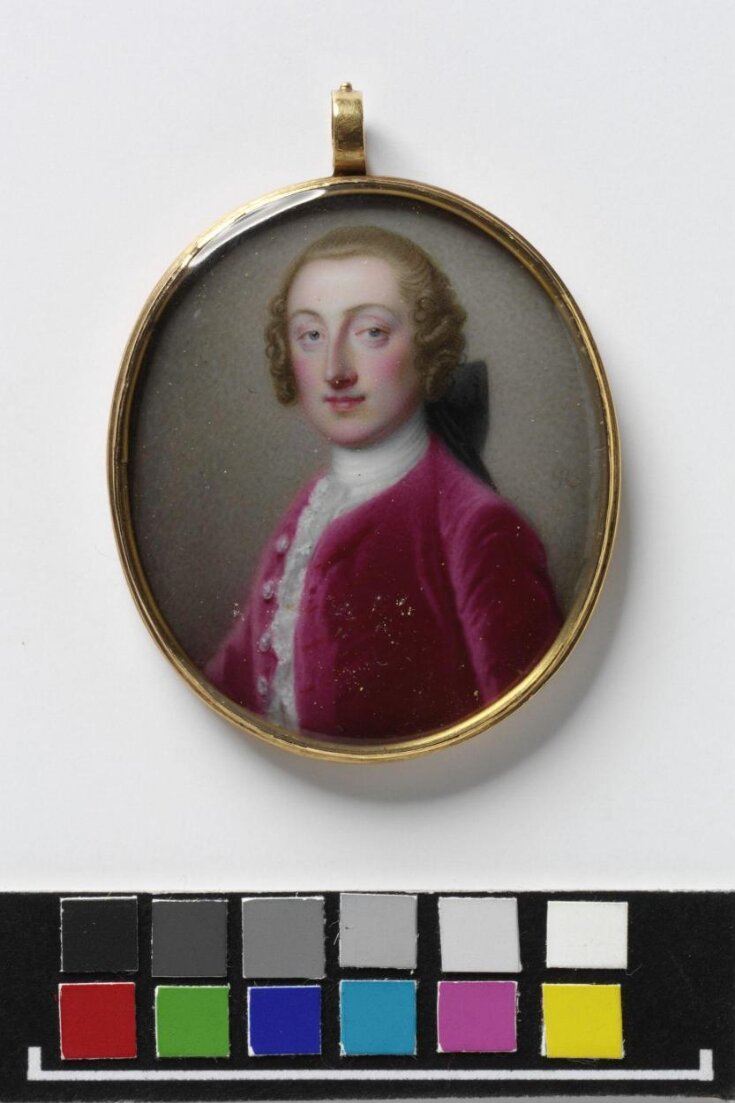

Portrait of William Pitt (1708-1778), 1st Earl of Chatham
Enamel Miniature
1740s (painted)
1740s (painted)
| Artist/Maker | |
| Place of origin |
The word ‘miniature’ describes a technique of painting in watercolour rather than the size of a painting. Miniature painting developed as a separate art in the 16th century and in Britain it became predominantly a portrait art. In mainland Europe, however, the taste for portraits small enough to be carried on the person was often met by artists working within very different artistic traditions. One type of ‘miniature’ (as all such small works are now known), produced more often in Europe than in Britain, was the enamel, which became fashionable in England only through the influence of foreign artists.
This portrait is painted in enamel on metal. The advantage of enamel over traditional miniature painting (watercolour painted on vellum or, from about 1700, on ivory) is that it does not fade when exposed to light. The process of painting with enamels is, however, less free than the miniature technique and is fraught with risk. The first colours to be laid on the metal support have to be those needing the highest temperature when firing. More colour is added and the enamel refired, the process ending with the colours needing the lowest temperature. Such labour meant that it was an expensive option.
Enamel was first practised in England in the 1630s by the Swiss goldsmith Jean Petitot at the court of Charles I. It was reintroduced around 1680 by a Swede, Charles Boit, and achieved wide popularity with the work of Christian Friedrich Zincke of Germany. Both Boit and Zincke were goldsmiths by training. Jean Rouquet, who painted this enamel, was also a European artist who came to London in the early 18th century to practise this art, which was so internationally fashionable and popular.
This miniature depicts British statesman and orator William Pitt was war minister during the Seven Years’ War between Britain and France (1756–63) and was key to Britain’s success in the war. He was the father of William Pitt the Younger, British prime minister during the Napoleonic wars, and hence is known as William Pitt the Elder.
This portrait is painted in enamel on metal. The advantage of enamel over traditional miniature painting (watercolour painted on vellum or, from about 1700, on ivory) is that it does not fade when exposed to light. The process of painting with enamels is, however, less free than the miniature technique and is fraught with risk. The first colours to be laid on the metal support have to be those needing the highest temperature when firing. More colour is added and the enamel refired, the process ending with the colours needing the lowest temperature. Such labour meant that it was an expensive option.
Enamel was first practised in England in the 1630s by the Swiss goldsmith Jean Petitot at the court of Charles I. It was reintroduced around 1680 by a Swede, Charles Boit, and achieved wide popularity with the work of Christian Friedrich Zincke of Germany. Both Boit and Zincke were goldsmiths by training. Jean Rouquet, who painted this enamel, was also a European artist who came to London in the early 18th century to practise this art, which was so internationally fashionable and popular.
This miniature depicts British statesman and orator William Pitt was war minister during the Seven Years’ War between Britain and France (1756–63) and was key to Britain’s success in the war. He was the father of William Pitt the Younger, British prime minister during the Napoleonic wars, and hence is known as William Pitt the Elder.
Delve deeper
Discover more about this object

Object details
| Categories | |
| Object type | |
| Title | Portrait of William Pitt (1708-1778), 1st Earl of Chatham (popular title) |
| Materials and techniques | Enamel on metal |
| Brief description | Enamel portrait miniature of William Pitt (1708-1778), 1st Earl of Chatham, by André Rouquet. Great Britain, ca.1745. |
| Physical description | Enamel oval portrait miniature of William Pitt (1708-1778), 1st Earl of Chatham. He is portrayed in quarter-length, wearing a dark pink jacket over a white shirt with a black bow at the back of his head, just visible over his right shoulder. Signed 'R'. |
| Dimensions |
|
| Marks and inscriptions | Signed 'R'. |
| Credit line | Given by Mr F. N. and Mrs O. A. Ashcroft |
| Subjects depicted | |
| Summary | The word ‘miniature’ describes a technique of painting in watercolour rather than the size of a painting. Miniature painting developed as a separate art in the 16th century and in Britain it became predominantly a portrait art. In mainland Europe, however, the taste for portraits small enough to be carried on the person was often met by artists working within very different artistic traditions. One type of ‘miniature’ (as all such small works are now known), produced more often in Europe than in Britain, was the enamel, which became fashionable in England only through the influence of foreign artists. This portrait is painted in enamel on metal. The advantage of enamel over traditional miniature painting (watercolour painted on vellum or, from about 1700, on ivory) is that it does not fade when exposed to light. The process of painting with enamels is, however, less free than the miniature technique and is fraught with risk. The first colours to be laid on the metal support have to be those needing the highest temperature when firing. More colour is added and the enamel refired, the process ending with the colours needing the lowest temperature. Such labour meant that it was an expensive option. Enamel was first practised in England in the 1630s by the Swiss goldsmith Jean Petitot at the court of Charles I. It was reintroduced around 1680 by a Swede, Charles Boit, and achieved wide popularity with the work of Christian Friedrich Zincke of Germany. Both Boit and Zincke were goldsmiths by training. Jean Rouquet, who painted this enamel, was also a European artist who came to London in the early 18th century to practise this art, which was so internationally fashionable and popular. This miniature depicts British statesman and orator William Pitt was war minister during the Seven Years’ War between Britain and France (1756–63) and was key to Britain’s success in the war. He was the father of William Pitt the Younger, British prime minister during the Napoleonic wars, and hence is known as William Pitt the Elder. |
| Bibliographic reference | Victoria & Albert Museum Department of Engraving Illustration and Design & Department of Paintings, Accessions 1946. London: Published under the Authority of the Ministry of Education, 1949. |
| Collection | |
| Accession number | P.5-1946 |
About this object record
Explore the Collections contains over a million catalogue records, and over half a million images. It is a working database that includes information compiled over the life of the museum. Some of our records may contain offensive and discriminatory language, or reflect outdated ideas, practice and analysis. We are committed to addressing these issues, and to review and update our records accordingly.
You can write to us to suggest improvements to the record.
Suggest feedback
You can write to us to suggest improvements to the record.
Suggest feedback
| Record created | July 14, 2003 |
| Record URL |
Download as: JSONIIIF Manifest
