| Categories | |
| Object type | |
| Title | Elizabeth I
(generic title) |
| Materials and techniques | Watercolour on vellum stuck to a playing card |
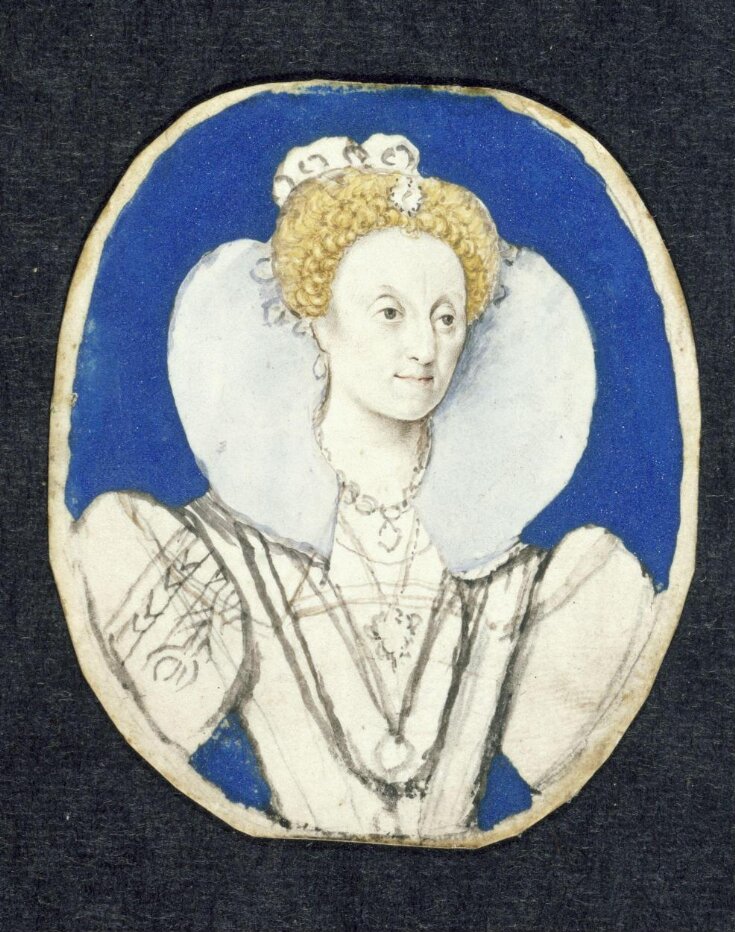
| Brief description | Portrait miniature of Elizabeth I, watercolour on vellum, painted by Isaac Oliver, 1590-92 |
| Physical description | Portrait miniature of Elizabeth I, oval, half-length on a blue ground. The card has been trimmed into an oval leaving squared edges at the top and bottom. A club is visible on the back of the support. The body has been sketched in outline. |
| Dimensions | - Height: 82mm
- Width: 52mm
- Frame with loop height: 103mm
- Frame height: 90mm
- Frame width: 77mm
- Frame depth: 12mm
- Frame aperture height: 61mm
- Frame aperture width: 51mm
Dimensions taken from: Strong, Roy. Artists of the Tudor Court: the Portrait Miniature Rediscovered 1520-1620.. London: The Victoria and Albert Museum, 1983. |
| Styles | |
| Credit line | Purchased with funds from the R. H. Stephenson Bequest |
| Object history | COLLECTIONS: The tradition that this was in the collection of Dr Richard Mead (1673-1754) can be discounted as there is no trace of it in the sale catalogue; first certainly recorded in the S. Reynolds Solly collection; sold by order of Mrs Edith Solly and the Trustees of the late Henry Reynolds Solly, Sotheby’s June 27th 1940 (lot 33) purchased for the V&A from the funds of the R. H. Stephenson Bequest. |
| Subjects depicted | |
| Bibliographic references | - Strong, Roy. Artists of the Tudor Court: the Portrait Miniature Rediscovered 1520-1620. London: The Victoria and Albert Museum, 1983. Cat. 199, pp. 124-125. Part Citation: "Without doubt this miniature was painted from life. The evidence for this is not only the extraordinary directness of observation in the painting but also its actual shape which incorporates, at the top and bottom, the straight edges of the playing card mount enabling the miniature to be held in place while Oliver was painting it. This would have subsequently been trimmed to fit the miniature case. The fact that this was not done would suggest that it was kept for reference as a face-pattern and is not, as has often been suggested merely an unfinished miniature.
That this was a pattern has been reinforced by the remarkable series of images it influenced. Oliver certainly pained at least one known miniature from it, sold from the Heckett Collection (Sotheby’s 24th April 1978 (lot 500)). The main reason for the sitting, however, was probably not for the multiplication of miniatures but for the purposes of engraving and the pattern connects directly with a series of engravings of Elizabeth commissioned by John Woutneel, a book and printseller from the Netherlands who settled in London in 1592. There is also an engraving of Elizabeth I dated 1592 which, although it is now only known in later states, directly related to Oliver’s miniature, by Crispin van de Passe I, two of whose sons, Simon and Willem, and a daughter, Magdalena, worked in England in the Jacobean period. There is no evidence that de Passe I, however, came in the 1590s but Woutneel either published, or acted as English agent for a number of his engravings. Of these one was the 1592 portrait of Elizabeth and the second the Queen Elizabeth I between columns dated 1596, almost certainly by him, which uses the same face-mask. Oliver would have been a natural choice of artist for drawing the Queen, belong as he did to the reformist exile group in London. Evidence would point to the sitting taking place c. 1592 and being the result of a specific approach through the refugee colony in the form of Woutneel. The face-pattern was probably utilized by the English engraver William Rogers, for his Rosa Electa. This portrait of Elizabeth is virtually contemporaneous with Marcus Gheeraerts the Younger’s Ditchley Portrait of Elizabeth. The artist’s were, of course, closely related, Oliver later being Gheeraert’s borther-in-law. There was no doubt a flow of ideas between them as, epitomizing a new generation of painters, they essayed the face of the ageing Queen. The result is in reality, gently refined but catching all the intelligence and certainly providing us with an image matching the celebrated Hentzner description of 1598: “her face oblong, fair but wrinkled, her eyes small, yet black and pleasant, her nose a little hooked, her lips narrow…her hair…an auburn colour but false…”
- p.110, fig 103
Les Tudors sous la direction scientifique de Charlotte Bolland et Cécile Maisonneuve. Paris : Réunion des musées nationaux-Grand palais : Musée du Luxembourg-Sénat, c2015. ISBN: 9782711862368.
- pp. 110-1
Catharine MacLeod with Rab MacGibbon, Victoria Button, Katherine Coombs and Alan Derbyshire. Elizabethan treasures : miniatures by Hilliard and Oliver. London : National Portrait Gallery, 2019. ISBN: 9781855147027
|
| Collection | |
| Accession number | |