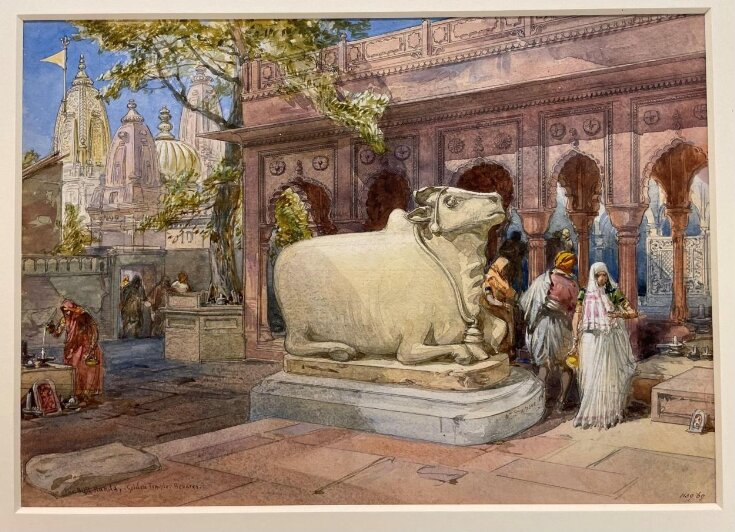

The Bull Nandi in the courtyard of the Golden Temple, Benares
Painting
1866 (made)
1866 (made)
| Artist/Maker | |
| Place of origin |
William Simpson (1823 - 1899) was a distinguished watercolourist and war artist. Having established his reputation by documenting the Crimean war in 1854, Day and Sons, the London lithography firm, commissioned him to sketch well-known sites in and around Delhi associated with the Revolt of 1857 by Indians against the rule of the British East India Company.
Simpson arrived in Calcutta (Kolkata) in 1859 and travelled widely. His rapid pencil drawings formed the preparatory studies for his finished watercolours done after his return to London in 1862. His detailed journal, sketches and pictures from India resulted in these highly coloured, evocative, and romantic interpretations of the landscape and architecture.
During his time in India, Simpson travelled from Kanpur to Allahabad, where he remained for about a week, and then went on to Benares (Varanasi), where he was put up at the Victoria Hotel. He spent three days at the Golden Temple. He completed the painting of the sculpture of the sacred bull-calf, Nandi, at the Golden Temple in Benares in 1869.
Simpson arrived in Calcutta (Kolkata) in 1859 and travelled widely. His rapid pencil drawings formed the preparatory studies for his finished watercolours done after his return to London in 1862. His detailed journal, sketches and pictures from India resulted in these highly coloured, evocative, and romantic interpretations of the landscape and architecture.
During his time in India, Simpson travelled from Kanpur to Allahabad, where he remained for about a week, and then went on to Benares (Varanasi), where he was put up at the Victoria Hotel. He spent three days at the Golden Temple. He completed the painting of the sculpture of the sacred bull-calf, Nandi, at the Golden Temple in Benares in 1869.
Object details
| Categories | |
| Object type | |
| Title | The Bull Nandi in the courtyard of the Golden Temple, Benares (generic title) |
| Materials and techniques | Pencil and watercolour on paper |
| Brief description | Painting of the Bull Nandi in the courtyard of the Golden Temple by William Simpson, Benares, 1866 |
| Physical description | Painting of the sculpture of the sacred bull-calf, Nandi, at the Golden Temple in Benares, India. Nandi, the vahana (mount) of Lord Shiva, is seated near the mandapa (pillared hall) in front of the Vishvantha Temple, also known as the Golden temple, dedicated to Lord Shiva. The temple has a clustered pointed spire, gilded and decorated with flags. Several Lingas (the phallic symbol of Shiva) are present. On the left, a woman in a pink sari bathes the Linga in milk, a ritual to energise and purify the deity. Local devotees carry lotas (vessels) containing milk. |
| Dimensions |
|
| Marks and inscriptions | The Bull Nanda, Golden Temple. Benares. Wm. Simpson 1866. (front) |
| Credit line | Purchased from Messrs Day and Son Ltd (London) in 1869 |
| Object history | Historical significance: William Simpson (1823 - 1899) William Simpson was commissioned to go to India by his employers, Day and Sons, the London lithography firm. Having established his reputation by documenting the Crimean war in 1854, he was instructed to sketch well-known sites in and around Delhi associated with the heavy fighting of 1857. Simpson arrived in Calcutta (Kolkata) in 1859 and travelled widely. His rapid pencil drawings formed the preparatory studies for his finished watercolours which were done after his return to London in 1862. His fond memories of India, as noted in his journal, resulted in these highly coloured, evocative and romantic interpretations of the Indian landscape. Simpson, a largely self-taught artist from a poor family in Scotland, had hoped to achieve fame on the publication of his paintings in a lavishly illustrated volume. Unfortunately, financial problems led to the poorly printed India Ancient and Modern containing only fifty images. Simpson called it the ‘big disaster’ of his life. The V&A has the single most important collection of watercolours made during Simpson's first expedition to India. |
| Production | Although the painting dates from 1864, the scene depicted was originally sketched in December 1860. |
| Subjects depicted | |
| Summary | William Simpson (1823 - 1899) was a distinguished watercolourist and war artist. Having established his reputation by documenting the Crimean war in 1854, Day and Sons, the London lithography firm, commissioned him to sketch well-known sites in and around Delhi associated with the Revolt of 1857 by Indians against the rule of the British East India Company. Simpson arrived in Calcutta (Kolkata) in 1859 and travelled widely. His rapid pencil drawings formed the preparatory studies for his finished watercolours done after his return to London in 1862. His detailed journal, sketches and pictures from India resulted in these highly coloured, evocative, and romantic interpretations of the landscape and architecture. During his time in India, Simpson travelled from Kanpur to Allahabad, where he remained for about a week, and then went on to Benares (Varanasi), where he was put up at the Victoria Hotel. He spent three days at the Golden Temple. He completed the painting of the sculpture of the sacred bull-calf, Nandi, at the Golden Temple in Benares in 1869. |
| Bibliographic references |
|
| Collection | |
| Accession number | 1139-1869 |
About this object record
Explore the Collections contains over a million catalogue records, and over half a million images. It is a working database that includes information compiled over the life of the museum. Some of our records may contain offensive and discriminatory language, or reflect outdated ideas, practice and analysis. We are committed to addressing these issues, and to review and update our records accordingly.
You can write to us to suggest improvements to the record.
Suggest feedback
You can write to us to suggest improvements to the record.
Suggest feedback
| Record created | July 11, 2003 |
| Record URL |
Download as: JSONIIIF Manifest
