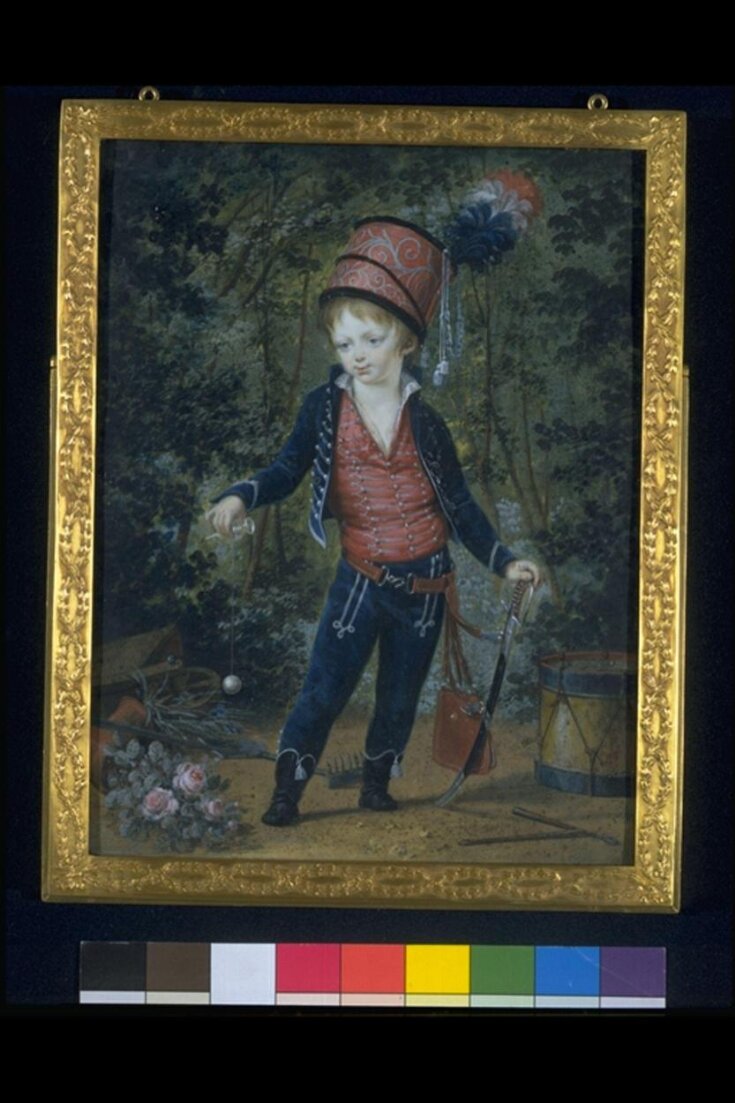
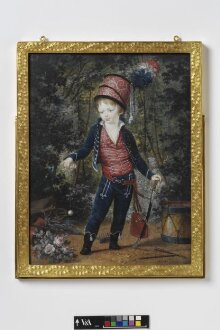

Duke of Reichstadt (1811-1832) as a boy
Miniature
ca. 1818 (painted)
ca. 1818 (painted)
| Artist/Maker | |
| Place of origin |
Miniature painting originally referred to the art of painting in watercolour on vellum (fine animal skin). It developed in the early 16th century out of the tradition of illuminating manuscripts (hand-written books). In England, miniature was predominantly a portrait art. It was practised by specialist miniature painters, such as Nicholas Hilliard (1547–1619). On the Continent, miniature painting as a portrait art had a few great practitioners, such as the French painter Jean Clouet (1516?–1572). But not even Clouet was a specialist. Like Hans Holbein, he worked both in miniature and in large in oil.
In France, it was not until the 1770s that a notable school of portrait miniaturists emerged. It was only then that they were able to rival English ones, such as Richard Cosway (1742–1821) and John Smart (1742–1811). Like Cosway and Smart, these French artists worked in watercolour on ivory.
This miniature is by Jean Baptiste Isabey, who was born in Nancy on 11 April 1767. Isabey was an outstanding French miniaturist who was taught the art by Girardet, Claudot and David. He was very popular with the French court and had a distinguished clientele. He held various appointments, including that of Royal Draughtsman and Painter.
The sitter is Napoleon Francis Joseph Charles, Duke of Reichstadt (1811–32), who was the son of the Emperor Napoleon I and Marie Louise, Archduchess of Austria. The Bonapartists referred to him as Napoleon II. He was born at the Tuileries palace in Paris on 20 March 1811. By his birth the Napoleonic dynasty seemed finally to be established, but in three years it had crumbled. Napoleon was forced to abdicate in favour of his son in 1814, but events prevented the reign of Napoleon II from being more than titular. While Napoleon was in exile on Elba, his consort and child went to Vienna. The child became a pawn in the complex game of European politics, which ended with his being given the title of ‘Duke of Reichstadt’ on 22 of July 1818. Thus Napoleon I lived to see his son reduced to a rank inferior to that of the Austrian archdukes. He had once said that he would prefer his son to be strangled rather than brought up as an Austrian prince.
In France, it was not until the 1770s that a notable school of portrait miniaturists emerged. It was only then that they were able to rival English ones, such as Richard Cosway (1742–1821) and John Smart (1742–1811). Like Cosway and Smart, these French artists worked in watercolour on ivory.
This miniature is by Jean Baptiste Isabey, who was born in Nancy on 11 April 1767. Isabey was an outstanding French miniaturist who was taught the art by Girardet, Claudot and David. He was very popular with the French court and had a distinguished clientele. He held various appointments, including that of Royal Draughtsman and Painter.
The sitter is Napoleon Francis Joseph Charles, Duke of Reichstadt (1811–32), who was the son of the Emperor Napoleon I and Marie Louise, Archduchess of Austria. The Bonapartists referred to him as Napoleon II. He was born at the Tuileries palace in Paris on 20 March 1811. By his birth the Napoleonic dynasty seemed finally to be established, but in three years it had crumbled. Napoleon was forced to abdicate in favour of his son in 1814, but events prevented the reign of Napoleon II from being more than titular. While Napoleon was in exile on Elba, his consort and child went to Vienna. The child became a pawn in the complex game of European politics, which ended with his being given the title of ‘Duke of Reichstadt’ on 22 of July 1818. Thus Napoleon I lived to see his son reduced to a rank inferior to that of the Austrian archdukes. He had once said that he would prefer his son to be strangled rather than brought up as an Austrian prince.
Object details
| Categories | |
| Object type | |
| Title | Duke of Reichstadt (1811-1832) as a boy (popular title) |
| Materials and techniques | Watercolour on ivory |
| Brief description | Portrait miniature of the Duke of Reichstadt as a boy, by Jean Baptiste Isabey, French, ca. 1818 |
| Physical description | Portrait miniature of the Duke of Reichstadt as a boy, on ivory and paper |
| Dimensions |
|
| Credit line | Bequeathed by Sir Bernard Eckstein Bart |
| Subject depicted | |
| Summary | Miniature painting originally referred to the art of painting in watercolour on vellum (fine animal skin). It developed in the early 16th century out of the tradition of illuminating manuscripts (hand-written books). In England, miniature was predominantly a portrait art. It was practised by specialist miniature painters, such as Nicholas Hilliard (1547–1619). On the Continent, miniature painting as a portrait art had a few great practitioners, such as the French painter Jean Clouet (1516?–1572). But not even Clouet was a specialist. Like Hans Holbein, he worked both in miniature and in large in oil. In France, it was not until the 1770s that a notable school of portrait miniaturists emerged. It was only then that they were able to rival English ones, such as Richard Cosway (1742–1821) and John Smart (1742–1811). Like Cosway and Smart, these French artists worked in watercolour on ivory. This miniature is by Jean Baptiste Isabey, who was born in Nancy on 11 April 1767. Isabey was an outstanding French miniaturist who was taught the art by Girardet, Claudot and David. He was very popular with the French court and had a distinguished clientele. He held various appointments, including that of Royal Draughtsman and Painter. The sitter is Napoleon Francis Joseph Charles, Duke of Reichstadt (1811–32), who was the son of the Emperor Napoleon I and Marie Louise, Archduchess of Austria. The Bonapartists referred to him as Napoleon II. He was born at the Tuileries palace in Paris on 20 March 1811. By his birth the Napoleonic dynasty seemed finally to be established, but in three years it had crumbled. Napoleon was forced to abdicate in favour of his son in 1814, but events prevented the reign of Napoleon II from being more than titular. While Napoleon was in exile on Elba, his consort and child went to Vienna. The child became a pawn in the complex game of European politics, which ended with his being given the title of ‘Duke of Reichstadt’ on 22 of July 1818. Thus Napoleon I lived to see his son reduced to a rank inferior to that of the Austrian archdukes. He had once said that he would prefer his son to be strangled rather than brought up as an Austrian prince. |
| Bibliographic reference | 100 Great Painting in The Victoria & Albert Museum.London: V&A, 1985, p.98
|
| Collection | |
| Accession number | P.40-1948 |
About this object record
Explore the Collections contains over a million catalogue records, and over half a million images. It is a working database that includes information compiled over the life of the museum. Some of our records may contain offensive and discriminatory language, or reflect outdated ideas, practice and analysis. We are committed to addressing these issues, and to review and update our records accordingly.
You can write to us to suggest improvements to the record.
Suggest feedback
You can write to us to suggest improvements to the record.
Suggest feedback
| Record created | July 11, 2003 |
| Record URL |
Download as: JSONIIIF Manifest
