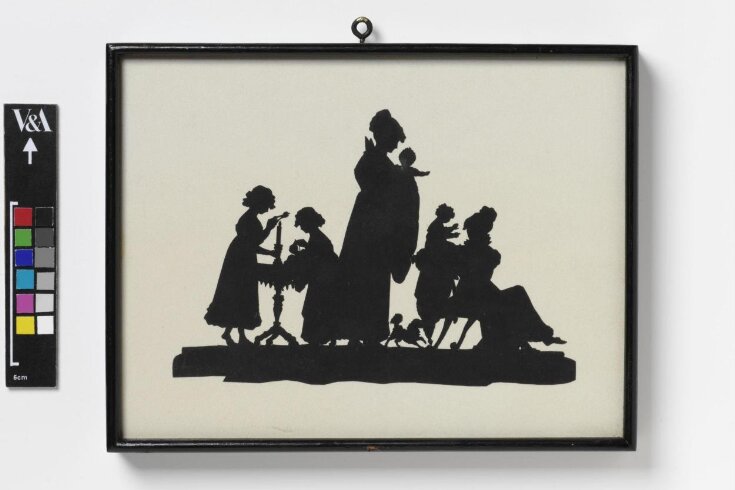

An Unknown family group
Miniature
ca. 1820-1828 (made)
ca. 1820-1828 (made)
| Artist/Maker | |
| Place of origin |
In the 18th century cut-paper images (usually blackened) were called 'shades'. If they were portraits, they were known as 'profiles'. The fashion for 'profiles' grew in the 1770s, when the archaeological discoveries of ancient Roman sites at Herculaneum and Pompeii encouraged a taste for Neo-classicism. ‘Profiles’ became even more fashionable after about 1775, when Johann Kaspar Lavater published his hugely popular Essays on Physiognomy. He claimed that one could detect a person’s character by concentrating on his or her main features. These would reveal both virtues and vices. Lavater illustrated the book with numerous simple black profiles.
The 'silhouette' was named after a French minister who was notorious for wasting his time on this popular hobby. Commercially, it was very successful, because in its simplest form it was a cheap and quick method of portraiture. Laura Muir Mackenzie's work, however, is an example of the continuing popularity of paper cutting as an amateur pastime. Mackenzie was the third daughter of Sir Alexander Muir Mackenzie of Delvine, Perthshire, Scotland, who became a baronet in 1803, and Jane, the eldest daughter of Sir Robert Murray, Baronet. She was a talented cutter of paper silhouettes, producing much of her work in her teens. She cut mainly group silhouettes. These were mainly of domestic scenes, such as babies being bathed, children playing cards and older members of a family playing chess.
The 'silhouette' was named after a French minister who was notorious for wasting his time on this popular hobby. Commercially, it was very successful, because in its simplest form it was a cheap and quick method of portraiture. Laura Muir Mackenzie's work, however, is an example of the continuing popularity of paper cutting as an amateur pastime. Mackenzie was the third daughter of Sir Alexander Muir Mackenzie of Delvine, Perthshire, Scotland, who became a baronet in 1803, and Jane, the eldest daughter of Sir Robert Murray, Baronet. She was a talented cutter of paper silhouettes, producing much of her work in her teens. She cut mainly group silhouettes. These were mainly of domestic scenes, such as babies being bathed, children playing cards and older members of a family playing chess.
Object details
| Categories | |
| Object type | |
| Title | An Unknown family group (popular title) |
| Materials and techniques | Cut paper |
| Brief description | Silhouette in cut paper of an unknown family group, by Laura Mackenzie. Great Britain, ca. 1820-1828. |
| Physical description | Silhouette in cut paper of an unknown family group |
| Dimensions |
|
| Credit line | Given by the Hon. Frances M. Talbot |
| Object history | Given by the Hon. Frances M. Talbot |
| Subjects depicted | |
| Summary | In the 18th century cut-paper images (usually blackened) were called 'shades'. If they were portraits, they were known as 'profiles'. The fashion for 'profiles' grew in the 1770s, when the archaeological discoveries of ancient Roman sites at Herculaneum and Pompeii encouraged a taste for Neo-classicism. ‘Profiles’ became even more fashionable after about 1775, when Johann Kaspar Lavater published his hugely popular Essays on Physiognomy. He claimed that one could detect a person’s character by concentrating on his or her main features. These would reveal both virtues and vices. Lavater illustrated the book with numerous simple black profiles. The 'silhouette' was named after a French minister who was notorious for wasting his time on this popular hobby. Commercially, it was very successful, because in its simplest form it was a cheap and quick method of portraiture. Laura Muir Mackenzie's work, however, is an example of the continuing popularity of paper cutting as an amateur pastime. Mackenzie was the third daughter of Sir Alexander Muir Mackenzie of Delvine, Perthshire, Scotland, who became a baronet in 1803, and Jane, the eldest daughter of Sir Robert Murray, Baronet. She was a talented cutter of paper silhouettes, producing much of her work in her teens. She cut mainly group silhouettes. These were mainly of domestic scenes, such as babies being bathed, children playing cards and older members of a family playing chess. |
| Collection | |
| Accession number | P.59-1930 |
About this object record
Explore the Collections contains over a million catalogue records, and over half a million images. It is a working database that includes information compiled over the life of the museum. Some of our records may contain offensive and discriminatory language, or reflect outdated ideas, practice and analysis. We are committed to addressing these issues, and to review and update our records accordingly.
You can write to us to suggest improvements to the record.
Suggest feedback
You can write to us to suggest improvements to the record.
Suggest feedback
| Record created | July 11, 2003 |
| Record URL |
Download as: JSONIIIF Manifest
