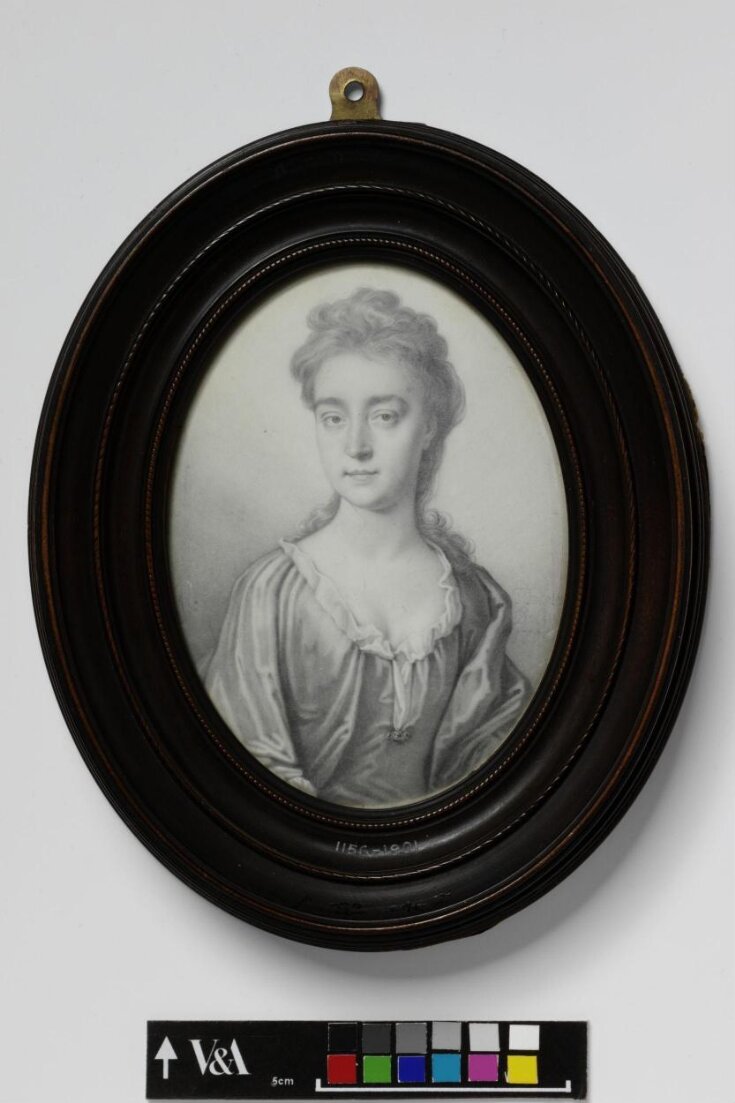

Portrait of a woman known as Sarah Churchill
Portrait Miniature
1709 (drawn)
1709 (drawn)
| Artist/Maker | |
| Place of origin |
In the second half of the 17th century in England there was a fashion for small black and white portraits drawn on vellum – fine animal skin – which is more durable than paper. These were called ‘plumbagos’, meaning black lead, but were usually drawn in graphite, as in this portrait, and sometimes in ink. Plumbagos developed in the Netherlands in the late 16th century within the printing trade. They were a development of evolved from the a printmaker’s original drawings on paper, from which a print would have been engraved. Plumbagos were introduced to England at the restoration of the monarchy in 1660 by printmakers who returned from exile abroad. As the taste for plumbagos became established, artists who were not print-makers also began to produce them. A few artists continued the art of the plumbago into the early 18th century. Almost nothing is known of Thomas Forster, but he was clearly a talented plumbago artist, whose portraits date from between 1690 and 1713.
Object details
| Categories | |
| Object type | |
| Title | Portrait of a woman known as Sarah Churchill (popular title) |
| Materials and techniques | Graphite on vellum |
| Brief description | Portrait miniature of a woman known as 'Sarah Churchill', dated 1709, plumbago on vellum, drawn by Thomas Forster (fl. 1690-1717). |
| Physical description | Plumbago portrait miniature of a woman known as 'Sarah Churchill' |
| Dimensions |
|
| Subject depicted | |
| Summary | In the second half of the 17th century in England there was a fashion for small black and white portraits drawn on vellum – fine animal skin – which is more durable than paper. These were called ‘plumbagos’, meaning black lead, but were usually drawn in graphite, as in this portrait, and sometimes in ink. Plumbagos developed in the Netherlands in the late 16th century within the printing trade. They were a development of evolved from the a printmaker’s original drawings on paper, from which a print would have been engraved. Plumbagos were introduced to England at the restoration of the monarchy in 1660 by printmakers who returned from exile abroad. As the taste for plumbagos became established, artists who were not print-makers also began to produce them. A few artists continued the art of the plumbago into the early 18th century. Almost nothing is known of Thomas Forster, but he was clearly a talented plumbago artist, whose portraits date from between 1690 and 1713. |
| Bibliographic reference | Summary Catalogue of Miniatures in the Victoria and Albert Museum, Emmett Microform, 1981 |
| Collection | |
| Accession number | 1156-1901 |
About this object record
Explore the Collections contains over a million catalogue records, and over half a million images. It is a working database that includes information compiled over the life of the museum. Some of our records may contain offensive and discriminatory language, or reflect outdated ideas, practice and analysis. We are committed to addressing these issues, and to review and update our records accordingly.
You can write to us to suggest improvements to the record.
Suggest feedback
You can write to us to suggest improvements to the record.
Suggest feedback
| Record created | July 11, 2003 |
| Record URL |
Download as: JSONIIIF Manifest
