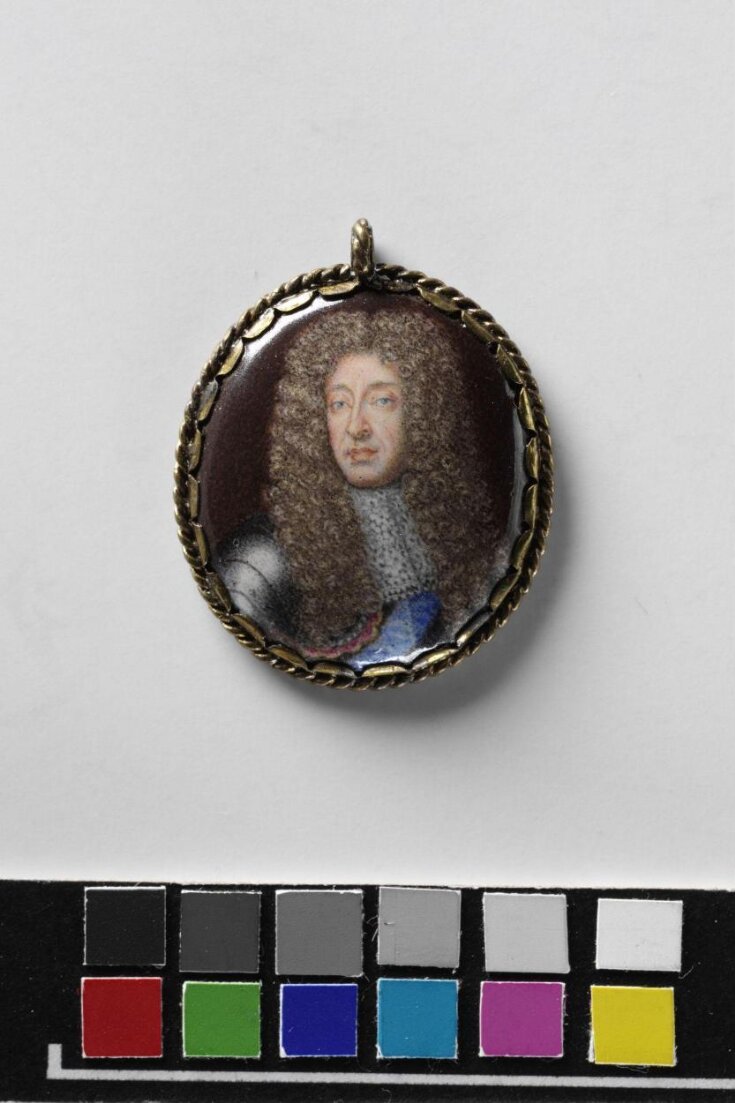

James II
Enamel Miniature
ca. 1685 (painted)
ca. 1685 (painted)
| Artist/Maker | |
| Place of origin |
This portrait is painted in enamel on metal. The advantage of enamel over traditional miniature painting (watercolour painted on vellum or, from about 1700, on ivory) is that it does not fade when exposed to light. The process of painting with enamels is, however, less free than the miniature technique and is fraught with danger. The first colours to be laid on the metal support have to be those needing the highest temperature when firing. More colour is added and the enamel refired, the process ending with the colours needing the lowest temperature. Such labour meant that it was an expensive option.
Enamel was first practised in Britain in the 1630s by the Swiss goldsmith Jean Petitot at the court of Charles I. It was reintroduced around 1680 by a Swede, Charles Boit, although it had remained a hugely popular and fashionable medium in Continental Europe. This enamel of Charles I’s son, James II, was probably not by an English artist. James had become king of Great Britain and Ireland after the death of his brother, Charles II, in 1685, but was devoutly committed to reviving Catholicism in Britain. He was forced to abdicate in the Glorious Revolution of 1688, when the birth of his son, James Edward - later known as the Old Pretender - heightened fears of a Catholic succession to the throne. With the help of Louis XIV of France, James established a court in exile at St Germain near Paris, where he died in 1701. This enamel may have been painted abroad for the use of a loyal supporter in Britain.
Enamel was first practised in Britain in the 1630s by the Swiss goldsmith Jean Petitot at the court of Charles I. It was reintroduced around 1680 by a Swede, Charles Boit, although it had remained a hugely popular and fashionable medium in Continental Europe. This enamel of Charles I’s son, James II, was probably not by an English artist. James had become king of Great Britain and Ireland after the death of his brother, Charles II, in 1685, but was devoutly committed to reviving Catholicism in Britain. He was forced to abdicate in the Glorious Revolution of 1688, when the birth of his son, James Edward - later known as the Old Pretender - heightened fears of a Catholic succession to the throne. With the help of Louis XIV of France, James established a court in exile at St Germain near Paris, where he died in 1701. This enamel may have been painted abroad for the use of a loyal supporter in Britain.
Object details
| Categories | |
| Object type | |
| Title | James II (generic title) |
| Materials and techniques | Enamel on metal |
| Brief description | Miniature portrait of James II. Enamel by an unknown artist, English school, ca.1685. |
| Physical description | Oval portrait miniature of James II. Head and shoulders. turned slightly to left, and wearing armour, wig and neckcloth. |
| Dimensions |
|
| Styles | |
| Credit line | Given by Dr Joan Evans, PSA |
| Object history | This is from the same model of James II by William Craft (late 18th century) reproduced in Helen Farquhar, Portraiture of our Stuart Monarchs…, Part II, 1910 (reprinted from the British Numismatics Journal, VI), perhaps based on the portrait by Kneller of 1684 in the National Portrait Gallery |
| Subjects depicted | |
| Summary | This portrait is painted in enamel on metal. The advantage of enamel over traditional miniature painting (watercolour painted on vellum or, from about 1700, on ivory) is that it does not fade when exposed to light. The process of painting with enamels is, however, less free than the miniature technique and is fraught with danger. The first colours to be laid on the metal support have to be those needing the highest temperature when firing. More colour is added and the enamel refired, the process ending with the colours needing the lowest temperature. Such labour meant that it was an expensive option. Enamel was first practised in Britain in the 1630s by the Swiss goldsmith Jean Petitot at the court of Charles I. It was reintroduced around 1680 by a Swede, Charles Boit, although it had remained a hugely popular and fashionable medium in Continental Europe. This enamel of Charles I’s son, James II, was probably not by an English artist. James had become king of Great Britain and Ireland after the death of his brother, Charles II, in 1685, but was devoutly committed to reviving Catholicism in Britain. He was forced to abdicate in the Glorious Revolution of 1688, when the birth of his son, James Edward - later known as the Old Pretender - heightened fears of a Catholic succession to the throne. With the help of Louis XIV of France, James established a court in exile at St Germain near Paris, where he died in 1701. This enamel may have been painted abroad for the use of a loyal supporter in Britain. |
| Bibliographic reference | Victoria & Albert Museum Department of Prints and Drawings and Department of Paintings, Accessions 1962. London: HMSO, 1964. |
| Collection | |
| Accession number | P.85-1962 |
About this object record
Explore the Collections contains over a million catalogue records, and over half a million images. It is a working database that includes information compiled over the life of the museum. Some of our records may contain offensive and discriminatory language, or reflect outdated ideas, practice and analysis. We are committed to addressing these issues, and to review and update our records accordingly.
You can write to us to suggest improvements to the record.
Suggest feedback
You can write to us to suggest improvements to the record.
Suggest feedback
| Record created | July 11, 2003 |
| Record URL |
Download as: JSONIIIF Manifest
