
Boughton Bed
Bed
1670-1697 (made)
1670-1697 (made)
| Artist/Maker | |
| Place of origin |
This bed typifies the expensive and sumptuous state beds installed in country houses in the late 17th century. Ralph Montagu, the first Duke of Montagu, acquired it between 1678 and 1697 when it was recorded in the newly completed state bedroom of Boughton House, Northamptonshire, which he had inherited in 1684. The bed was the centrepiece of the state bedroom, one of a series of rooms designed to demonstrate the status, wealth and good taste of the owner rather than for living in, following precedents established at the court of Louis XIV. Having spent a period of exile in France, Montagu may have acquired the bed there, or received it as a royal perquisite of office. Early alterations suggest that a bed made in the 1670s may have been updated during the 1690s when he married, and when Boughton, his country house, was completed and received a visit from King William III.
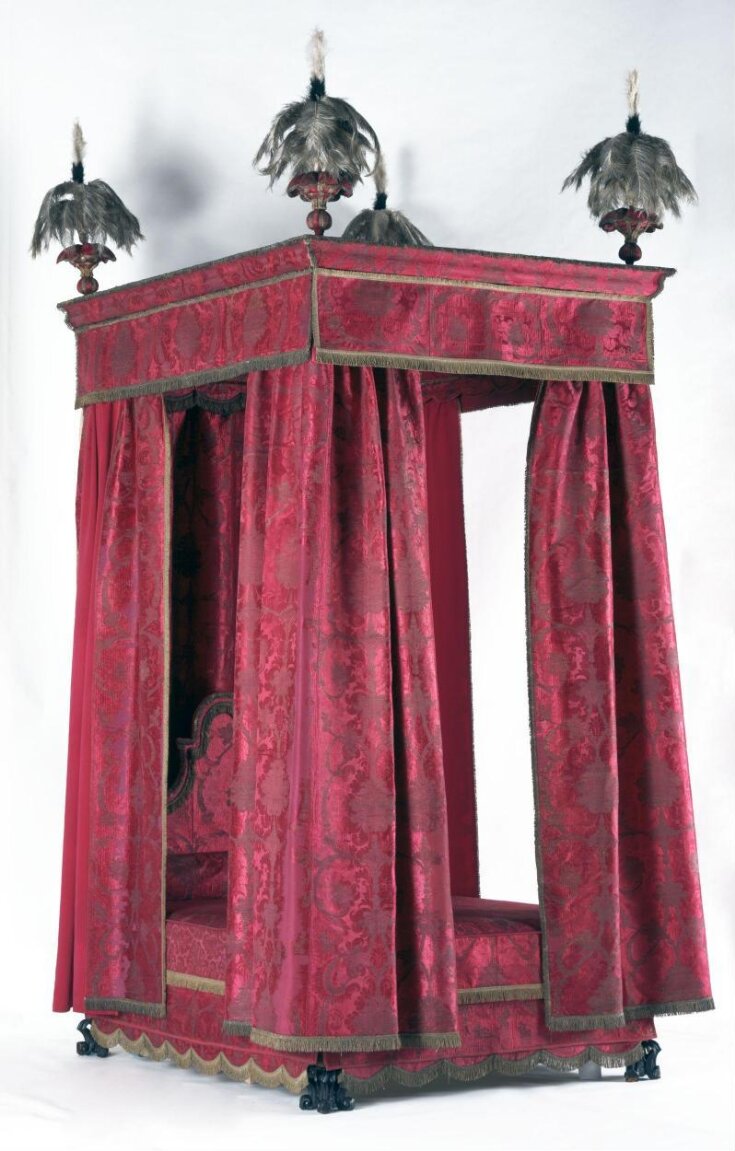
The rich hangings of crimson Italian silk damask brocaded with gold thread entirely cover the plain oak frame, and at each corner of the cornice is a vase-shaped finial made of carved softwood with ostrich feathers. The bed was given to the Victoria and Albert Museum in 1916, but after extensive conservation was returned on long-term loan to Boughton House, Northamptonshire in 2003, where it re-installed in its original setting.
The rich hangings of crimson Italian silk damask brocaded with gold thread entirely cover the plain oak frame, and at each corner of the cornice is a vase-shaped finial made of carved softwood with ostrich feathers. The bed was given to the Victoria and Albert Museum in 1916, but after extensive conservation was returned on long-term loan to Boughton House, Northamptonshire in 2003, where it re-installed in its original setting.
Object details
| Categories | |
| Object type | |
| Parts | This object consists of 68 parts.
|
| Title | Boughton Bed (popular title) |
| Materials and techniques | Silk damask brocaded with gold thread, on a frame of oak and pine, with carved walnut feet painted black and finials of ostrich and egret feathers |
| Brief description | Boughton Bed, English or French, 1670-1690, red silk brocade on an oak frame. |
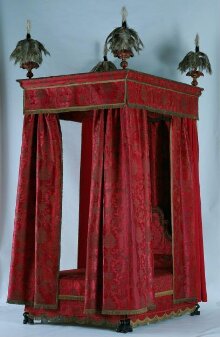
| Physical description | Tall tester bed with an oak frame, rectangular in form, with hangings, linings and covers of Italian crimson silk damask brocaded with gold thread, trimmed with gold braid. The tester is enclosed by flat upper valances, below a curved cornice. At the four corners of the cornice are plumes of grey and white ostrich feathers rising from silk-covered wooden urns. The four feet are carved in openwork with angular scrolls, painted black. The curtains, upper and lower valances and counterpane are trimmed with gold fringing. The flat headboard, with a scrolling top, is lined with matching silk damask and fringing. Behind the headboard is hung a headcloth of matching silk damask. The interior of the tester is domed, the joins trimmed with braid, with four short scalloped inner valances attached to each long side. The outer valances, hung from the lower edge of the cornice, are plain and rectangular, trimmed along the straight lower edge with fringing. The lower valances, attached to the bed rails, are in two parts, a plain rectangular panel, below which hangs a scalloped edging strip attached separately. The curtains have been made into four sections in the 20th century, hanging at each corner and reaching half way down the lower valances. |
| Dimensions |
|
| Style | |
| Credit line | Given by the 8th Duke of Buccleuch |
| Object history | The bed was first recorded at Boughton House, Northamptonshire, in an inventory dated 1697 of the goods of Ralph Montagu. It was made between 1678 and 1697; its exact origin and date of manufacture remain uncertain, owing to an absence of other documentary evidence. Stylistic dating does not provide a clear answer as it has elements of the styles of the 1670s and the 1690s. Ralph Montagu inherited Boughton House, Northamptonshire, from his father the 2nd Lord Montagu in 1684. Montagu spent a period of exile in France but returned on the accession of William III and was reappointed Master of the Royal Wardrobe, a position he had held under Charles II. He then extended the family seat in Northamptonshire in readiness for a royal visit. King William dined at Boughton in October 1695 but the household accounts indicate that the State Apartments were not complete at that time.The King did not sleep at Boughton. The bed was certainly in place in the state bedchamber in1697 when it was described as 'In ye BedChamber A Crimson gold flowerd damask bed gold fring all Round feet coopes & fethers to ye bed & all things belonging as a thick quilt a holond quilt a fether bed & a bolster 2 blankets..' There is no surviving payment for the bed but in June 1705 the leading French upholsterer Francis Lapiere was paid £6.0.0 'for taking a crimson & gold damask bed all to pieces & new making it up again to go to Boughton', suggesting that it was altered in London at this time. The quality of the brocade used for the Boughton bed ensured its survival. It is listed in later inventories of Boughton House. An inventory of 1709 lists the additions by Lapiere including a case rod and curtains. By 1827 the hangings were described as much decayed. The bed was given to the Victoria and Albert Museum in 1916 as 'the old bed in which William III is supposed to have slept'. The bed was displayed at the Museum until the 1970s, when the upholstery received extensive conservation for new galleries planned for the 1980s but these gallery plans were not completed. The hangings were pieced together in a different formation to use the best preserved parts, doing away with the corner 'bonegraces' at the two end posts and forming four large curtains. The bed was again on display for a few years until the mid 1980s. It was then conserved . The bed was displayed with bed slats and a base made by the Museum, new bolster pillows and a mattress from another bed. When the plans for the new British Galleries were made in the late 1990s, discussions started on the re-instatement of the bed at Boughton House. Further conservation work was undertaken between 1999 and 2002 in preparation for the long-term loan to Boughton and it was returned to the State Bedroom there in 2003. For the loan, a new inert base was made to support the bed covers, and the modern bolsters, bed base and slats used in the Museum display were disposed of. The mattress was returned to store. Notes from Registered Papers, file no. 2841/16 3 April 1916 letter, Buccleuch to Cecil Smith offers "the old bed in which William III is supposed to have slept". He suggests that it might not be "of sufficient interest to occupy the large space that it requires…measuring height 14', length 7', width 6'". 4 April 1916 response, Smith accepts the bed stating "it will be of the greatest possible value to the Museum". Further April correspondence puts off collection of the bed until after Buccleuch has left Boughton in July as he "may be saved sundry remarks from members of (his) family". 15 May 1916 minute paper, Cecil Smith reports on a visit from the Duke of Buccleuch who again mentioned giving the William III bed to the Museum. No action is to be taken until he writes to say he is ready to make the gift. 23 August 1916 memo, O Brackett reports that the Duke of Buccleuch has given permission to send for the bedstead at Boughton. 31 August 1916 transit room receipt notes condition "woodwork worm-eaten (especially feet) brocade worn". 31 August 1916 Gift form, lists the bed see attached. 4 September 1916 minute paper, O Brackett reports to the Director that "the feet of the bedstead are much worm-eaten and require treatment, and nearly all the hangings are worn and damaged and will have to be repaired". Arrangements to repair are to be made with the Art Workroom -- it may take a month or two. 4 September 1916 drafter letter to the Duke of Buccleuch conveys the Museum's thanks. "The Bedstead is indeed a most valuable addition to our collection of English furniture and will…..be of very great interest to the public". Historical significance: The late 17th century state bed was symbolic of the wealth and importance of the patron. It was the focal point of the state apartment in country houses, prepared in readiness for a royal visit, and suggested an association with the crown, whether or not they were actually slept in by the monarch. They were hung with the most sumptuous fabric available, trimmed with gold or silver thread. The bed in the State Apartments at Boughton House was the focal point of a sequence of three rooms, each increasing in grandeur. It stood in the Third State Room, or State Bedroom, the walls if which were hung with Mortlake tapestries of the Acts of the Apostles. A set of six chairs were luxuriously upholstered with crimson silk damask similar to the silk of the bed. |
| Historical context | The bed is similar in style to fashionable beds of the 1670s, which had a basic rectangular wooden frame completely enclosed by curatins. These were know in England as 'French beds' because the style originated there. During the 1670s Ralph Montagu was Charles II's ambassador to the French Court and Master of the King's Wardrobe and it is tempting to suggest that he acquired the bed when he was in France in the 1670s. Alternatively he might have acquired it from the King as a royal perquisite, as a result of his royal appointment. It might possibly be one of six beds ordered by Charles II from Louis XIV's upholsterer, Jean Peyrard, in 1672 and 1673. As a comparison, another of these is thought to be the 'King's Bed' now at Knole, Kent, acquired by the Sixth Earl of Dorset as a perquisite in 1694. The Knole bed has very similar ostrich feather plumes arising from urns, a shaped headboard and carved feet. On the other hand some elements of the Boughton bed suggest a later date. Certain baroque features, such as the shaped tester, the scalloped edges to the valances, and the elaborately carved feet, are more typical of the 1690s. Perhaps the bed was made in the 1690s and acquired by Ralph Montagu then, possibly as a perquisite when he was Master of the Wardrobe to William III. Another theory is that Lord Montagu bought the bed in the 1670s, but altered it in the 1690s, increasing the height of the bed by adding feet, raising the headboard and adding a shaped cornice. There is physical evidence of early alterations to the bed. There are early spacers above the feet, and above the tester to raise the height of the cornice. Nails were knocked into the headposts to raise the headboard. The cornice itself might have had a curved section added, as the frame is oak, but the shaped part is pine. The rest of the bedstock is all oak. The lower valances were lengthened at an early date by the addition of scalloped edges. Historical evidence could be consistent with this theory. The State Apartments at Boughton House were completed between 1695 and 1697. The bed may have been altered for the new state bedroom but it is not possible to be certain. The visible alterations could instead have been made when the bed was sent to London in 1705 to be repaired by the French upholsterer Francis Lapiere. The silk fabric cannot be dated precisely owing to absence of dated comparisons. It dates from the period 1670-1700, though on balance it is more likely to dated from the end of that period; The brocaded pattern is 'shadowed by the larger pattern in the silk damask beneath, a technique typical of the 1690s. The silk on the chairs which accompanied the bed is not of the same pattern. |
| Production | The bed was first recorded in 1697 but may have been made in Paris in the 1670s |
| Association | |
| Summary | This bed typifies the expensive and sumptuous state beds installed in country houses in the late 17th century. Ralph Montagu, the first Duke of Montagu, acquired it between 1678 and 1697 when it was recorded in the newly completed state bedroom of Boughton House, Northamptonshire, which he had inherited in 1684. The bed was the centrepiece of the state bedroom, one of a series of rooms designed to demonstrate the status, wealth and good taste of the owner rather than for living in, following precedents established at the court of Louis XIV. Having spent a period of exile in France, Montagu may have acquired the bed there, or received it as a royal perquisite of office. Early alterations suggest that a bed made in the 1670s may have been updated during the 1690s when he married, and when Boughton, his country house, was completed and received a visit from King William III. The rich hangings of crimson Italian silk damask brocaded with gold thread entirely cover the plain oak frame, and at each corner of the cornice is a vase-shaped finial made of carved softwood with ostrich feathers. The bed was given to the Victoria and Albert Museum in 1916, but after extensive conservation was returned on long-term loan to Boughton House, Northamptonshire in 2003, where it re-installed in its original setting. |
| Bibliographic references |
|
| Collection | |
| Accession number | W.67:1 to 34, A to O-1916 |
About this object record
Explore the Collections contains over a million catalogue records, and over half a million images. It is a working database that includes information compiled over the life of the museum. Some of our records may contain offensive and discriminatory language, or reflect outdated ideas, practice and analysis. We are committed to addressing these issues, and to review and update our records accordingly.
You can write to us to suggest improvements to the record.
Suggest feedback
You can write to us to suggest improvements to the record.
Suggest feedback
| Record created | July 7, 2003 |
| Record URL |
Download as: JSONIIIF Manifest
