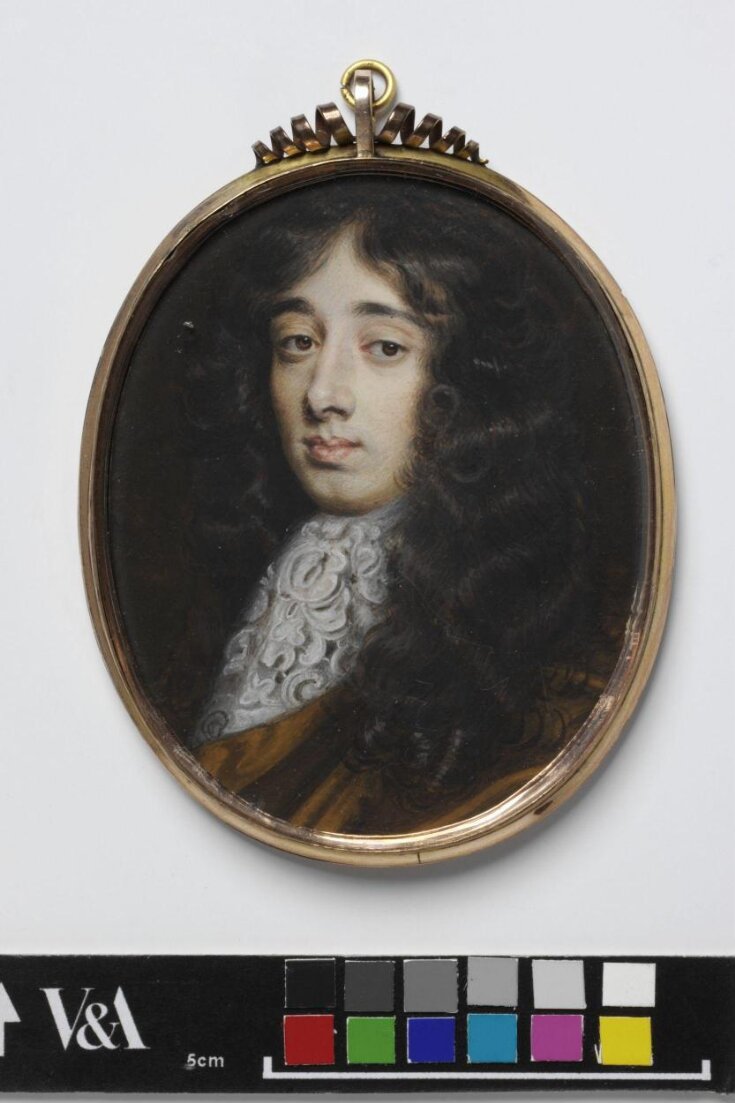

An Unknown Man, possibly James II as Duke of York
Portrait Miniature
ca. 1670 (painted)
ca. 1670 (painted)
| Artist/Maker | |
| Place of origin |
Portrait of a man, turned slightly to left and looking to front; the sitter is wearing a patterned lace neckcloth. Features in brown, sanguine and grey with some blue shadowing, diagonally hatched across the features and heavily impasted with coloured gouache and with white for the lights; touches of white and brownish yellow in the eyes and a white high spot on the tip of the nose; all on a pale carnation ground; hair in brown wash, heavily hatched with darker colour and with the lights in grey gouache, also over the carnation; cravat in white shaded with grey; costume in washes of brown-yellow and dark brown; background a plain dark brown wash; on vellum put down on pasteboard.
Frame: Recent twentieth-century brass (?)-gilt oval locket, the convex back bent over in a sharp arris to meet the straight sides (imitating a seventeenth-century type with closing front cover), which hold the bevelled edge of the flat glass in a bezel; the hanger of flat wire, flanked by two separate spirals in tapering flat wire of four turns.
Frame: Recent twentieth-century brass (?)-gilt oval locket, the convex back bent over in a sharp arris to meet the straight sides (imitating a seventeenth-century type with closing front cover), which hold the bevelled edge of the flat glass in a bezel; the hanger of flat wire, flanked by two separate spirals in tapering flat wire of four turns.
Object details
| Categories | |
| Object type | |
| Title | An Unknown Man, possibly James II as Duke of York (generic title) |
| Materials and techniques | Watercolour on vellum put down on pasteboard |
| Brief description | Portrait miniature of an unknown man, possibly James II as Duke of York, watercolour on vellum by Richard Gibson, ca.1670. |
| Physical description | Portrait of a man, turned slightly to left and looking to front; the sitter is wearing a patterned lace neckcloth. Features in brown, sanguine and grey with some blue shadowing, diagonally hatched across the features and heavily impasted with coloured gouache and with white for the lights; touches of white and brownish yellow in the eyes and a white high spot on the tip of the nose; all on a pale carnation ground; hair in brown wash, heavily hatched with darker colour and with the lights in grey gouache, also over the carnation; cravat in white shaded with grey; costume in washes of brown-yellow and dark brown; background a plain dark brown wash; on vellum put down on pasteboard. Frame: Recent twentieth-century brass (?)-gilt oval locket, the convex back bent over in a sharp arris to meet the straight sides (imitating a seventeenth-century type with closing front cover), which hold the bevelled edge of the flat glass in a bezel; the hanger of flat wire, flanked by two separate spirals in tapering flat wire of four turns. |
| Dimensions |
|
| Content description | Portrait of a man with long hair, wearing a lace neckcloth. |
| Styles | |
| Marks and inscriptions | '37' and 'III' (Inscribed on the back of card) |
| Credit line | Purchased with funds from the Stephenson Bequest |
| Object history | Provenance: Acquired from an unrecorded source by J Pierpont Morgan; sold Christie's 24 June 1935, lot 51 (as Sir Robert Walpole by Lawrence Crosse); bt Frost & Reed on behalf of Mr G H Kemp, on whose death in 1940 the miniature was sold by his executors through Frost & Reed to the Museum; bt with funds from the R H Stephenson Bequest. |
| Subject depicted | |
| Bibliographic reference | Murdoch, John. Seventeenth-century English Miniatures in the collection of the Victoria and Albert Museum. London: The Stationery Office, 1997. |
| Collection | |
| Accession number | P.12-1940 |
About this object record
Explore the Collections contains over a million catalogue records, and over half a million images. It is a working database that includes information compiled over the life of the museum. Some of our records may contain offensive and discriminatory language, or reflect outdated ideas, practice and analysis. We are committed to addressing these issues, and to review and update our records accordingly.
You can write to us to suggest improvements to the record.
Suggest feedback
You can write to us to suggest improvements to the record.
Suggest feedback
| Record created | July 3, 2003 |
| Record URL |
Download as: JSONIIIF Manifest
