Griffin Ewer
Ewer
ca. 1120 (made)
ca. 1120 (made)
| Artist/Maker | |
| Place of origin |
An aquamanile was a jug used both in the home and at church for washing hands ('aqua' means water in Latin and 'manus' hand). These jugs were made from precious metals, base metals or ceramic.
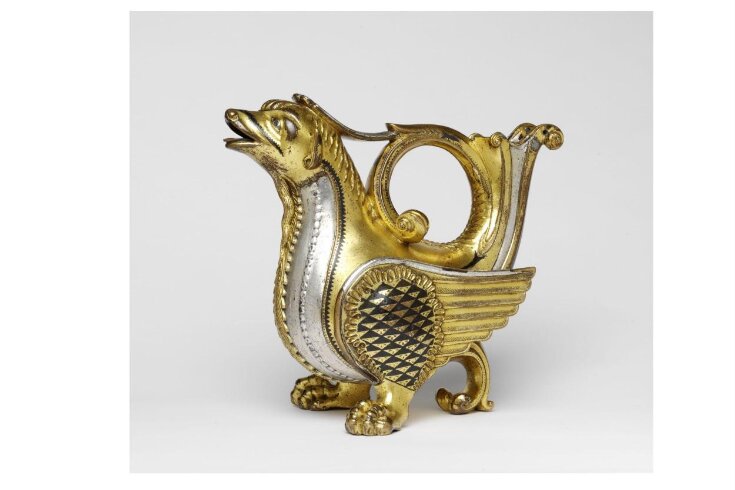
From the 12th century onwards aquamaniles depicting lions, horses, dragons and other beasts were very popular. This example represents a griffin, a fantastical creature with the head and claws of a lion and the wings of an eagle. In medieval times griffins were considered to be noble creatures, who acted as guardians and protectors.
From the 12th century onwards aquamaniles depicting lions, horses, dragons and other beasts were very popular. This example represents a griffin, a fantastical creature with the head and claws of a lion and the wings of an eagle. In medieval times griffins were considered to be noble creatures, who acted as guardians and protectors.
Object details
| Categories | |
| Object type | |
| Title | Griffin Ewer (popular title) |
| Materials and techniques | Bronze, gilt, cast and chased; silver, niello |
| Brief description | Griffin aquamanile, cast copper inlaid with sheet silver and niello |
| Physical description | A Griffin Ewer, gilt bronze, cast and chased, decorated with silver and niello. In the form of a Griffin, resting upon two feet with an extra decorative support underneath his tail. The beast faces forward with wings folded. A design resembling a heraldic shield adorns each wing. The ewer would have been filled through the hole in the creature's tail (the lid is now missing) and poured through the mouth of the beast. The griffin is a fantastical creature that combines the head and claws of a lion with the wings of an eagle. The western form of the griffin was influenced by the eastern senmurvs, images of which were woven into ancient Sassanian and Byzantine sillks imported into Europe. In antiquity the griffin held a positive image as a protector and guardian. This continued into the Middle Ages particularly in Romanesque art, where sculptural forms of the griffin act as guardians on the facades of churches and cathedrals. The image of the griffin appeared less frequently in Gothic art. |
| Dimensions |
|
| Object history | Middle Ages Exhibition R.F.2002/903 Canossa Exhibition RF.2005/481 Purchase Historical significance: Only a few dozen aquamaniles survive: this is one of the oldest and most technically sophisticated, the cast copper alloy inlaid with sheet silver and niello (an ancient and skilled technique which goes back at least to Ancient Egypt). A companion to this piece is in the Kunsthistoriches Museum in Vienna. It is in the shape of a dragon and has very similar technical finish. Since its acquisition this piece has been considered an important work of medieval art. Sir Matthew Digby Wyatt, nineteenth century Art Refereree, architect and journalist wrote "so fine and historical a piece of metalwork seldom occurs for sale...designed and executed by a master of his craft (with) admirable hardiesse." This ewer's Viennese counterpart inspired nineteenth century versions in silver and ceramic. It also influenced other nineteenth century objects. A Claret Jug (M.20-1986) made in 1877 is believed to have a form derived from a Vienna Porcelain Chocolate pot (eighteenth century) which in turn was derived from the aquamanile in the Kunstshistoriches Museum. There is no evidence however, that the V&A ewer ever influenced nineteenth century art. |
| Historical context | Ewers, often known as aquamanilia (from the Latin, aqua= water, manus=hand), are vessel used for washing hands. They were used in the church, during the mass, or in a domestic context, before and after meals. From the 12th century onwards ewers depicting creatures such as lions, horses, unicorns, dragons and birds were very popular. They were made in precious metals, base metals and ceramics. |
| Production | Made in Germany, or Mosan (the land of the Meuse River valley) |
| Subject depicted | |
| Summary | An aquamanile was a jug used both in the home and at church for washing hands ('aqua' means water in Latin and 'manus' hand). These jugs were made from precious metals, base metals or ceramic. From the 12th century onwards aquamaniles depicting lions, horses, dragons and other beasts were very popular. This example represents a griffin, a fantastical creature with the head and claws of a lion and the wings of an eagle. In medieval times griffins were considered to be noble creatures, who acted as guardians and protectors. |
| Associated objects | |
| Bibliographic references |
|
| Collection | |
| Accession number | 1471-1870 |
About this object record
Explore the Collections contains over a million catalogue records, and over half a million images. It is a working database that includes information compiled over the life of the museum. Some of our records may contain offensive and discriminatory language, or reflect outdated ideas, practice and analysis. We are committed to addressing these issues, and to review and update our records accordingly.
You can write to us to suggest improvements to the record.
Suggest feedback
You can write to us to suggest improvements to the record.
Suggest feedback
| Record created | July 2, 2003 |
| Record URL |
Download as: JSONIIIF Manifest
