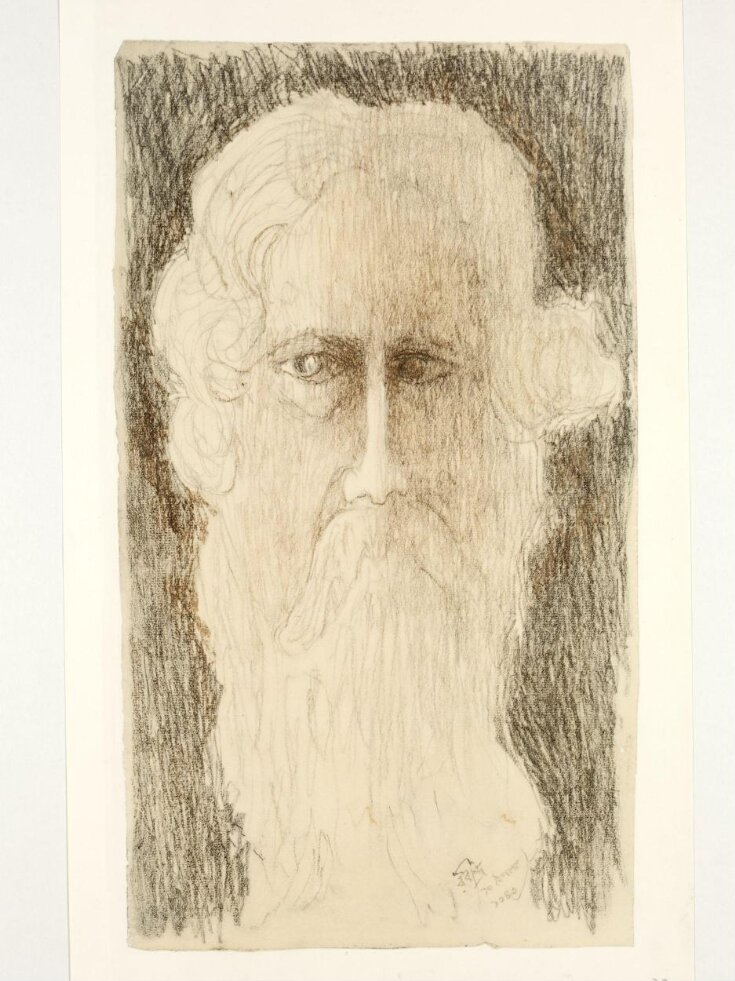

Self portrait
Lithograph
ca. 1930 - ca. 1940 (made)
ca. 1930 - ca. 1940 (made)
| Artist/Maker | |
| Place of origin |
Rabindranath Tagore (1861-1941) was a Bengali polymath, being a poet, playwright, novelist, composer and visual artist. His work reshaped Bengali literature and music during the late nineteenth and early twentieth centuries and he was awarded the Nobel Prize in Literature in 1913.
Rabindranath's earliest visual work appeared in his manuscripts of poems (eg. Purabi) and comprised of doodles, scribbles and erasures made out of unwanted words and lines. Towards the end of his career, Tagore aged 67, striving to create a universally accessible art, took up painting more consistently. Around 1928, the artist made thousands of sketches and drawings using brush, pencil and pen. The artist developed a style characterised by simple bold forms and a rhythmic quality. The subjects depicted often involved animals, figures and statuesque women.
This painting depicts the full-face, self-portrait of the bearded artist. The unworked background and the enhanced contour push the figure out from the ground. The flatness of the figure is enhanced by the lack of colour and the use of rough pencil lines.
Rabindranath's earliest visual work appeared in his manuscripts of poems (eg. Purabi) and comprised of doodles, scribbles and erasures made out of unwanted words and lines. Towards the end of his career, Tagore aged 67, striving to create a universally accessible art, took up painting more consistently. Around 1928, the artist made thousands of sketches and drawings using brush, pencil and pen. The artist developed a style characterised by simple bold forms and a rhythmic quality. The subjects depicted often involved animals, figures and statuesque women.
This painting depicts the full-face, self-portrait of the bearded artist. The unworked background and the enhanced contour push the figure out from the ground. The flatness of the figure is enhanced by the lack of colour and the use of rough pencil lines.
Delve deeper
Discover more about this object

Object details
| Categories | |
| Object type | |
| Title | Self portrait (generic title) |
| Materials and techniques | Reproduced, printed in ink on paper |
| Brief description | Lithograph, reproduction of drawing, self portrait, by Rabindranath Tagore, inks on paper, Kolkata, ca. 1930-1940 |
| Physical description | Reproduction of crayon and pencil drawing, printed in inks on paper, the full-face, self-portrait of the bearded artist. The unworked background and the enhanced contour push the figure out from the ground. The flatness of the figure is enhanced by the lack of colour and the use of rough pencil lines. |
| Dimensions |
|
| Content description | Self portrait of the artist. |
| Marks and inscriptions | (Signed in Bengali.)
|
| Credit line | Given by B. Baer Esq., 1961. |
| Object history | RF No: 61/1768. Given by B. Baer. The reproduction made by Ganymed Press, was commissioned by the Government of India for the 'Poet's Pictures: The Drawings of Rabindranath Tagore' exhibition held at the Commonwealth Institute from 5-28 May 1961 in connection with the centenary celebration of Tagore's birth in May 1861. This is one of a set of 40 reproductions given to the V&A by the Ganymed Press in return for mouting and framing them for the above exhibition. The catalogue for the exhibition is held in the RFs. The last page of the catalogue gives a list of the owners of the original paintings from which the reproductions were made. |
| Historical context | Rabindranath Tagore (1861-1941) was a Bengali polymath, being a poet, visual artist, playwright, novelist and composer. His work reshaped Bengali literature and music during the late nineteenth and early twentieth centuries. In 1913, he won the Nobel Prize in Literature and was knighted by the British Crown in 1915. Rabindranath was born in Calcutta and grew up into a family whose exceptional creativity spearheaded the city's cultural scene. In 1901, he set up the Santiniketan School (later known as Visva Bharati University) on the Birbhum family countryside lands (outside Calcutta). The institution, conceived as an alternative to the educational system set up by the British, was modelled after the forest schools of ancient India. In 1919, Rabindranath founded the art wing Kala Bhavan at Santiniketan and invited the artist Nandalal Bose to paint frescos on the walls. Rabindranath was involved with the Indian independence movement for independence but maintained throughout, the role of the enlightened poet who champions the universality of artistic expression. His earliest visual work appeared in his manuscripts of poems (eg. Purabi) and comprised of doodles, scribbles and erasures made out of unwanted words and lines. Towards the end of his career, aged 67, striving to create a universally accessible art, Rabindranath took up painting more consistently. In 1924 he travelled to China and Japan with Nandalal Bose and experimented with brush and wash techniques. The artist developed a style characterised by simple bold forms and a rhythmic quality. The subjects depicted often involved animals, figures and statuesque women.Around 1928, Rabindranath made thousands of sketches and drawings using brush, pencil and pen. The artist’s work has been exhibited in India and internationally. |
| Subjects depicted | |
| Summary | Rabindranath Tagore (1861-1941) was a Bengali polymath, being a poet, playwright, novelist, composer and visual artist. His work reshaped Bengali literature and music during the late nineteenth and early twentieth centuries and he was awarded the Nobel Prize in Literature in 1913. Rabindranath's earliest visual work appeared in his manuscripts of poems (eg. Purabi) and comprised of doodles, scribbles and erasures made out of unwanted words and lines. Towards the end of his career, Tagore aged 67, striving to create a universally accessible art, took up painting more consistently. Around 1928, the artist made thousands of sketches and drawings using brush, pencil and pen. The artist developed a style characterised by simple bold forms and a rhythmic quality. The subjects depicted often involved animals, figures and statuesque women. This painting depicts the full-face, self-portrait of the bearded artist. The unworked background and the enhanced contour push the figure out from the ground. The flatness of the figure is enhanced by the lack of colour and the use of rough pencil lines. |
| Bibliographic references |
|
| Collection | |
| Accession number | IS.94-1961 |
About this object record
Explore the Collections contains over a million catalogue records, and over half a million images. It is a working database that includes information compiled over the life of the museum. Some of our records may contain offensive and discriminatory language, or reflect outdated ideas, practice and analysis. We are committed to addressing these issues, and to review and update our records accordingly.
You can write to us to suggest improvements to the record.
Suggest feedback
You can write to us to suggest improvements to the record.
Suggest feedback
| Record created | July 1, 2003 |
| Record URL |
Download as: JSONIIIF Manifest
