Lamp
mid 13th century (made)
| Artist/Maker | |
| Place of origin |
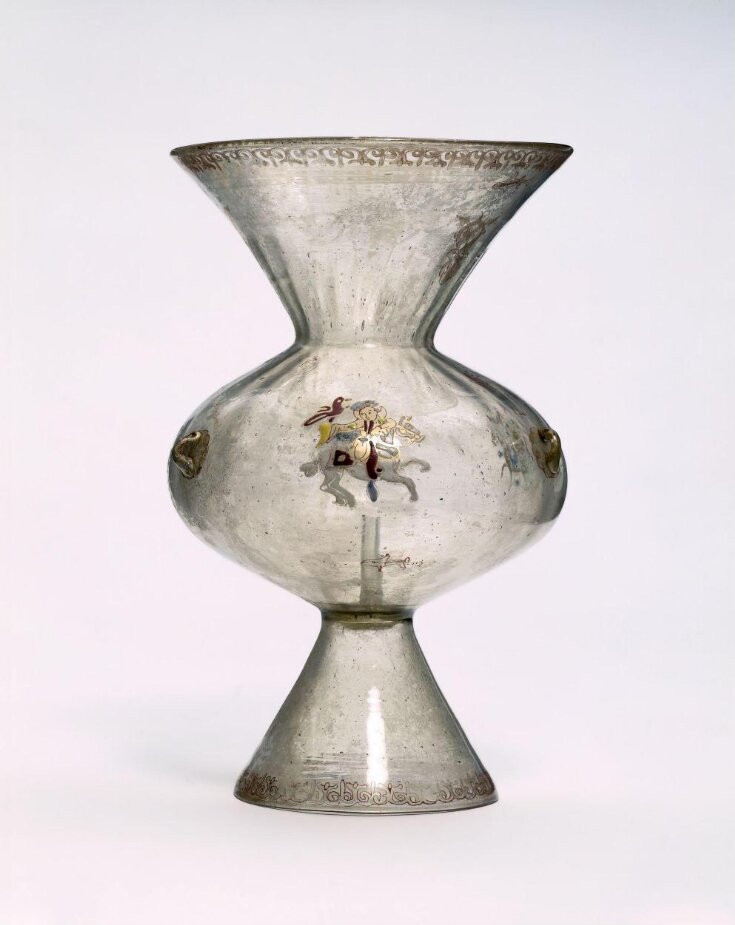
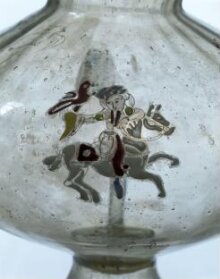
This glass lamp is thought to have been made in Syria in around 1250. It is the only known example of an Islamic lamp with figures in the gilded and enamelled decoration. This indicates that it was made for use in a secular context, since figures were never used on objects made for mosques and other religious buildings. The lamp has a boldly waisted body, rounded below and flaring above. To this were added a high foot, three suspension loops and, at the bottom of the reservoir, a tubular wick-holder. The body was blown in a mould, giving it a gently ribbed exterior. The sparse decoration consists principally of a trio of mounted falconers, each set between pairs of suspension hooks.
Object details
| Categories | |
| Object type | |
| Materials and techniques | Glass, gilded and enamelled |
| Brief description | Glass lamp with three falconers painted in enamel, Egypt or Syria, around 1250. |
| Physical description | Footed lamp of yellowish grayish colourless glass, moulded in a pattern of vertical ribs with a globular body and flared neck. Decorated on three sides with horsemen holding falcons in red, white and yellow enamels. Gilded floriated band around the neck and foot outlined in red and a fish and a bird outlined in red appear on the body of the lamp. Three small suspension rings are attached to the sides of the lamp, the areas around them gilded and outlined in red. A narrow tube for the wick is attached to the interior at the bottom of the lamp. Said to have been found in a Christian monastery in Syria. The use of figural decoration showes the pleasures of hunting with hawks. This indicates that the lamp was made for secular rather than religious use. |
| Dimensions |
|
| Style | |
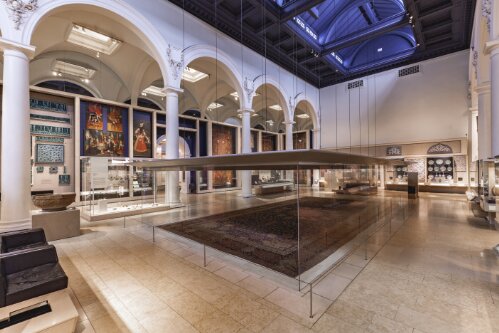
| Gallery label | Jameel Gallery
Glass Lamps
Egypt or Syria
About 1250 and 1342–5
The lamp on the left is decorated with three mounted falconers. The presence of human figures indicates that it was made for a domestic, non-religious setting. The lamp on the right has no figures. It was probably commissioned for a religious institution by a Mamluk official called Kafur al-Rumi, who is named in the inscriptions.
Glass, enamelled and gilded
Museum nos. 330-1900; 6820-1860(Jameel Gallery) |
| Object history | Said to have been found in a Christian monastery in Syria but most likely was commissioned by a wealthy Muslim, either for his home or for a hunting lodge. |
| Historical context | By the thirteenth century, glass lamps had attained their deinitive shape, characterized by a nearly globular body, a long flared neck and an attached flared foot. For three centuries prior, they had been vase or beaker shaped. This is the only known lamp to feature figural decoration, other examples of gilded and enamelled lamps were used to light mosques and as such feature vegetal and geometric motifs. Ribs are the only molded pattern ever used on enamelled vessels (see Kenesson in Ward, Gilded and Enamelled Glass of the Near and Middle East, 1998, pl. 12.4 for an example in Washington). The shallowness of the ribs on this vessel suggests the lamp was reblown or optic blown outside the mold. |
| Subjects depicted | |
| Summary | This glass lamp is thought to have been made in Syria in around 1250. It is the only known example of an Islamic lamp with figures in the gilded and enamelled decoration. This indicates that it was made for use in a secular context, since figures were never used on objects made for mosques and other religious buildings. The lamp has a boldly waisted body, rounded below and flaring above. To this were added a high foot, three suspension loops and, at the bottom of the reservoir, a tubular wick-holder. The body was blown in a mould, giving it a gently ribbed exterior. The sparse decoration consists principally of a trio of mounted falconers, each set between pairs of suspension hooks. |
| Bibliographic references |
|
| Collection | |
| Accession number | 330-1900 |
About this object record
Explore the Collections contains over a million catalogue records, and over half a million images. It is a working database that includes information compiled over the life of the museum. Some of our records may contain offensive and discriminatory language, or reflect outdated ideas, practice and analysis. We are committed to addressing these issues, and to review and update our records accordingly.
You can write to us to suggest improvements to the record.
Suggest feedback
You can write to us to suggest improvements to the record.
Suggest feedback
| Record created | December 13, 1997 |
| Record URL |
Download as: JSONIIIF Manifest
