This object, or the text that describes it, is deemed offensive and discriminatory. We are committed to improving our records, and work is ongoing.
Jim Crow
Figure
ca. 1821-30 (made)
ca. 1821-30 (made)
| Artist/Maker | |
| Place of origin |
The spread of the Industrial Revolution throughout Britain in the early 19th century created a new middle class with money to spend on decorating their homes. Fine porcelain figures from the Meissen factory in Germany had been popular but expensive during the 18th century, and in the following century the Potteries in Staffordshire found a market for their cheaper earthenware figures. In a period when literacy levels were low and news hard to come by outside the main towns and cities, the figures became a form of visual literacy depicting key personalities of the day from politics, royalty, sport, literature and entertainment.
This figure represents ‘Jim Crow’, a character created by Thomas Dartmouth ‘Daddy’ Rice, the white American entertainer and first populariser of ‘blackface’ performance. 'Jim Crow' was a racist stage depiction of a poor and uneducated rural black man, first performed by Rice in 1828. The character and the associated song ‘Jump Jim Crow’ found instant popularity and Rice toured America and overseas, including a performance at the Surrey Theatre in 1836. Later the character’s name gained notoriety through its association with state and local laws enacted in the Southern states of the United States between 1876 and 1964 which restricted the access of African Americans to public facilties.
This figure represents ‘Jim Crow’, a character created by Thomas Dartmouth ‘Daddy’ Rice, the white American entertainer and first populariser of ‘blackface’ performance. 'Jim Crow' was a racist stage depiction of a poor and uneducated rural black man, first performed by Rice in 1828. The character and the associated song ‘Jump Jim Crow’ found instant popularity and Rice toured America and overseas, including a performance at the Surrey Theatre in 1836. Later the character’s name gained notoriety through its association with state and local laws enacted in the Southern states of the United States between 1876 and 1964 which restricted the access of African Americans to public facilties.
Object details
| Categories | |
| Object type | |
| Title | Jim Crow (manufacturer's title) |
| Materials and techniques | Lead-glazed earthenware painted with enamels |
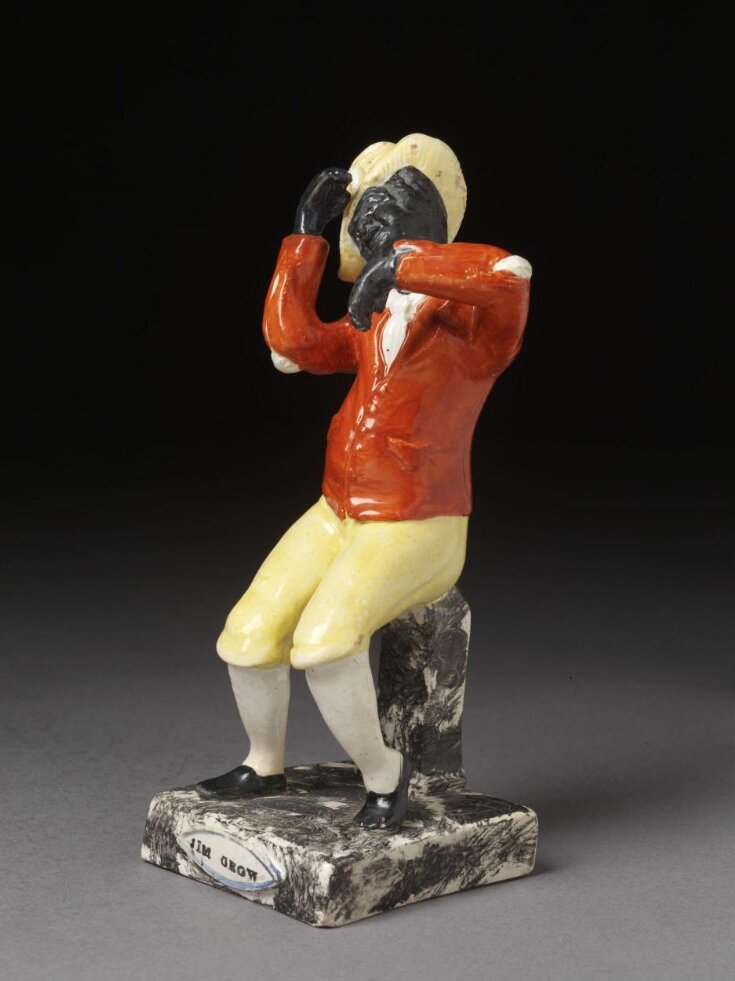
| Brief description | Figure of Jim Crow in lead-glazed earthenware painted with enamel, Staffordshire, about 1821-30. |
| Physical description | Figure of Jim Crow in lead-glazed earthenware painted with enamel. He wears tattered clothes, is slightly seated on a post and his arms in a jerky gesture. His left arm is bent and raised level with his shoulder, and his right hand is raised to his forehead. He wears a yellow hat, red-orange buttoned jacket, yellow leggings, white socks and black shoes. On a square plinth. |
| Dimensions |
|
| Marks and inscriptions | 'JIM CROW' (Applied to front of base) |
| Credit line | Purchased through the Julie and Robert Breckman Staffordshire Fund |
| Historical context | This figure represents ‘Jim Crow’, a character created by Thomas Dartmouth ‘Daddy’ Rice, the white American entertainer and first populariser of ‘blackface’ performance. Jim Crow was a racist stage depiction of a poor and uneducated rural black man, first performed by Rice in 1828. The character and the associated song ‘Jump Jim Crow’ found instant popularity and Rice toured America and overseas, including a performance at the Surrey Theatre in 1836. Later the character’s name gained notoriety through its association with state and local laws enacted in the Southern and border states of the United States between 1876 and 1964 which restricted the access of African Americans to public facilties. |
| Subjects depicted | |
| Association | |
| Summary | The spread of the Industrial Revolution throughout Britain in the early 19th century created a new middle class with money to spend on decorating their homes. Fine porcelain figures from the Meissen factory in Germany had been popular but expensive during the 18th century, and in the following century the Potteries in Staffordshire found a market for their cheaper earthenware figures. In a period when literacy levels were low and news hard to come by outside the main towns and cities, the figures became a form of visual literacy depicting key personalities of the day from politics, royalty, sport, literature and entertainment. This figure represents ‘Jim Crow’, a character created by Thomas Dartmouth ‘Daddy’ Rice, the white American entertainer and first populariser of ‘blackface’ performance. 'Jim Crow' was a racist stage depiction of a poor and uneducated rural black man, first performed by Rice in 1828. The character and the associated song ‘Jump Jim Crow’ found instant popularity and Rice toured America and overseas, including a performance at the Surrey Theatre in 1836. Later the character’s name gained notoriety through its association with state and local laws enacted in the Southern states of the United States between 1876 and 1964 which restricted the access of African Americans to public facilties. |
| Collection | |
| Accession number | C.39-2002 |
About this object record
Explore the Collections contains over a million catalogue records, and over half a million images. It is a working database that includes information compiled over the life of the museum. Some of our records may contain offensive and discriminatory language, or reflect outdated ideas, practice and analysis. We are committed to addressing these issues, and to review and update our records accordingly.
You can write to us to suggest improvements to the record.
Suggest feedback
You can write to us to suggest improvements to the record.
Suggest feedback
| Record created | June 20, 2003 |
| Record URL |
Download as: JSONIIIF Manifest
