Spice Box
15th century (made)
| Artist/Maker | |
| Place of origin |
This spice container was used in Jewish worship, during the Havdalah ceremony that marks the end of the Sabbath, the holy day of rest. The spices are blessed and the box is passed around for all to smell. After the ceremony, the new week starts.
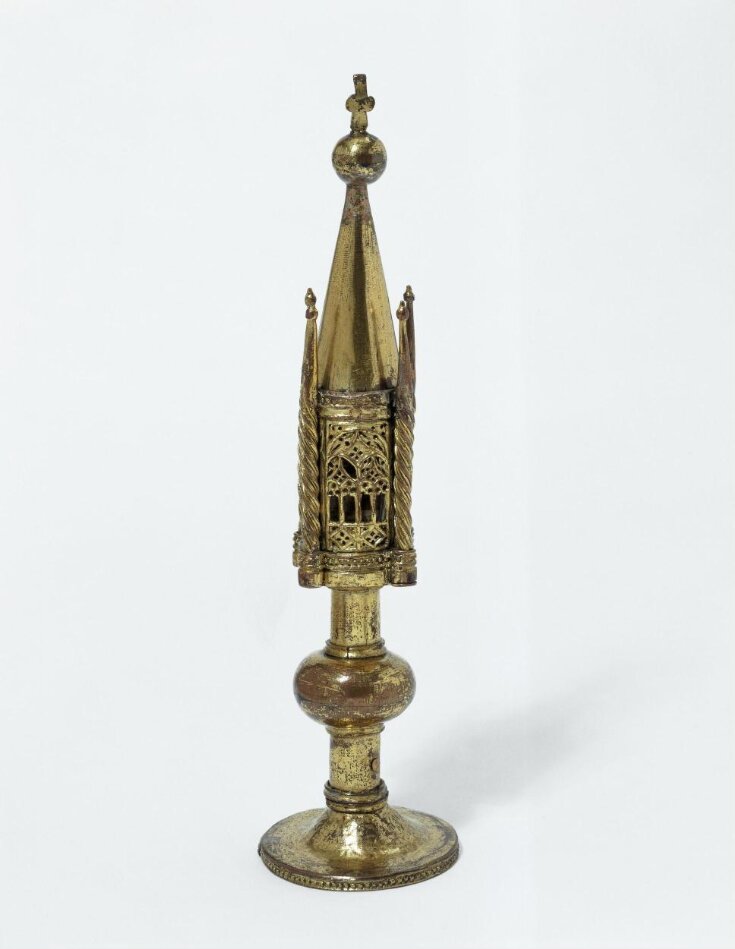
The container is unusual in that at some time it was used in Christian worship as a reliquary. A small cross was attached to top and a relic placed inside the holder, sealed in red wax. The wax is just visible through the tracery window.
The container is unusual in that at some time it was used in Christian worship as a reliquary. A small cross was attached to top and a relic placed inside the holder, sealed in red wax. The wax is just visible through the tracery window.
Object details
| Categories | |
| Object type | |
| Parts | This object consists of 2 parts.
|
| Materials and techniques | Gilt copper |
| Brief description | Judaica. North Italian; copper-gilt, late 15th century Spice box. Judaica. North Italian, copper-gilt, late 15th century |
| Physical description | Copper gilt spice box. The tower is cylindrical with four elaborately pierced tracery windows, seperated by twisted columns ending in spires. The conical spire-like cover is surmounted by an orb with a crudely formed cross. The stem is cylindrical with a ball-knop and spreading foot. |
| Dimensions |
|
| Gallery label | Spice Container
This spice container was used in Jewish worship, during the Havdalah ceremony that marks the end of the Sabbath, the holy day of rest. The spices are blessed and the box is passed around for all to smell. After the ceremony, the new week starts.
There are different interpretations of the meaning of the spices. They may symbolise the fragrance of the Sabbath, which is left behind when the Sabbath ends.
The container is unusual in that at some time it was used in Christian worship as a reliquary. A small cross was attached to top and a relic placed inside the holder, sealed in red wax. The wax is just visible through the tracery window.
Northern Italy, 1400-1500;
copper gilt
Museum no. M.40-1951(22/11/2005) |
| Credit line | Given by Dr W.L. Hildburgh |
| Object history | Hildburgh Gift (ex Hildburgh loan 1192) Jews of Europe Exhibition RF.2003/597 |
| Historical context | Jewish Worship Judaism is the oldest religion in the world to worship the one God.World Jewry has three main groups: Sephardic, Askenazic and Mizrahi (the Jews who never left the Middle East). All are bound together by a common history and their adherence to the Torah (the first five books of the Hebrew Bible) and the Talmud (a compendium of rabbinic law and lore). Jewish religious traditions and rituals centre on the home, the community and the synagogue. Central to Judaism is the observance of the Sabbath. This is a holy day, set apart from the rest of the working week. It begins one hour before sunset on Friday and ends on Saturday evening when three stars can be seen in the night sky. The Jewish year revolves around a number of festivals, such as Passover. These originated in ancient times and embody multiple layers of meaning, from agricultural festivals to historical events. |
| Summary | This spice container was used in Jewish worship, during the Havdalah ceremony that marks the end of the Sabbath, the holy day of rest. The spices are blessed and the box is passed around for all to smell. After the ceremony, the new week starts. The container is unusual in that at some time it was used in Christian worship as a reliquary. A small cross was attached to top and a relic placed inside the holder, sealed in red wax. The wax is just visible through the tracery window. |
| Bibliographic reference | Keen, Michael. Jewish Ritual Art in the Victoria and Albert Museum. London: HMSO, 1991. 116 p., ill. ISBN 0112904491. |
| Collection | |
| Accession number | M.40&:1-1951 |
About this object record
Explore the Collections contains over a million catalogue records, and over half a million images. It is a working database that includes information compiled over the life of the museum. Some of our records may contain offensive and discriminatory language, or reflect outdated ideas, practice and analysis. We are committed to addressing these issues, and to review and update our records accordingly.
You can write to us to suggest improvements to the record.
Suggest feedback
You can write to us to suggest improvements to the record.
Suggest feedback
| Record created | June 20, 2003 |
| Record URL |
Download as: JSONIIIF Manifest
