The Shepherdess
Oil Painting
1850-1852 (painted)
1850-1852 (painted)
| Artist/Maker | |
| Place of origin |
Jean-François Millet (1814-1875) was born in Normandy and first trained with a local portrait painter, Bon Du Mouchel (1807-1846), and later in Cherbourg with Lucien-Théophile Langlois (1803-1845), a pupil of Antoine-Jean Gros (1771-1835). In Paris, he then entered the atelier of the history painter Paul Delaroche (1797-1856). He first specialised in portraiture and then moved towards the naturalistic style with peasant scenes for which he became best known.
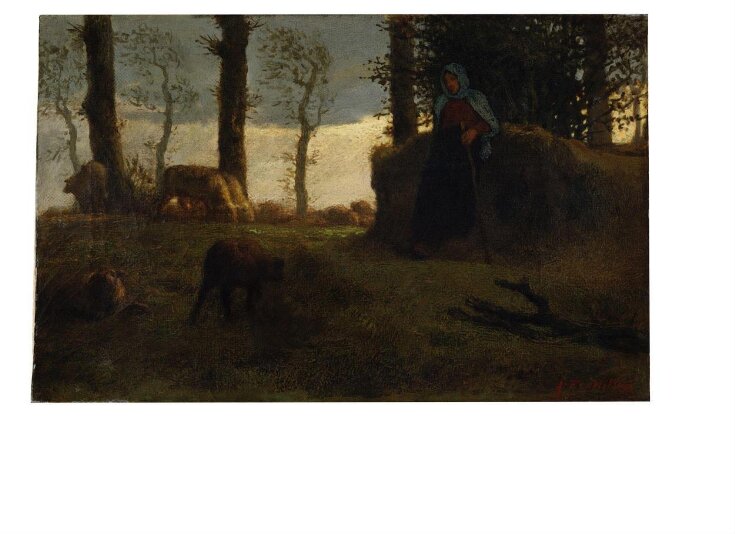
This painting is a fine example of Millet's early output. It depicts a shepherdess looking after her flock, a recurrent subject matter in the artist's oeuvre. Although he also executed a number of portraits, Millet is best known for his scene of the contemporary rural life often interpreted as a reaction against the industrial revolution and the rural depopulation which started as soon as the 1840s. His free brushwork made him one of the most authoritative exponents of the Barbizon school.
This painting is a fine example of Millet's early output. It depicts a shepherdess looking after her flock, a recurrent subject matter in the artist's oeuvre. Although he also executed a number of portraits, Millet is best known for his scene of the contemporary rural life often interpreted as a reaction against the industrial revolution and the rural depopulation which started as soon as the 1840s. His free brushwork made him one of the most authoritative exponents of the Barbizon school.
Object details
| Categories | |
| Object type | |
| Title | The Shepherdess |
| Materials and techniques | oil on canvas |
| Brief description | Oil painting, 'The Shepherdess', Jean-François Millet, 1850-1852 |
| Physical description | A shepherdess, leaning against a haystack, is looking after her flock; a luminous plain behind trees in the left background. |
| Dimensions |
|
| Styles | |
| Marks and inscriptions |
|
| Credit line | Bequeathed by Constantine Alexander Ionides |
| Object history | Millet studio sale, Paris, 10-11 May Paris 1875, lot 6; sold for 3,300 francs; purchased by Ionides for £800 before 1881; bequeathed to the Museum in 1900. At some point the painting may have passed through the hands of the French dealer Adolphe Goupil, see his label on the back. Historical significance: This painting is a fine example of Millet's early output. It depicts a shepherdess leaning against a haystack and watching after her flock. It was probably painted in the early 1850s (1850-1852) and displays a broad, fluid brushwork characteristic of Millet painterly technique. Millet is best known for his representations of the contemporary rural life and among these, the topic of the shepherdess looking after her flock recurs throughout the 1850s and 1860s (see for instance Shepherdess in the Baltimore Museum of Art; The Young Shepherdess in the Musée d'Orsay, Paris). There is a preparatory drawing for this precise composition in the Museum of Fine Arts, Boston (Inv. 76.438 and lot 126 in the Millet sale). The drawing as well as the painting focuses on the rendering of light through the trees' trunks on the left background while the right half of the composition is left in the shadow. This backlighting effect would become a recurrent compositional formula in Millet's oeuvre. A number of works would be executed following this technique by gradually increasing the contrast between light and shade such as in his masterpiece Angelus, Musée d'Orsay, Paris, executed shortly after between 1857 and 1859. |
| Historical context | 19th-century French art is marked by a succession of movements based on a more or less close relationship with nature. At the beginning of the century, Romantic artists were fascinated by nature they interpreted as a mirror of the mind. They investigated human nature and personality, the folk culture, the national and ethnic origins, the medieval era, the exotic, the remote, the mysterious and the occult. This movement was heralded in France by such painter as Eugène Delacroix (1798-1863). In its opposition to academic art and its demand for a modern style Realism continued the aims of the Romantics. They assumed that reality could be perceived without distortion or idealization, and sought after a mean to combine the perception of the individual with objectivity. This reaction in French painting against the Grand Manner is well represented by Gustave Courbet (1819-1877) who wrote a 'Manifesto of Realism', entitled Le Réalisme published in Paris in 1855. These ideas were challenged by the group of the Barbizon painters, who formed a recognizable school from the early 1830s to the 1870s and developed a free, broad and rough technique. They were mainly concerned by landscape painting and the rendering of light. The works of Narcisse Virgile Diaz de la Peña (1807-1876), Jules Dupré (1811-1889), Théodore Rousseau (1812-1867), Constant Troyon (1810-1865) and Jean-François Millet (1814-1875) anticipate somehow the plein-air landscapes of the Impressionists. |
| Subjects depicted | |
| Summary | Jean-François Millet (1814-1875) was born in Normandy and first trained with a local portrait painter, Bon Du Mouchel (1807-1846), and later in Cherbourg with Lucien-Théophile Langlois (1803-1845), a pupil of Antoine-Jean Gros (1771-1835). In Paris, he then entered the atelier of the history painter Paul Delaroche (1797-1856). He first specialised in portraiture and then moved towards the naturalistic style with peasant scenes for which he became best known. This painting is a fine example of Millet's early output. It depicts a shepherdess looking after her flock, a recurrent subject matter in the artist's oeuvre. Although he also executed a number of portraits, Millet is best known for his scene of the contemporary rural life often interpreted as a reaction against the industrial revolution and the rural depopulation which started as soon as the 1840s. His free brushwork made him one of the most authoritative exponents of the Barbizon school. |
| Bibliographic references |
|
| Collection | |
| Accession number | CAI.48 |
About this object record
Explore the Collections contains over a million catalogue records, and over half a million images. It is a working database that includes information compiled over the life of the museum. Some of our records may contain offensive and discriminatory language, or reflect outdated ideas, practice and analysis. We are committed to addressing these issues, and to review and update our records accordingly.
You can write to us to suggest improvements to the record.
Suggest feedback
You can write to us to suggest improvements to the record.
Suggest feedback
| Record created | June 19, 2003 |
| Record URL |
Download as: JSONIIIF Manifest
