Le Pardon de Plourin, Brittany
Oil Painting
1877 (painted)
1877 (painted)
| Artist/Maker | |
| Place of origin |
Léon Lhermitte (1844-1925) was born in Mont-Saint-Père but became a student at the Petite Ecole in Paris, under the supervision of Horace Lecoq de Boisbaudran (1802-1897), whose classes were also attended by Henri Fantin-Latour (1836-1904) and Alphonse Legros (1837-1911) among others. He exhibited at the Salon between 1866 and the first decade of the 20th century. He was a founder-member of the Société Nationale des Beaux-Arts in 1890 and was made officer of the Légion d'honneur in 1894.
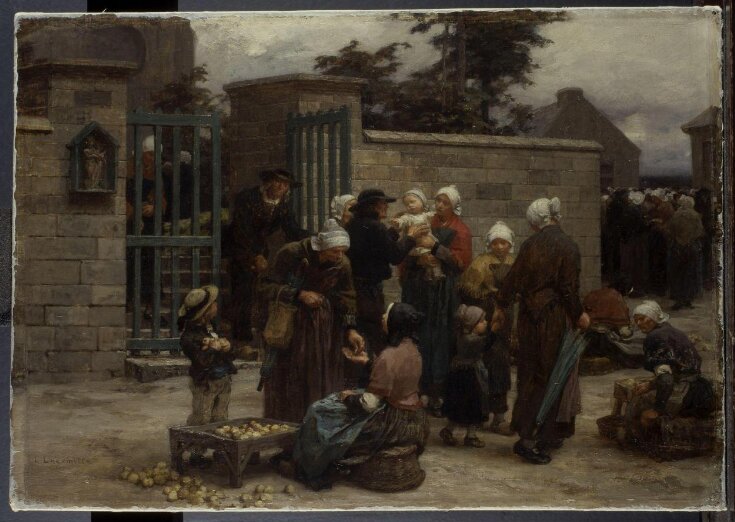
This painting is typical of Lhermitte's peasant scenes. It shows a scene of everyday life outside of a church on the occasion of a religious feast called a 'Pardon' celebrated during Easter.
This painting is typical of Lhermitte's peasant scenes. It shows a scene of everyday life outside of a church on the occasion of a religious feast called a 'Pardon' celebrated during Easter.
Object details
| Categories | |
| Object type | |
| Title | Le Pardon de Plourin, Brittany |
| Materials and techniques | oil on canvas |
| Brief description | Oil painting, 'Le Pardon de Plourin, Brittany', Léon-Augustin Lhermitte, 1877 |
| Physical description | Men and women in traditional dresses chatting and buying fruits and cakes while leaving the church in a village. |
| Dimensions |
|
| Styles | |
| Marks and inscriptions | 'L. Lhermitte' (Signed by the artist, lower left) |
| Credit line | Bequeathed by Constantine Alexander Ionides |
| Object history | Commissioned from the artist (as a pair with CAI 68) by Constantine Alexander Ionides around April 1877 (a letter in a private collection from Lhermitte in Paris to Ionides dated 19 April 1877 mentions that one of his two pictures is finished and that the other would be ready in time for his next trip to London). listed in Ionides' inventory of November 1881 as either 'Marché au pommes' or 'Marché au fruits' by Lhermitte, each with a valuation of £75; bequeathed by Constantine Alexander Ionides, 1900. Historical significance: This painting is typical of Lhermitte's peasant genre scenes. The title identifies the present work as a religious festival known in Breton as a 'Pardon' in the village of Plourin in Finistere in Brittany. According to Lhermitte's diary it was executed in Mont-Saint-Père, the artist's native town, after sketches and documents brought back from Brittany in the previous few years. The artist focused here on the representation of traditional costume and the popular culture which combined the sale of apples, cakes, etc. with Christian ritual (the Pardon). Comparable market scenes include Apple Market, Landerneau, Brittany dated c. 1878, in the Philadelphia Museum of Art, and Market at Château-Thierrry, executed in 1879, in the Thyssen-Bornemisza Museum, Madrid. |
| Historical context | 19th-century French art is marked by a succession of movements based on a more or less close relationship with nature. At the beginning of the century, Romantic artists were fascinated by nature they interpreted as a mirror of the mind. They investigated human nature and personality, the folk culture, the national and ethnic origins, the medieval era, the exotic, the remote, the mysterious and the occult. This movement was heralded in France by such painter as Eugène Delacroix (1798-1863). In its opposition to academic art and its demand for a modern style Realism continued the aims of the Romantics. They assumed that reality could be perceived without distortion or idealization, and sought after a mean to combine the perception of the individual with objectivity. This reaction in French painting against the Grand Manner is well represented by Gustave Courbet (1819-1877) who wrote a 'Manifesto of Realism', entitled Le Réalisme published in Paris in 1855. These ideas were challenged by the group of the Barbizon painters, who formed a recognizable school from the early 1830s to the 1870s and developed a free, broad and rough technique. They were mainly concerned by landscape painting and the rendering of light. The works of Narcisse Virgile Diaz de la Peña (1807-1876), Jules Dupré (1811-1889), Théodore Rousseau (1812-1867), Constant Troyon (1810-1865) and Jean-François Millet (1814-1875) anticipate somehow the plein-air landscapes of the Impressionists. |
| Subject depicted | |
| Place depicted | |
| Summary | Léon Lhermitte (1844-1925) was born in Mont-Saint-Père but became a student at the Petite Ecole in Paris, under the supervision of Horace Lecoq de Boisbaudran (1802-1897), whose classes were also attended by Henri Fantin-Latour (1836-1904) and Alphonse Legros (1837-1911) among others. He exhibited at the Salon between 1866 and the first decade of the 20th century. He was a founder-member of the Société Nationale des Beaux-Arts in 1890 and was made officer of the Légion d'honneur in 1894. This painting is typical of Lhermitte's peasant scenes. It shows a scene of everyday life outside of a church on the occasion of a religious feast called a 'Pardon' celebrated during Easter. |
| Bibliographic references |
|
| Collection | |
| Accession number | CAI.69 |
About this object record
Explore the Collections contains over a million catalogue records, and over half a million images. It is a working database that includes information compiled over the life of the museum. Some of our records may contain offensive and discriminatory language, or reflect outdated ideas, practice and analysis. We are committed to addressing these issues, and to review and update our records accordingly.
You can write to us to suggest improvements to the record.
Suggest feedback
You can write to us to suggest improvements to the record.
Suggest feedback
| Record created | June 19, 2003 |
| Record URL |
Download as: JSONIIIF Manifest
