
Henry IV, the Dauphin and the Spanish Ambassador
Oil Painting
before 1817 (painted)
before 1817 (painted)
| Artist/Maker | |
| Place of origin |
Jean Auguste Dominique Ingres (1780-1867) was born in Montauban. He studied with local painters in Toulouse before entering the Paris studio of David (1748-1825) in 1797. He was soon consider as the champion of the French classical tradition of history painting, traditionally opposed to the art of Delacroix in the early 19th century. Ingres was awarded the prix de Rome in 1801 and alternated long sojourns in Italy and Paris from 1806 until 1855. He received important state commissions and official honours for his oeuvre that also includes portraits paintings which represent a good testimonial of the 19th-century French high society.
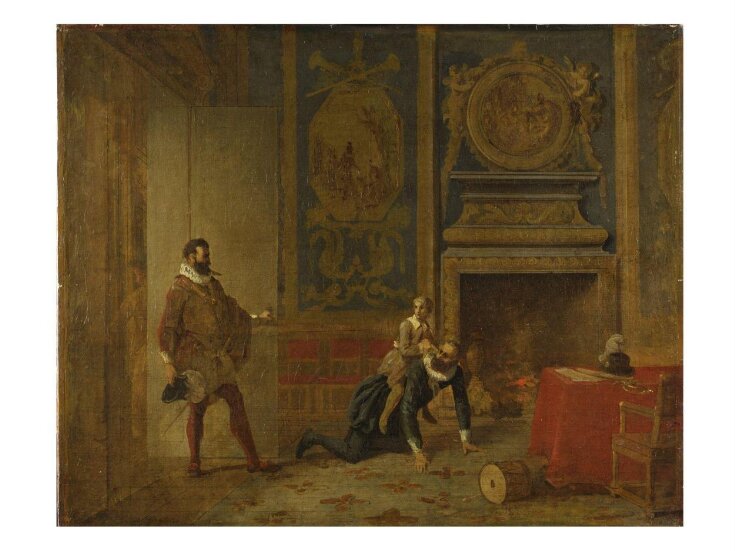
This work is an unfinished preparatory study for a painting executed in 1817. It depicts the King Henry IV of France playing with his son, the future Louis XIII (1601-1643) surprised by the Spanish ambassador. The subject matter was taken from a popular anecdote and is a fine example of the history paintings inspired by the history of France in vogue during the first half of the 19th century.
This work is an unfinished preparatory study for a painting executed in 1817. It depicts the King Henry IV of France playing with his son, the future Louis XIII (1601-1643) surprised by the Spanish ambassador. The subject matter was taken from a popular anecdote and is a fine example of the history paintings inspired by the history of France in vogue during the first half of the 19th century.
Object details
| Categories | |
| Object type | |
| Title | Henry IV, the Dauphin and the Spanish Ambassador (popular title) |
| Materials and techniques | oil on canvas |
| Brief description | Oil painting, 'Henri IV, the Dauphin and the Spanish Ambassador: a Sketch', Jean-Auguste-Dominique Ingres, before 1817 |
| Physical description | Henry IV is crawling on hands and knees on the floor with his son on his back; on the left, the ambassador looks in surprise. |
| Dimensions |
|
| Styles | |
| Marks and inscriptions | 'Ingres' (Signed by the artist, lower left) |
| Credit line | Bequeathed by Constantine Alexander Ionides |
| Object history | According to Delaborde, given by Ingres to Dominique Papéty, pensionnaire of the Académie de France in Rome; before 1870 coll. M. Delareyberette, Duc de Morny; before 1876 coll. M. Meyer; from whom perhaps purchased (stock book entry difficult to read - perhaps 'Duger' or 'Meyer'?) on 21 November 1881 as Ingres 'Henri IV et l'ambassadeur d'Angleterre' by Goupil & Co., Paris (stock book no. 15785); from whom bought by Constantine Alexander Ionides, 21 November 1881; listed in his inventory (private collection) on 21 November 1881 as 'Oil sketch. Henri IV receiving an ambassador. by Ingres. Goupil' at a valuation of £280; bequeathed by Constantine Alexander Ionides to the Museum in 1900. Historical significance: According to Ingres’ early biographer, Henri Delaborde, this painting was a preparatory study (‘première pensée’) for the finished version, executed in 1817, for the Duc de Blacas (Musée du Petit Palais, Paris – Inv. 1164) and exhibited at the Paris Salon in 1824 and at the Exposition universelle in 1855. CAI.58 was most likely the earliest of a series of four and was left unfinished. Of the four versions, the V&A painting is the most distinctive one with only a few figures whereas the other versions included more children and the Queen and a very different interior. It depicts the king Henry IV playing a horse with his son, the Dauphin, on his back and surprised in such posture by the Spanish Ambassador. The subject is taken from an anecdote related in the Mémorial pittoresque de la France (1786). The king, being discovered, asked the Ambassador if he were a father and on receiving an affirmative reply, observed quietly: ‘Then I shall finish my round’. This painting is a fine example of the so-called ‘goût troubadour’, an aesthetic movement that aimed to renew the classical tradition by focusing of subject matters drawn from the Middle Age and the history of France. Ingres painted other two versions of the subject in addition to the ones mentioned above: one, dated 1828, was formerly in Alphonse de Rothschild collection, Paris, while another belonged to Mme Ingres (Wildenstein, no. 62). It was a popular subject treated by several artists in the 19th century, including Pierre Revoil (1776-1842), in the Musée National du Château de Pau, dated 1813, and Richard Parkes Bonington (1802-1828), in the Wallace Collection, London, dated c. 1827. |
| Historical context | History painting, i.e. depictions of non recurring events based on religious, classical, literary or allegorical sources, particularly developed in Italy during the Renaissance (15th-16th centuries). History painting could include religious themes, or depictions of momentous recent events, but the term was most frequently associated with Classical subject-matter. However a renewed impetus was given to religious subjects after the Council of Trent (1545-63), which stipulated new iconographical programmes. The development of art treatises, in which the compositional rules guiding the art of painting were discussed also notably, influenced the evolution of history painting. From around 1600 history painting's principal rivals: still-life, landscape and genre painting began to emerge as independent collectable genres. Furthermore, the Rococo taste for the ornamental in the early 18th century prioritised the decorative quality of history painting, so that subject matters became more entertaining than exemplary. There was a renewed interest in history painting during the Neo-Classical period after which the taste for such pictures faded towards the end of the 19th century when an innovative approach to the image was led by the Symbolists and was developed further by subsequent schools in the early 20th century. |
| Subjects depicted | |
| Summary | Jean Auguste Dominique Ingres (1780-1867) was born in Montauban. He studied with local painters in Toulouse before entering the Paris studio of David (1748-1825) in 1797. He was soon consider as the champion of the French classical tradition of history painting, traditionally opposed to the art of Delacroix in the early 19th century. Ingres was awarded the prix de Rome in 1801 and alternated long sojourns in Italy and Paris from 1806 until 1855. He received important state commissions and official honours for his oeuvre that also includes portraits paintings which represent a good testimonial of the 19th-century French high society. This work is an unfinished preparatory study for a painting executed in 1817. It depicts the King Henry IV of France playing with his son, the future Louis XIII (1601-1643) surprised by the Spanish ambassador. The subject matter was taken from a popular anecdote and is a fine example of the history paintings inspired by the history of France in vogue during the first half of the 19th century. |
| Bibliographic references |
|
| Collection | |
| Accession number | CAI.58 |
About this object record
Explore the Collections contains over a million catalogue records, and over half a million images. It is a working database that includes information compiled over the life of the museum. Some of our records may contain offensive and discriminatory language, or reflect outdated ideas, practice and analysis. We are committed to addressing these issues, and to review and update our records accordingly.
You can write to us to suggest improvements to the record.
Suggest feedback
You can write to us to suggest improvements to the record.
Suggest feedback
| Record created | June 18, 2003 |
| Record URL |
Download as: JSONIIIF Manifest
