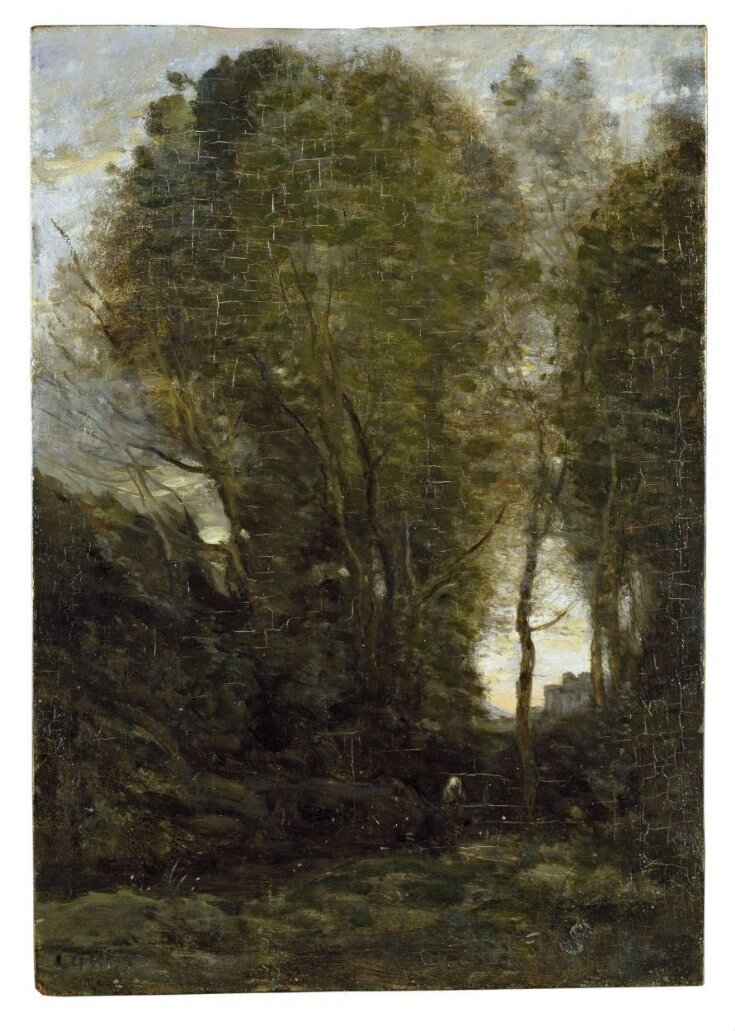
Twilight: Landscape with Tall Trees and a Female Figure
Oil Painting
ca. 1855-ca. 1860 (painted)
ca. 1855-ca. 1860 (painted)
| Artist/Maker | |
| Place of origin |
Jean-Baptiste-Camille Corot (1796-1875) was born in Paris and only at the age of 26 devoted himself to painting. He studied with two pupils of Pierre-Henri Valenciennes (1750-1819), first with Achille Etna Michallon (1796-1822) and later with Jean-Victor Bertin (1767-1842). He spent three years in Italy and specialised in landscape paintings. He enjoyed quickly a great success but the turning-point of his career, however, came with the accession to power of Louis-Napoléon who praised his art with the consequence that collectors and dealers began to be interested in his work.
This painting is a fine example of Corot's late period when he painted landscapes only vaguely reminiscent of places. The diffuse light and strong shade places the moment of execution at the very end of the day when light starts weakening but is still very bright. Two sketchy figures are drawn on the foreground and appear more evocative than real.
This painting is a fine example of Corot's late period when he painted landscapes only vaguely reminiscent of places. The diffuse light and strong shade places the moment of execution at the very end of the day when light starts weakening but is still very bright. Two sketchy figures are drawn on the foreground and appear more evocative than real.
Object details
| Categories | |
| Object type | |
| Title | Twilight: Landscape with Tall Trees and a Female Figure |
| Materials and techniques | oil on panel |
| Brief description | Oil painting, 'Twilight: Landscape with Tall Trees and Female Figure', Jean-Baptiste-Camille Corot, ca. 1855-ca. 1860 |
| Physical description | A wooded landscape with tall trees and a village in the distance by twilight, in the foreground is a meadow brook in the shade and one or two sketchy figures. |
| Dimensions |
|
| Style | |
| Marks and inscriptions | 'Corot' (Signed lower left) |
| Credit line | Bequeathed by Constantine Alexander Ionides |
| Object history | Possibly Le Soir au Vallon (Robaut, ii., n. 1205) with Durand-Ruel in 1876 (but this was apparently signed on the right-hand side); Coll. 'Maxwell' (possibly Andrew Maxwell, a Glasgow collector), from whom purchased on 21 July 1881 as Corot 'Crêpuscle' by Goupil & Co., Paris (stock book no. 15577); from whom bought by Constantine Alexander Ionides, 21 July 1881; listed in his inventory (private collection) in November 1881 at a valuation of £210; bequeathed by Constantine Alexander Ionides to the Museum in 1900. Historical significance: This painting is typical of Corot's later period when he painted enigmatic landscape in a diffuse atmosphere as an invitation to personal reverie. The present painting shows a meadow brook among tall trees with a distant village in the background. One or two sketchy figures appear in the foreground. This painting corresponds to the description of the Soir au vallon provide by Robaut in his catalogue raisonné (1905, II, no. 1205) but it is stated to have been signed on the right hand-side whereas CAI.65 is signed on the left hand-side. This painting shows a diffuse however bright light Corot was famous for. He often painted superimposed areas of shade and light which provide a strong contrast. This compositional formula was based on his direct observation of nature but also re-elaborated in his studio. This artistic practice derived from his master's dictum, Michallon, to paint out of doors directly from the motif but was also inspired by the landscapes of Claude Lorrain (1604-1682) and 17th-century Dutch masters. Corot's reputation was bolstered after 1846 by Baudelaire's warm criticism and his popularity grew then rapidly. By the early 1850s Corot's reputation was firmly established, and he moved away from landscapes in the Neo-classical style to concentrate on rendering his impressions of nature. X-ray photography shows this composition was painted over another scene depicting a bridge, a diagonal tree and a cottage. The re-use of a previously painted panel has been a common practice since the Renaissance. The severe cracking is the result of Corot painting over this scene before it had completely dried. |
| Historical context | Although France and England became the new centres of landscape art in the 18th century, the Italian and Dutch traditions retained their authority. However the Arcadian vision of Italy increasingly tended towards a more precise observation of nature. Some of the most exciting developments took place in Venice, in the soft scenes of Francesco Zuccarelli (1702-1788), inspired by Claude Lorrain (1604-1682), and the fresh, spontaneous landscapes of Marco Ricci (1676-1730). Wealthy patrons, often accompanied by artists, on The Grand Tour, created a market for veduta and capriccio paintings, respectively topographical and fantasist landscape paintings. Landscape conventions were further enriched by foreign artists working in Italy, responding both to the beauty of Italian light and scenery celebrated by the Latin poets and vividly captured in the most popular landscapes of Claude Lorrain, Nicolas Poussin (1594-1665) and Gaspard Dughet (1615-1675). |
| Subjects depicted | |
| Summary | Jean-Baptiste-Camille Corot (1796-1875) was born in Paris and only at the age of 26 devoted himself to painting. He studied with two pupils of Pierre-Henri Valenciennes (1750-1819), first with Achille Etna Michallon (1796-1822) and later with Jean-Victor Bertin (1767-1842). He spent three years in Italy and specialised in landscape paintings. He enjoyed quickly a great success but the turning-point of his career, however, came with the accession to power of Louis-Napoléon who praised his art with the consequence that collectors and dealers began to be interested in his work. This painting is a fine example of Corot's late period when he painted landscapes only vaguely reminiscent of places. The diffuse light and strong shade places the moment of execution at the very end of the day when light starts weakening but is still very bright. Two sketchy figures are drawn on the foreground and appear more evocative than real. |
| Bibliographic references |
|
| Collection | |
| Accession number | CAI.65 |
About this object record
Explore the Collections contains over a million catalogue records, and over half a million images. It is a working database that includes information compiled over the life of the museum. Some of our records may contain offensive and discriminatory language, or reflect outdated ideas, practice and analysis. We are committed to addressing these issues, and to review and update our records accordingly.
You can write to us to suggest improvements to the record.
Suggest feedback
You can write to us to suggest improvements to the record.
Suggest feedback
| Record created | June 18, 2003 |
| Record URL |
Download as: JSONIIIF Manifest
