
Table
1769 (made)
| Artist/Maker | |
| Place of origin |
Object Type
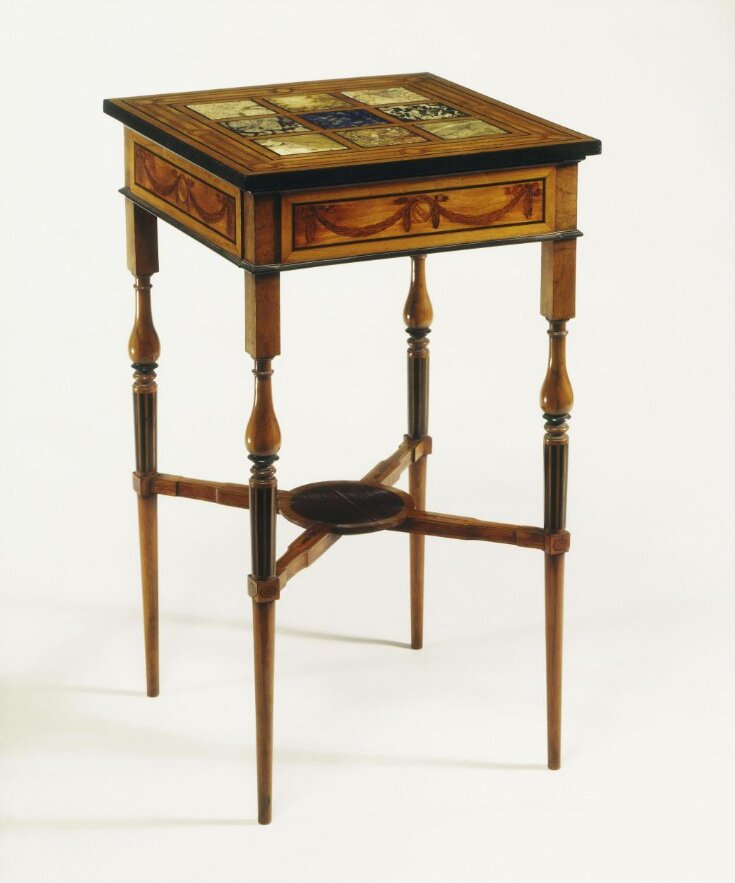
This table, fitted with a single drawer, is a very rare example of furniture designed by the architect Sir William Chambers (1723-1796) for his own use. It is clearly an architect-designed piece, with unusually attenuated legs and fine proportions. It was probably made purely for decoration rather than for use.
People
Chambers once described himself as 'a very pretty connoisseur in furniture'. His table was made by the Swedish cabinet-maker Georg Haupt (1741-1784) when he was in London. After spending five years in Paris and London, Haupt returned to Stockholm in 1769 to become cabinet-maker to the Swedish royal family.
Materials & Making
The table is made of oak, veneered with satinwood, ebony and other woods, with specimen marbles set in the top.
Time
The use of marble specimens set in tables was considered very fashionable during the 1760s and 1770s, and interest in Classical archaeology was widespread. An important contribution was Chambers's own Treatise on Civil Architecture, published in 1759, which helped establish him as one of the leading Neo-classical architects of his day. Chambers had studied extensively in Paris between 1749 and 1750, and in Rome between 1750 and 1755. The shape of the legs was probably inspired by Greek urns.
This table, fitted with a single drawer, is a very rare example of furniture designed by the architect Sir William Chambers (1723-1796) for his own use. It is clearly an architect-designed piece, with unusually attenuated legs and fine proportions. It was probably made purely for decoration rather than for use.
People
Chambers once described himself as 'a very pretty connoisseur in furniture'. His table was made by the Swedish cabinet-maker Georg Haupt (1741-1784) when he was in London. After spending five years in Paris and London, Haupt returned to Stockholm in 1769 to become cabinet-maker to the Swedish royal family.
Materials & Making
The table is made of oak, veneered with satinwood, ebony and other woods, with specimen marbles set in the top.
Time
The use of marble specimens set in tables was considered very fashionable during the 1760s and 1770s, and interest in Classical archaeology was widespread. An important contribution was Chambers's own Treatise on Civil Architecture, published in 1759, which helped establish him as one of the leading Neo-classical architects of his day. Chambers had studied extensively in Paris between 1749 and 1750, and in Rome between 1750 and 1755. The shape of the legs was probably inspired by Greek urns.
Object details
| Categories | |
| Object type | |
| Parts | This object consists of 3 parts.
|
| Materials and techniques | Satinwood, oak and pine, inlaid with ebony and hardstones |
| Brief description | Table, satinwood, inlaid with ebony, the top inlaid with specimen marbles. English, 1769. Designed by William Chambers and made by Georg Haupt. |
| Physical description | The following description has been transcribed from the original accession record of 1977. ENGLISH: dated 1769. Small Satinwood table with one drawer with laurel festoons, and the top inlaid with nine specimen plaques of coloured marbles on tapering legs with x-shaped stretcher. |
| Dimensions |
|
| Gallery label |
|
| Credit line | Purchased with the assistance of the Brigadier Clark Fund through Art Fund |
| Object history | Designed by Sir William Chambers (born in Göteborg, Sweden, 1723, died in London, 1796); made in London by Georg Haupt (born in Stockholm, 1741, died there in 1784) Historical significance: The fact of this table's manufacture are recoreded in an insccription. The collaboration between Chambers, architect to George III, and Haupt, a Swedish cabinet maker trained in Paris, makes this a crucial example of advanced Neo-classical taste. |
| Production | dated 1769 |
| Summary | Object Type This table, fitted with a single drawer, is a very rare example of furniture designed by the architect Sir William Chambers (1723-1796) for his own use. It is clearly an architect-designed piece, with unusually attenuated legs and fine proportions. It was probably made purely for decoration rather than for use. People Chambers once described himself as 'a very pretty connoisseur in furniture'. His table was made by the Swedish cabinet-maker Georg Haupt (1741-1784) when he was in London. After spending five years in Paris and London, Haupt returned to Stockholm in 1769 to become cabinet-maker to the Swedish royal family. Materials & Making The table is made of oak, veneered with satinwood, ebony and other woods, with specimen marbles set in the top. Time The use of marble specimens set in tables was considered very fashionable during the 1760s and 1770s, and interest in Classical archaeology was widespread. An important contribution was Chambers's own Treatise on Civil Architecture, published in 1759, which helped establish him as one of the leading Neo-classical architects of his day. Chambers had studied extensively in Paris between 1749 and 1750, and in Rome between 1750 and 1755. The shape of the legs was probably inspired by Greek urns. |
| Bibliographic references |
|
| Collection | |
| Accession number | W.38:1 to 3-1977 |
About this object record
Explore the Collections contains over a million catalogue records, and over half a million images. It is a working database that includes information compiled over the life of the museum. Some of our records may contain offensive and discriminatory language, or reflect outdated ideas, practice and analysis. We are committed to addressing these issues, and to review and update our records accordingly.
You can write to us to suggest improvements to the record.
Suggest feedback
You can write to us to suggest improvements to the record.
Suggest feedback
| Record created | July 2, 1998 |
| Record URL |
Download as: JSONIIIF Manifest
