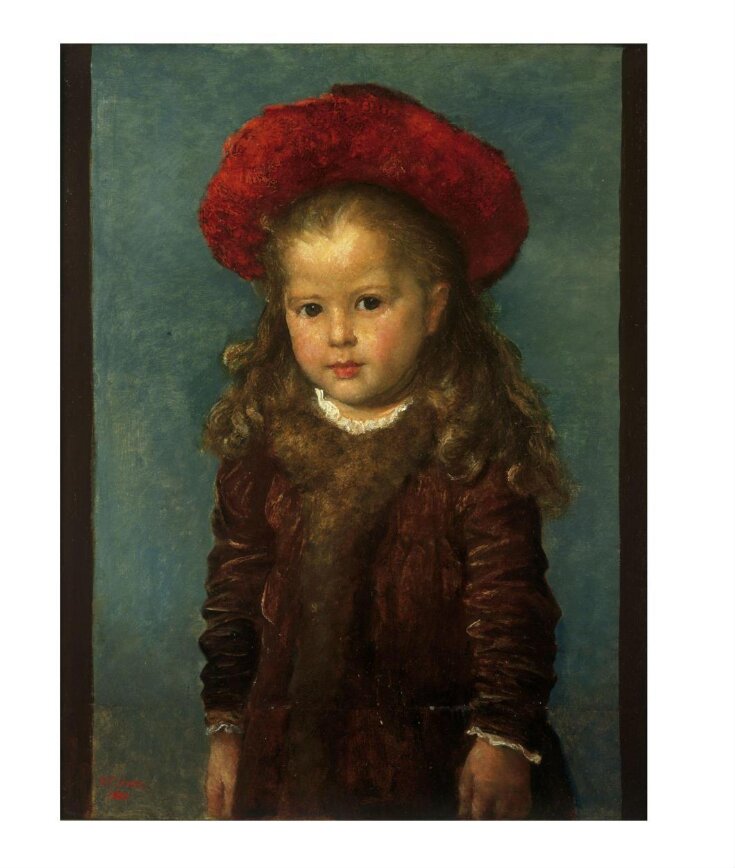

Zoe Ionides
Oil Painting
1881 (painted)
1881 (painted)
| Artist/Maker | |
| Place of origin |
Zoe Ionides (1877-1973) was the seventh child of Constantine Ionides and his wife Agathonike. Watts painted portraits of several members of the Ionides family.
Object details
| Categories | |
| Object type | |
| Title | Zoe Ionides (popular title) |
| Materials and techniques | oil on canvas |
| Brief description | Oil painting on canvas, 'Zoe Ionides', George Frederick Watts, 1881 |
| Physical description | Half-length, nearly full face figure of a little girl with her hands hanging by her sides. She has brown eyes and light brown hair, and wears a red hat, a reddish dress, and a fur around her neck. |
| Dimensions |
|
| Styles | |
| Marks and inscriptions | G F. Watts. / 1881. (Signed in the lower left-hand corner) |
| Credit line | Bequeathed by Constantine Alexander Ionides |
| Object history | Bequeathed by Constantine Alexander Ionides, 1900. However, it was stipulated in the will that this, along with 19 other family portraits, should stay in the family until the death of his wife - she died in 1920 when the paintings were received by the museum. Historical significance: George Frederick Watts was born on 23 September, 1817. He received no regular schooling on account of poor health, but later studied under the sculptor William Behnes and entered the R.A schools in 1835. In 1837 he achieved recognition for The Wounded Heron (Compton Watts Gal.), exhibited at the R.A. Watts won a prize of £300 for his painting Caractacus in the 1843 Westminster Hall competition. He went to Florence until 1847, where he worked under the patronage of Lady Holland. On his return to England, Watts won a further prize of £500 in the Westminster Hall competition for his Alfred inciting the Saxons to prevent the landing of the Danes. Inspired by Michelangelo and with his reputation now firmly established, Watts was determined to devote himself to grand, universal themes such as Faith; Hope; Charity; Love and Life; and Love and Death. However he rose to front rank as a portrait painter and painted of his many eminent contemporaries including Thomas Carlyle, John Stuart Mill, William Gladstone and John Everett Millais. He was elected to the A.R.A and R.A in 1867. In 1864 he married 16-year-old Ellen Terry and painted a charming allegorical portrait of her, Choosing, but the couple separated the following year. A major late sculpture, Physical Energy (1904, London, Kensington Gardens) is surprisingly modernistic. Watts presented many of his works to art galleries and institutions. He died on 1 July, 1904. Zoe Ionides (1877- 1973) was the seventh of eight children of Constantine Alexander Ionides, donor of the V&A's Ionides collection, and his wife Agathonike. In this portrait, the little girl is dressed in neutral shades which, as with the ribbon in CAI 1144, accentuate the bright red colour of her hat. During a lifelong friendship, G. F. Watts painted over fifty members of the Ionides family spread over five generations. From 1880-1881 Constantine Alexander commissioned Watts to paint a series of family portraits of himself (CAI 1141), his wife (CAI 1142) and his three daughters Euterpe (CAI 1143), Helen or 'Lallie' (CAI 1144) and Zoe, the youngest. Zoe married Stephen Manuel in 1911 and the couple had three children. The Manuel family, who were neighbours with the Ionides family in Finsbury Circus, were also influential patrons of artists including James Abbot McNeill Whistler, Alphonse Legros and Henri Fantin-Latour. The frame was designed by G. F. Watts. The portrait entered the V&A collection in 1920 after the death of Agathonike Ionides. |
| Historical context | The frame was designed by G. F. Watts |
| Subject depicted | |
| Summary | Zoe Ionides (1877-1973) was the seventh child of Constantine Ionides and his wife Agathonike. Watts painted portraits of several members of the Ionides family. |
| Associated object | |
| Collection | |
| Accession number | CAI.1145 |
About this object record
Explore the Collections contains over a million catalogue records, and over half a million images. It is a working database that includes information compiled over the life of the museum. Some of our records may contain offensive and discriminatory language, or reflect outdated ideas, practice and analysis. We are committed to addressing these issues, and to review and update our records accordingly.
You can write to us to suggest improvements to the record.
Suggest feedback
You can write to us to suggest improvements to the record.
Suggest feedback
| Record created | June 17, 2003 |
| Record URL |
Download as: JSONIIIF Manifest
