Tabernacle
ca. 1180 (made)
| Artist/Maker | |
| Place of origin |
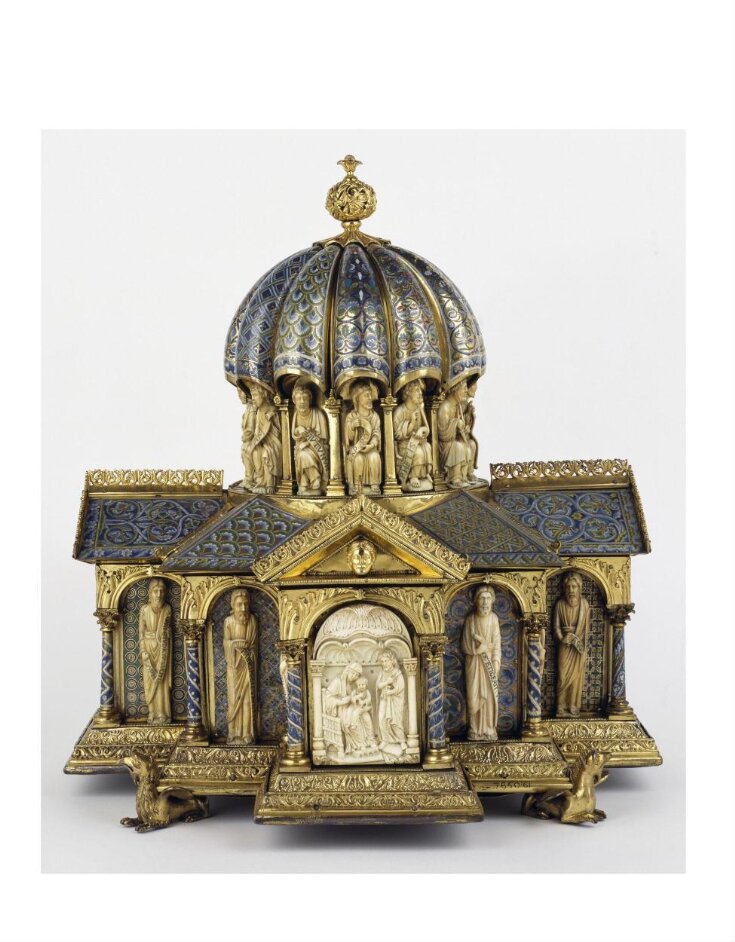
This piece is an astonishing example of the art of goldsmiths in Cologne in the period 1150-1200. The inscriptions and imagery all suggest that it functioned as a portable tabernacle rather than a reliquary (a container for holy relics). A tabernacle held the pyx, a container for the consecrated bread used in the Christian Eucharist. This tabernacle would therefore have been used in processions or would have been set on an altar for veneration.
The work here is closely related to a group of enamelled pieces that include the very similar but smaller cross-shaped and domed tabernacle in the Kunstgewerbemuseum in Berlin. It is highly likely that this tabernacle, and the one in Berlin, are the earliest examples in the form of a cruciform church with a dome.
Recent conservation revealed a parchment written in 1855, signed with the name of the dealer Carrand. According to this new evidence the tabernacle was thought to come from a Benedictine monastery in Cologne. Saint Pantaleon is likely to be the original location. The shrines of Saint Marinus and Saint Albinus are both still preserved there and their enamel reliquaries are stylistically very close to this piece.
The work here is closely related to a group of enamelled pieces that include the very similar but smaller cross-shaped and domed tabernacle in the Kunstgewerbemuseum in Berlin. It is highly likely that this tabernacle, and the one in Berlin, are the earliest examples in the form of a cruciform church with a dome.
Recent conservation revealed a parchment written in 1855, signed with the name of the dealer Carrand. According to this new evidence the tabernacle was thought to come from a Benedictine monastery in Cologne. Saint Pantaleon is likely to be the original location. The shrines of Saint Marinus and Saint Albinus are both still preserved there and their enamel reliquaries are stylistically very close to this piece.
Object details
| Categories | |
| Object type | |
| Materials and techniques | Walrus ivory and elephant ivory figures and reliefs, mounted in a setting of gilt copper and enamel on an oak core |
| Brief description | Tabernacle, gilded bronze and copper on a wooden core, with champlevé enamel and walrus ivory, Lower Rhine (Germany), Cologne, probably from the church of St Pantaleon, ca. 1180, and French, 1853-55 |
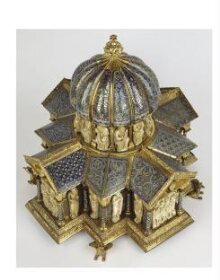
| Physical description | Bronze and copper gilt reliquary, covered with enamel. Ivory carvings in the porticos. The whole rests on a wooden substructure. The object is in the form of a miniature domed church of Greek cross design, supported by four gilt-copper griffins (two of the nineteenth century). The curved segments of the cupola, the sloping roofs of the main body of the structure, the background to the niches in which the prophets stand and the columns between them are decorated with distinctive enamel designs which allow a confident ascription to a Cologne workshop of about 1180. Around the dome are seated Christ and the eleven apostles, with below, sixteen figures of prophets who hold inscribed scrolls on which are written words taken from Matthew, XVI, 13-16. Four ivory plaques depict the Virgin and Child with St Joseph, the Journey of the Magi, the Crucifixion and the Holy Women at the Sepulchre; the first two of these are nineteenth century replacements, copied from the reliquary now in the Kunstgewerbemuseum, Berlin (originally in Brunswick Cathedral as part of the Guelf treasury). According to Alfred Darcel (La Collection Soltykoff, in Gazette des Beaux Arts, 1861, p.169-304), the Carrands had already restored the object in the 1850s and had added the knop at the top, two griffins and the following prophets: Maleachi, Sacharja, Bileam. The reliefs depicting the Journey of the three Magi, and the Holy Family, were copied from the examples of the Guelf treasury by the Parisien sculptor Geoffrey Dechaulme. The position of Christ, whose scroll contains the beginning of the text passage, therefore determines the front of the object, directly above the relief of the Crucifixion. The inscriptions of the apostles are read anti-clockwise around the cupola, ending with St Peter. The apostles, with the exception of Peter (who holds his attribute, the key) follow a set bearded type and are indistinguishable from one another, while the fourth apostle is identical with Christ. All the figures are carved from walrus ivory and the incised inscriptions are highlighted with either red or black paint. The sixteen prophets below, standing in niches to the sides of the narrative reliefs, also (with one exception) hold scrolls. The inscriptions clearly identify the prophets by their sayings; like those of the apostles, these are incised and embellished with red and black colouring. In size they range from 12.6 to 13 cm in height and 3.2 to 3.5 cm in width. The Crucifixion relief is made up of four parts: a central section, the shell like canopy above and the two columns. The Maries and the Sepulcre relief, of two parts, is of elephant ivory. The two 19th century plaques of the Journey of the Magi and the Virgin and Child with St Joseph are also of two pieces and carved from elephant ivory. The four reliefs range in height from 12.4 cm to 12.8 cm. |
| Dimensions |
|
| Marks and inscriptions |
|
| Gallery label | Original label:
SHRINE or RELIQUARY. Copper-gilt. Decorated with champleve enamel and with ivory carvings inserted. The shrine is in the form of a quadrangular Byzantine temple surmounted by a dome and with a projecting portico on each of the four sides. An ivory plaque is inserted in the front of each portico, carved in relief of the Nativity, the Magi on horseback, the Crucifixion and the Resurrection. Sixteen ivory statuettes of prophets stand around the temple and twelve ivory statuettes of Apostles surround the doem, each bearing a scroll in his hand. The colums, walls and roff are enamelled. The whole rests on a base of copper gilt, standing on four griffins. |
| Object history | According to the parchment written in 1855 (see inscriptions), the object was thought to come from a Benedictine monastery in Cologne, probably Saint Pantaleon or Saint Martin. Saint Pantaleon is likely to be the original location in which are still preserved the shrines of Saint Marinus and Saint Albinus; both their enamels are stylistically very close to 7650-1861. In a memorandum written by chanoine Franz Bock from Aachen, he stated that the object originally came from the Benedict nunnery at Eltenberg (Hochelten). According to Bock in the 1840s it was in the possession of the dealer Jakob Cohen in Anholt in the Lower Rhine region, who removed the walrus carvings to sell them individually to the Duke Salm-Salm. The latter eventually bought the entire reliquary. Bock described the appearance of the reliquary at that time as a shrine which was robbed of its ornaments (den seines Schmuckes beraubten Schreins), and that is was then restored by a goldsmith and a carpenter commissioned by the Duke. In 1853 he sold the object to the Cologne dealer Schmitz. The latter sold it through Jean-Baptist Carrand and his son Louis to Prince Soltykoff in 1853. The museum acquired the "grand chasse" in 1861. Crown and Veil Exhibition RF.2003/459 Historical significance: The tabernacle is a astonishing example of the the art of goldsmiths in Cologne in the second half of the thirteenth century and is closely related to a group of enamelled work among them the cross-shaped and domed tabernacle in the Kunstgewerbemuseum in Berlin and several other portable altars such as in Siegburg and Bamberg. It is highly likely, that the present piece together with the example in Berlin are the earliest receptacula in form of a cruciform church with a dome. |
| Historical context | The inscriptions and the iconography of the object are all related to Christ, the Redemption of Mankind, the Arc of the Old Testament. It has therefore been suggested that the 'chasse' did not function as reliquary but as a portable tabernacle which contained in a pyx the host. The tabernacle would have been used in processions or would have been set on an altar for veneration. The original function of the object is not certain. |
| Production | and French, 1853-55; formerly called 'Eltenberg Reliquary' |
| Subjects depicted | |
| Summary | This piece is an astonishing example of the art of goldsmiths in Cologne in the period 1150-1200. The inscriptions and imagery all suggest that it functioned as a portable tabernacle rather than a reliquary (a container for holy relics). A tabernacle held the pyx, a container for the consecrated bread used in the Christian Eucharist. This tabernacle would therefore have been used in processions or would have been set on an altar for veneration. The work here is closely related to a group of enamelled pieces that include the very similar but smaller cross-shaped and domed tabernacle in the Kunstgewerbemuseum in Berlin. It is highly likely that this tabernacle, and the one in Berlin, are the earliest examples in the form of a cruciform church with a dome. Recent conservation revealed a parchment written in 1855, signed with the name of the dealer Carrand. According to this new evidence the tabernacle was thought to come from a Benedictine monastery in Cologne. Saint Pantaleon is likely to be the original location. The shrines of Saint Marinus and Saint Albinus are both still preserved there and their enamel reliquaries are stylistically very close to this piece. |
| Associated object | 259:1-1867 (Object) |
| Bibliographic references |
|
| Collection | |
| Accession number | 7650-1861 |
About this object record
Explore the Collections contains over a million catalogue records, and over half a million images. It is a working database that includes information compiled over the life of the museum. Some of our records may contain offensive and discriminatory language, or reflect outdated ideas, practice and analysis. We are committed to addressing these issues, and to review and update our records accordingly.
You can write to us to suggest improvements to the record.
Suggest feedback
You can write to us to suggest improvements to the record.
Suggest feedback
| Record created | June 16, 2003 |
| Record URL |
Download as: JSONIIIF Manifest
