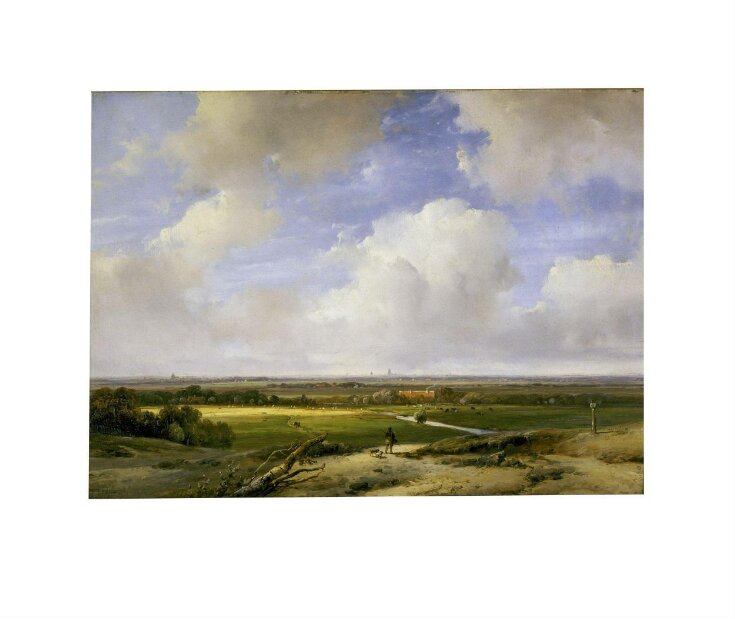

Landscape near Haarlem
Oil Painting
1839 (made)
1839 (made)
| Artist/Maker | |
| Place of origin |
Andreas Schelfhout (1787-1870) was apprenticed in The Hague to the decorative painter Joannes Henricus Albertus Antonius Breckenheijmer (1772-1856) and soon specialised in landscape painting but also narrative genre scenes. He became best known for his representations of the Dutch winter landscape. He was a prolific draughtsman and produced many watercolours. Schelfhout achieved a great success during his lifetime and had many pupils including members of the later Hague school such as Johan Barthold Jongkind (1819-1891) and Johannes Franciscus Hoppenbrouwers (1819-1866).
This painting is a typical example of Schelfhout's famous summer landscapes in which an expansive landscape is stretched to the horizon dominated by a huge cloudy sky. The artist further strengthened the sense of depth by a subtle play of diagonal and horizontal lines and the superposition of patches of bright and darker hues. The highly detailed brushwork and jewel-like quality of the painting also recall the technique of the watercolour, an activity for which Schelfhout was famous and highly appreciated. This painting witnesses the long lasting influence of the seventeenth century Dutch tradition and the artists' persistent interest in nature and its atmospheric effects in Holland.
This painting is a typical example of Schelfhout's famous summer landscapes in which an expansive landscape is stretched to the horizon dominated by a huge cloudy sky. The artist further strengthened the sense of depth by a subtle play of diagonal and horizontal lines and the superposition of patches of bright and darker hues. The highly detailed brushwork and jewel-like quality of the painting also recall the technique of the watercolour, an activity for which Schelfhout was famous and highly appreciated. This painting witnesses the long lasting influence of the seventeenth century Dutch tradition and the artists' persistent interest in nature and its atmospheric effects in Holland.
Object details
| Category | |
| Object type | |
| Title | Landscape near Haarlem (generic title) |
| Materials and techniques | Oil on oak panel |
| Brief description | Oil painting, 'A Landscape near Haarlem', Andreas Schelfhout, 1839 |
| Physical description | A panoramic flat landscape with a river and a red roof house in the middle, and a town in the distance dominated by an enormous cloudy sky; a figure and two dogs in the foreground. |
| Dimensions |
|
| Style | |
| Marks and inscriptions | 'A. Schelfhout f39' (Signed and dated by the artist, lower left) |
| Gallery label | The Dutch artist Andreas Schelfhout was known for his use of clear, bright colours. In this jewel-like painting the eye is drawn into the landscape by the converging diagonals of the fallen tree in the foreground and the canal, towards the tiny figures on the path and the brilliantly sunlit area beyond.(September 2009) |
| Credit line | Bequeathed by Rev. Chauncy Hare Townshend |
| Object history | Bequeathed by Rev. Chauncy Hare Townshend, 1868 Ref : Parkinson, Ronald, Catalogue of British Oil Paintings 1820-1860. Victoria & Albert Museum, HMSO, London, 1990. p.xix. 'Chauncy Hare Townshend (1798-1868) was born into a wealthy family, only son of Henry Hare Townsend of Busbridge Hall, Godalming, Surrey. Educated at Eton and Trinity Hall, Cambridge (BA 1821). Succeeded to the family estates 1827, when he added 'h' to the Townsend name. He had taken holy orders, but while he always referred to himself as 'Rev.' on the title pages of his books, he never practised his vocation... . Very much a dilettante in the eighteenth-century sense, he moved in the highest social and literary circles; a great friend of Charles Dickens (he was the dedicatee of Great Expectations) with whom he shared a fascination of mesmerism... Bulwer Lytton described his life's 'Beau-deal of happiness' as 'elegant rest, travel, lots of money - and he is always ill and melancholy'. Of the many watercolours and British and continental oil paintings he bequeathed to the V&A, the majority are landscapes. He is the first identifiable British collector of early photographs apart from the Prince Consort, particularly landscape photography, and also collected gems and geological specimens.' Historical significance: This painting is a typical example of Schelfhout's mature work in which he turned to a brighter palette under the influence of the French Romantic landscape painting after his stay in Paris in the early 1830s. This work is related to an unfinished sketch of the same view in the National Gallery, London: Landscape with Cumulus Clouds. Schelfhout did many similar compositions: another View near Haarlem, dated 1844, is in the Rikjsmuseum, Amsterdam (SK-C-1673) and a close landscape dated 1835 is in the Dordrecht Museum. These highly detailed landscapes are reminiscent of the great Dutch tradition of landscape painting in the 17th century that was still popular throughout the 18th and 19th centuries until Impressionism marked a decisive shift at the end of the 19th century. This composition relates to the work of Jacob van Ruisdael (1628/29-1682) and especially Philips de Koninck (1619-1688) who was famous for his bird's eye view of the Dutch landscape (See V7A paintings inv. no. Dyce.8 and CAI.85). The sharp focus of such landscapes and the emphasis upon the sky seem to have been especially congenial to the Rev. Chauncey Hare Townshend, who became a major early patron of landscape photography, and particuarly of the French photographer Gustave le Gray, who excelled in seascapes with extensive skies. Townshend owned a number of such photographs (V&A nos.67.995, 67.997, 68.000-68.004). |
| Historical context | Landscape paintings became extremely popular during the 17th century and increasingly encompassed a variety of forms and genres. Dutch painters had a new attention for nature and their familiar surroundings and progressively did experiments with innovative techniques concentrating on the atmospheric effects and the sense of depth. Panoramic views became popular in the 17th-century Netherlands and views of the Dutch countryside developed quickly, especially under the influence of Jan van Goyen (1596-1656) who developed a broken brushwork technique and used a restrained monochromatic palette of earthy colours. The end of the 17th century is remarkable for a shift in taste that came to favour more academic and classical landscapes under the influence of Italianate landscape paintings. Landscapes were then often employed as settings for mythological or historical subjects. However during the end of the 18th century and the first half of the 19th, Dutch artists returned to favour the 17th century imagery and largely imitated the landscape and genre paintings of the great painters of the Golden Age. This trend flourished in the Hague school (1870-90) before coming to an end with the beginning of the Impressionism. |
| Subjects depicted | |
| Place depicted | |
| Summary | Andreas Schelfhout (1787-1870) was apprenticed in The Hague to the decorative painter Joannes Henricus Albertus Antonius Breckenheijmer (1772-1856) and soon specialised in landscape painting but also narrative genre scenes. He became best known for his representations of the Dutch winter landscape. He was a prolific draughtsman and produced many watercolours. Schelfhout achieved a great success during his lifetime and had many pupils including members of the later Hague school such as Johan Barthold Jongkind (1819-1891) and Johannes Franciscus Hoppenbrouwers (1819-1866). This painting is a typical example of Schelfhout's famous summer landscapes in which an expansive landscape is stretched to the horizon dominated by a huge cloudy sky. The artist further strengthened the sense of depth by a subtle play of diagonal and horizontal lines and the superposition of patches of bright and darker hues. The highly detailed brushwork and jewel-like quality of the painting also recall the technique of the watercolour, an activity for which Schelfhout was famous and highly appreciated. This painting witnesses the long lasting influence of the seventeenth century Dutch tradition and the artists' persistent interest in nature and its atmospheric effects in Holland. |
| Bibliographic reference | C.M. Kauffmann, Catalogue of Foreign Paintings, II. 1800-1900, London: Victoria and Albert Museum, 1973, p. 93, cat. no. 199. |
| Collection | |
| Accession number | 1576-1869 |
About this object record
Explore the Collections contains over a million catalogue records, and over half a million images. It is a working database that includes information compiled over the life of the museum. Some of our records may contain offensive and discriminatory language, or reflect outdated ideas, practice and analysis. We are committed to addressing these issues, and to review and update our records accordingly.
You can write to us to suggest improvements to the record.
Suggest feedback
You can write to us to suggest improvements to the record.
Suggest feedback
| Record created | June 11, 2003 |
| Record URL |
Download as: JSONIIIF Manifest
