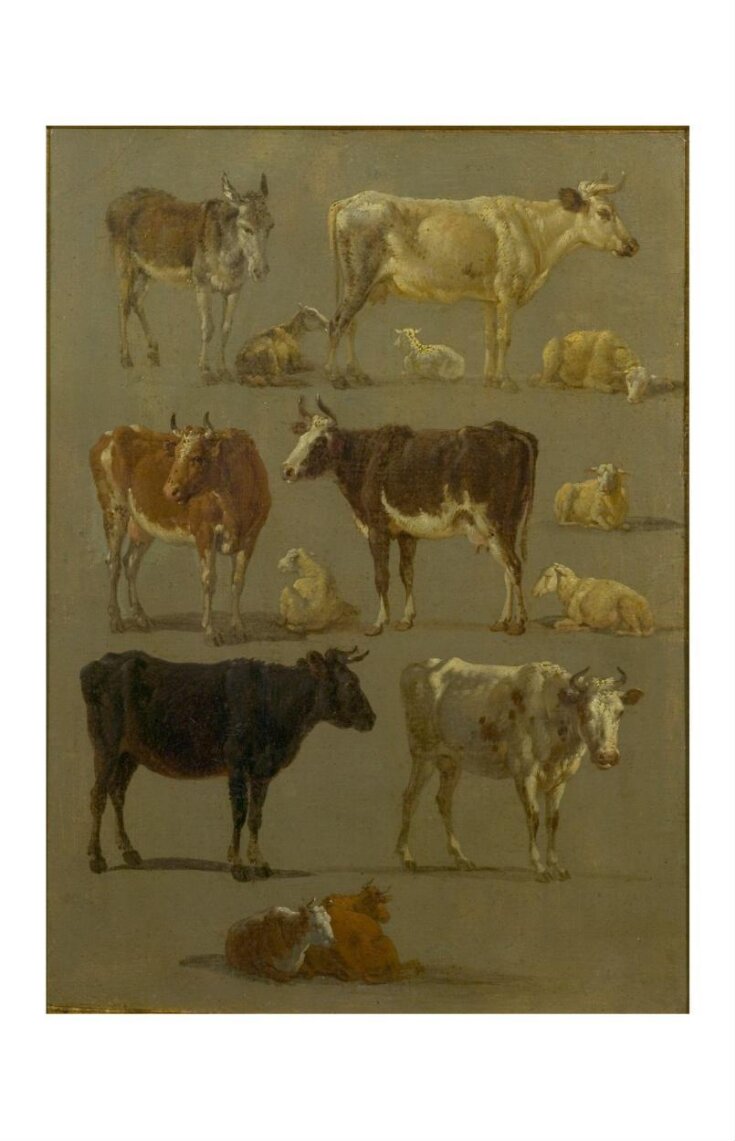

Studies of Animals: Cows and Oxen, Sheep and a Donkey
Oil Painting
Late 18th century (painted)
Late 18th century (painted)
| Artist/Maker | |
| Place of origin |
Jean-François Legillon (1739-1797), born in Bruges, was trained by Jean-Baptiste Descamps (1715-1791) in Rouen (France), whose paintings, which typically depict scenes of daily life, were influenced by the work of Jean-Siméon Chardin (1699-1779) and Jean-Baptiste Greuze (1725-1805). Legillon quickly specialised in landscapes and interior scenes, reminiscent of the art of the Golden Age's painters Paulus Potter (1625-1654) and Karel Dujardin (1626-1678).
This study of animals is a good example of Legillon's working process. He executed a few studies of this kind as a preparation for his landscape paintings in which he would include these figures. He thus followed the great landscape tradition which developed in the Netherlands during the 17th century and was still very appreciated in the following centuries up to the end of the 19th century.
This study of animals is a good example of Legillon's working process. He executed a few studies of this kind as a preparation for his landscape paintings in which he would include these figures. He thus followed the great landscape tradition which developed in the Netherlands during the 17th century and was still very appreciated in the following centuries up to the end of the 19th century.
Object details
| Category | |
| Object type | |
| Title | Studies of Animals: Cows and Oxen, Sheep and a Donkey (generic title) |
| Materials and techniques | Oil on paper laid on canvas |
| Brief description | Oil painting, 'Studies of Animals', Jean François Legillon, late 18th century |
| Physical description | Studies of animal seen from profile and the back in diverse positions: cows, oxen, sheep and a donkey. |
| Dimensions |
|
| Style | |
| Credit line | Bequeathed by Constantine Alexander Ionides |
| Object history | Possibly in the collection of Alexander Constantine Ionides, father of Constantine Alexander Ionides. Bequeathed by Constantine Alexander Ionides, 1900 Historical significance: Jean-François Legillon made a few studies of full-length animals and human figures after life, drawn in different positions that he would reused in his landscape paintings. Comparable studies of cows are in the Steinmetzkabinet, Bruges. He specialised in landscape paintings with cattle, such as Landscape with barn and cattle, dated ca. 1776, in the Groeningemuseum, Bruges. He hardly used to include human figures in his compositions, following thus the style of the Dutch Golden Age's painters Paulus Potter and Karel Dujardin. In addition to these full-length studies, he also executed more detailed studies such as the Head of a goat and Head of a donkey, both in the Steinmetzkabinet, Bruges. The representation of cows was important in the whole Netherlands as they were a symbol of national pride, especially after the Eighty Years' War (1568-1648) when the Netherlands finally gained their independence from the Spanish dominion. This iconographic representation extended well into the 19th century during which Netherlandish artists, even those who belonged to The Hague School (1870-1890), considered as a vehicle for a new artistic approach, continued to depict them as the main subject of their works. |
| Historical context | Italianates landscapes were particularly praised during the 17th century up to the early 19th century. The term conventionally refers to the school of Dutch and Flemish painters and draughtsmen who were active in Rome for more than a hundred years, starting from the early 17th century. These artists produced mainly pastoral subjects bathed in warm southern light, set in an Italian, or specifically Roman, landscape. They formed in Rome a proper association called the Schildersbent, which flourished from ca. 1620 to 1720 and was notorious for its opposition to the Roman Accademia di S Luca.The term is also often applied, but wrongly, to artists who never left the northern Netherlands but who worked primarily in an Italianate style. Eighteenth-century collectors, especially French ones, preferred a view by Nicolaes Berchem (ca.1620-1683) or Jan Both (ca.1610-1652) to a scene of the Dutch country side by Jacob van Ruisdael (ca.1628-1682) for instance. The taste for the Italianates continued undiminished into the 19th century. An early voice denouncing these artists was that of John Constable (1776-1837) and at the end of the century Italianates had lost favour oartly because of the rise of Impressionism and the appreciation of the Dutch national school of landscape expounded by such eminent critics as Wilhem von Bode, E.W. Moes and Cornelis Hofstede de Groot. |
| Subjects depicted | |
| Summary | Jean-François Legillon (1739-1797), born in Bruges, was trained by Jean-Baptiste Descamps (1715-1791) in Rouen (France), whose paintings, which typically depict scenes of daily life, were influenced by the work of Jean-Siméon Chardin (1699-1779) and Jean-Baptiste Greuze (1725-1805). Legillon quickly specialised in landscapes and interior scenes, reminiscent of the art of the Golden Age's painters Paulus Potter (1625-1654) and Karel Dujardin (1626-1678). This study of animals is a good example of Legillon's working process. He executed a few studies of this kind as a preparation for his landscape paintings in which he would include these figures. He thus followed the great landscape tradition which developed in the Netherlands during the 17th century and was still very appreciated in the following centuries up to the end of the 19th century. |
| Bibliographic references |
|
| Collection | |
| Accession number | CAI.82 |
About this object record
Explore the Collections contains over a million catalogue records, and over half a million images. It is a working database that includes information compiled over the life of the museum. Some of our records may contain offensive and discriminatory language, or reflect outdated ideas, practice and analysis. We are committed to addressing these issues, and to review and update our records accordingly.
You can write to us to suggest improvements to the record.
Suggest feedback
You can write to us to suggest improvements to the record.
Suggest feedback
| Record created | June 10, 2003 |
| Record URL |
Download as: JSONIIIF Manifest
