The Virgin and Child in a Gothic architectural setting
Oil Painting
ca. 1500 (made)
ca. 1500 (made)
| Artist/Maker | |
| Place of origin |
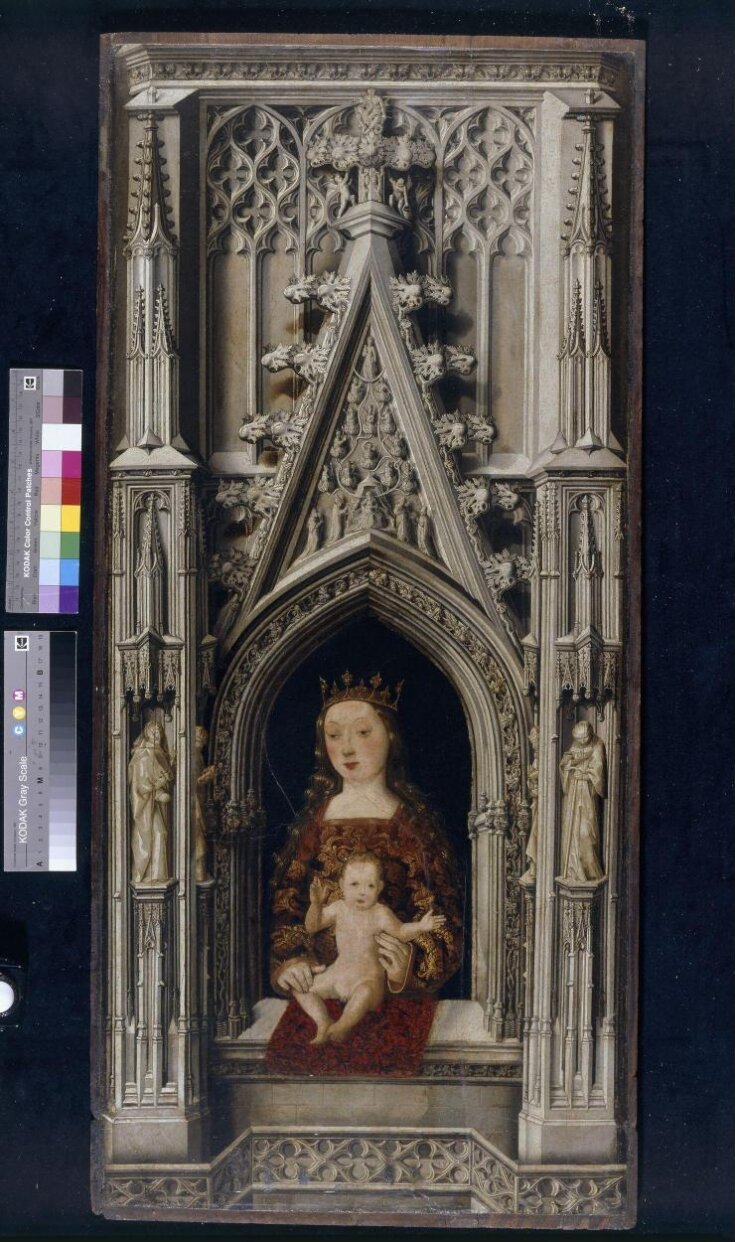
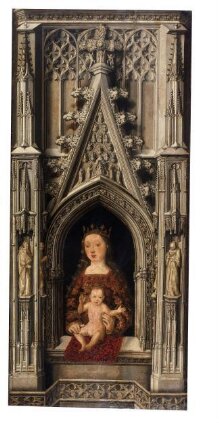
This painting is a good example of the Hispano-Flemish style of the late 15th century in Spain. Probably executed in Seville, this work shows the Virgin and Child set in an architectural frame which derives from the decoration of the doors of the Cathedral of Seville. The dominant feature of this frame is the acanthus leaves which runs all along the different sections while the Madonna, with a round face and long curly hair, and the Child are reminiscent of Flemish prototypes. The importance of the architectural frame compared with the Madonna and Child suggest this piece was part of large ensemble.
Object details
| Categories | |
| Object type | |
| Title | The Virgin and Child in a Gothic architectural setting (generic title) |
| Materials and techniques | Oil on chestnut |
| Brief description | Oil painting on chestnut panel, The Virgin and Child in an elaborate Gothic architectural setting, Seville school, ca. 1500 |
| Physical description | A crowned Virgin, wearing a red embroidered dress with acanthus leaves pattern, and a naked Child are set in a pointed arch part of an elaborate Gothic architectural setting carved with acanthus leaves and grapes, pinnacles, pointed arch, quatrefoils and sculptures. |
| Dimensions |
|
| Style | |
| Production type | Unique |
| Object history | Nothing is known of the provenance of this panel before it was purchased from Sr Zuloago in Madrid in 1866. Historical significance: Dr August L. Mayer (written communication, 1936) thought this work was from the school of Toledo whereas Chandler Post (1938) ascribed it to the school of Seville and it was subsequently tentatively catalogued as by Pedro Sanchez I (Gaya Nuno, 1936 and Kauffmann, 1973). This attribution relies upon the only surviving panel by Pedro Sanchez I - Entombment dated ca. 1490, Szépmûveszeti Museum, Budapest - however this painting shows a much more sculptural and harsh execution which differs quite substantially from 335-1866. The painting shows a Madonna and Child set in a Gothic architectonic frame. The support being chestnut and the fact that it was bought on the Madrid art market indicate the painting is probably Spanish, more specifically from the school of Seville as the Gothic frame surrounding the Virgin and Child derives from the decoration of the doors of Seville cathedral and yet is not a direct copy. The architectural elements recall indeed the doors of S. Miguel and of the Bautismo, constructed before 1454 and located in the west front of the cathedral. The Madonna and Child are set within a pointed arch with free standing figures on each side, which differs from the doors’ sculptures. On the right is perhaps St Anthony Abbot whose traditional attribute is a tau-shaped (T) stick. The other figures of the buttress are hardly identifiable but resemble stereotypes of doctors and fathers of the Western church. Three of them are reading like those of the doors of the Bautismo, and the fourth is represented looking to the top as the Saint John of S. Miguel’s doors. Some of these sculptures were paid to Lorenzo Mercadante de Bretana the years 1464-67. Above the Virgin and Child a carved ‘tree of Jesse’ is represented. It rises from the enthroned figure of Jesse while on the branches appear the ancestors of Christ. It culminates with the Virgin holding the Child, standing on a crescent moon. The theme occurs in the Middle Ages and in the early Renaissance, especially in the Netherlands. All along this ‘window of Jesse’ run acanthus leaves and grapes, dominated by a cross surmounted by a human figure intertwined with a dragon, a common illustration of the victory of good over evil. The architectural frame on one hand and the Virgin and Child on the other may result from the work of two different painters as their execution looks quite dissimilar. In fact the Virgin and Child do not appear as refined and neat as the rest of the painting. Her dress however, embroidered with a pattern of acanthus leaves, recalls the dominant feature of the frame. It is therefore rather difficult to identify a painter responsible for this work. According to Iniguez, there is a remote influence of Juan Sanchez de Castro and of the master of the Ordones Militares, especially in the form of the Virgin face. This type of composition of a Madonna and Child enclosed within a gothic architectonic frame is quite recurrent in Flemish examples such as Roger van der Weyden’s two Enthroned Virgin and Child, Museo Thyssen-Bornemisza, Madrid (Inv. 435(1930.125)) and Kunsthistorisches Museum, Vienna (Inv. GG_951). Moreover in these pictures, the Virgin has long and curly fair hair and wears a crown. This painting appears therefore a good example of the Hispano-Flemish type of painting typical of the last quarter of the 15th century. However the importance of the architectural elements is quite unusual and suggests this painting was part of a large ensemble. |
| Historical context | Objects and images were used for protection, intercession and as votive offerings since Antiquity. Amulets, rings and talismans were common throughout the Middle Ages and the Renaissance and often had 'pagan' (non-Christian) and erotic imagery. Popular images were also produced expressly for the purpose of intercession, protection and instruction. In particular the Virgin, Christ and the saints were depicted, for they were considered to be advocates before God and agents of protection against evil. Christians in the Middle Ages and Renaissance periods expressed and strengthened their faith through public rituals, such as celebration of the Eucharist, and personal devotions conducted in a private chapel, monastic cell, or simply in a secluded part of their home. In Western Europe, a form of spirituality that emphasized the emotional involvement of the faithful emerged by 1300. Believers were encouraged to contemplate events from the life of Christ, the Virgin, or the saints, as if they were present. Images of the Virgin and Child were among the most popular images for private devotion and these were primarily small religious paintings suitable as a focus for private worship, as opposed to larger altarpieces intended for public display. Such images frequently emphasized the tender relationship between the mother and her child. |
| Subjects depicted | |
| Summary | This painting is a good example of the Hispano-Flemish style of the late 15th century in Spain. Probably executed in Seville, this work shows the Virgin and Child set in an architectural frame which derives from the decoration of the doors of the Cathedral of Seville. The dominant feature of this frame is the acanthus leaves which runs all along the different sections while the Madonna, with a round face and long curly hair, and the Child are reminiscent of Flemish prototypes. The importance of the architectural frame compared with the Madonna and Child suggest this piece was part of large ensemble. |
| Bibliographic references |
|
| Collection | |
| Accession number | 335-1866 |
About this object record
Explore the Collections contains over a million catalogue records, and over half a million images. It is a working database that includes information compiled over the life of the museum. Some of our records may contain offensive and discriminatory language, or reflect outdated ideas, practice and analysis. We are committed to addressing these issues, and to review and update our records accordingly.
You can write to us to suggest improvements to the record.
Suggest feedback
You can write to us to suggest improvements to the record.
Suggest feedback
| Record created | June 10, 2003 |
| Record URL |
Download as: JSONIIIF Manifest
