Please complete the form to email this item.

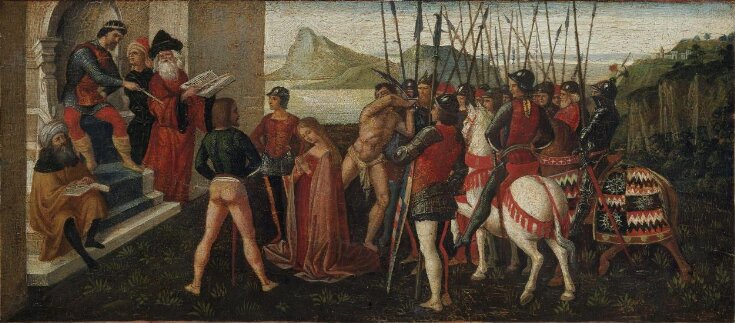
Oil painting - The Martyrdom of St Catherine
  • The Martyrdom of St Catherine
    Francesco Verla, born 1499 - died 1522
  • Enlarge image

The Martyrdom of St Catherine

  • Object:

    Oil painting

  • Place of origin:

    Verona, Italy (possibly, painted)

  • Date:

    ca. 1500 (painted)

  • Artist/Maker:

    Francesco Verla, born 1499 - died 1522 (Circle of, production)

  • Materials and Techniques:

    [oil] oil on poplar panel

  • Credit Line:

    Bequeathed by Constantine Alexander Ionides

  • Museum number:

    CAI.98&:1

  • Gallery location:

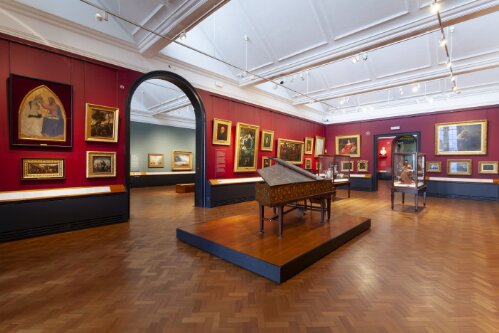
    Paintings, room 81, case EAST WALL

  • Download image

Francesco Verla (active 1499-1520) was documented for the first time in Vicenza in 1499 and travelled to Rome in 1503 before returning shortly after in the Veneto. He worked in Vicienza, Schio, Trento and Rovereto where he probably died between 1521 and 1522.

This painting is most likely a part of a predella panel, i.e. the long horizontal structure at the base or 'foot' of an altarpiece, which narrative scenes usually refer to the large image above. It shows the martyrdom of a female saint, traditionally identified as St Catherine of Alexandria who was beheaded after the failed tentative of tormenting her on a wheel. This painting is reminiscent of Francesco Verla's manner, an artist active in the Veneto near Verona, whose art combined the influence by Perugino and his school, and more Northern characteristics.

Physical description

[oil] On a lake shore with mountains in the mid distance, a group of soldiers with horses surrounds a female figure kneeling before a king and two philosophers, a naked man behind her is about to behead her.

Place of Origin

Verona, Italy (possibly, painted)

Date

ca. 1500 (painted)

Artist/maker

Francesco Verla, born 1499 - died 1522 (Circle of, production)

Materials and Techniques

[oil] oil on poplar panel

Dimensions

[oil] Height: 25.5 cm estimate, Width: 51.2 cm estimate

Object history note

Acquired by Constantine Alexander Ionides in Florence, via Buonarroti, on 26 February 1883, as attributed to P. della Francesca, for £100 (his inventory, private collection). Bequeathed to the museum in 1900.
[oil] Bequeathed by Constantine Alexander Ionides, 1901
Ref: Basil S. Long, Catalogue of the Constantine Alexander Ionides collection.Vol. 1, Paintings in oil, tempera and water-colour, together with certain of the drawings, London : Printed under the authority of the Board of Education, 1925.
C. Monkhouse, 'The Constantine Ionides Collection' in Magazine of Art, vii, 1884, pp. 36-44, 208-214.

The collection formed by Constantine Ionides includes works of a wide variety of schools, periods and artists. His collection includes Old Masters, 17th century works, contemporary British works and French 19th century works. Constantine formed friendships with artists of the day, especially Legros, who, having spent 17 years in Britain, became a naturalise British citizen. Constantine proved a stable and generous buyer of Legros work, while Legros, in turn, became an advisor in the matters of art to the attentive Constantine. Under the influence of Legros Constantine developed a keen interest in French 19th century paintings purchasing works by Delacroix, Degas, Millet and Rousseau.

Constantine's plans concerning his collection conformed to a more 'public-welfare' vein of thought than his father or brother. He decided to donate his collection to the Victoria & Albert Museum, instead of privately distributing it or disposing of it in a Sales room.

His will states:

'All my pictures both in oil and water colors and crayon or colored chalks (but subject as to my family portraits to the interest herein before given to my said Wife) and all my etchings drawings and engravings to the South Kensington Museum for the benefit of the nation to be kept there as one separate collection to be called "The Constantine Alexander Ionides Collection" and not distributed over the Museum or lent for exhibition. And I desire that the said Etchings Drawings and Engravings shall be framed and glazed by and at the expense of the authorities of the Museum so that Students there can easily see them.'

The collection bequeathed to the museum in 1901 comprises 1138 pictures, drawing and prints, to which a further 20 items were added on the death of his widow in 1920. The works are listed in the V&A catalogue of the Constantine Alexander Ionides collection.

Historical significance: This painting was acquired as by Piero della Francesca (c.1415-1492) (Monkhouse, 1884), successively catalogued as Umbrian (Long, 1925) and attributed to Girolamo dai Libri (c.1474-1555) (Berenson, 1936). It was eventually ascribed to the Veronese school by Dr Levi d'Ancona (written communication, 1970). The later attribution appear the more acceptable and in fact, this painting bears some similarities with a group of predella panels (Musée du Petit-Palais, Avignon) attributed to Francesco Verla active (1499-1520) between Verona and Vicenza, and influenced by Perugino and his school.
The present painting shows the eminent execution of a young woman, simply but elegantly dressed, kneeling in prayer before a monarch. The subject matter is traditionally identified as the martyrdom of St Catherine of Alexandria although her traditional attribute, the wheel, is missing. The two doctors holding a book on each side of the emperor may represent the philosophers and orators that the emperor Maxentius summoned to undermine Catherine's faith. Dr Levi d'Ancona proposed to identify the landscape as a view from the Veronese shore of Lake Garda.
The delicate features of the saint, the linear simplicity of the landscape as well as the compact albeit lively figures of men are reminiscent of Verla's manner although the stiff creases of the saint's dress denote a less experimented hand. The contrapposto pose of the executioner is particularly interesting while the surrounding soldiers poised in such a way as to display a wide variety of movements recalls such composition as Michele da Verona's Crucifixion, c. 1500, Pinacoteca di Brera, Milan. On the other hand, the perspective view of the raised throne and niche appears clumsy. The numerous and very detailed plants depicted in the foreground is reminiscent of Perugino's manner and the Florentines' and can be found in the Avignon panels as well.
Another predella panel by Francesco Verla for the altarpiece of St Catherine in the Church of S Francesco, Schio, shows a similar composition albeit in reverse, analogously set by a lake but with much fewer figures.This panel shows an additional scene on the left illustrating the failed tentative of tormenting the saint on a wheel broken by angels. This composition suggests that CAI.98 is either incomplete, i.e. cut off on one side, or missing a pendant that would have presented the failed martyrdom of the saint on the wheel.
Because of the subject matter and related works, it is very unlikely that this painting was originally a small cassone panel as Monkhouse proposed (1884) and must reasonably be considered as a part of a predella.
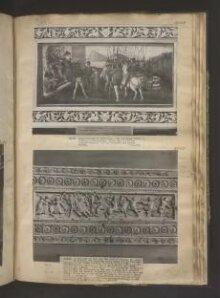
Another version of this subject was engraved in reverse by Domenico Campagnola (1500-1564) in 1517.

Historical context note

[oil] Predella is the Italian term used to describe the long horizontal structure at the base or 'foot' of an altarpiece. This structure was more common in Italy than in other countries such as the Netherlands, Spain and Germany where predella panels beneath altarpieces were much rarer. The appearance of the predella can be seen as part of the development of the subject painted on the altarpiece above providing a visual commentary on the major images above and at the same time raising the main panels, improving thus their visibility.
The predella seems to appear during the beginning of the 13th century in the Western world in such example as Bonaventura Berlinghieri's St Francis altarpiece, 1235, Church of S. Francesco, Pescia and gradually developed until the 15th century. It became the opportunity to formulate new ideas by allegorical means rather than merely expand the main subject matter of the altarpiece by using narrative or extra figures. For example, the predella of Raphael's Entombment, Galleria Borghese, Rome, shows the Theological Virtues between standing putti and not scenes of the life of Christ as it was customary. The taste for predella panel however declined during the 16th century and disappeared almost completely at the end of the century.

Descriptive line

Oil painting, 'The Martyrdom of St Catherine', Circle of Francesco Verla, ca. 1500

Bibliographic References (Citation, Note/Abstract, NAL no)

Cosmo Monkhouse, 'The Constantine Ionides Collection', Magazine of Art, p. 211.
'A brilliant but much repainted "cassone" panel representing the martyrdom of a saint. It is full of small figures whose energy reminds one rather of Andrea del Castagno than the painter (Piero della Francesca) to whom it has been ascribed'
Kauffmann, C.M., Catalogue of Foreign Paintings, I. Before 1800 London: Victoria and Albert Museum, 1973, pp. 149-150, cat. no. 177.
The following is the full text of the entry:

North Italian (?Veronese), early 16th century
177
THE MARTYRDOM OF ST CATHERlNE (?)
Poplar panel
10 x 20 1/8 (25.5 x 51.2)
1 1/8 (2.8) thick
Ionides Bequest
CAI.98

At one time attributed to Piero della Francesca (Monkhouse, 1884), this painting was subsequently described as North Italian (Athenaeum, 1904), catalogued by Long (1925) as Umbrian (?) and attributed by Berenson (1936, 1968) to Girolamo dai Libri of Verona. The latter attribution does not appear acceptable on grounds of either quality or style in the light of recent work on Girolamo dai Libri (M. Levi D'Ancona, V. & A. Museum Yearbook, i, 1969, p. 16 ff.).However, Dr Levi D'Ancona (written communication) supports a tentative attribution to the school of Verona and suggests that the scene is set on the Veronese shore of Lake Garda.
The subject has been identified as the martyrdom of St Catherine, who is shown kneeling in prayer before being beheaded. The absence of her wheel casts some doubt on this identification, but the crowned figure seated on the throne could well be the Emperor Maximinus, who condemned her to death after failing to break her on the wheel. A comparison can be made with an engraving by Domenico Campagnola, dated 1517 (Bartsch, xiii, 381.6), which shows a very similar composition in reverse, but here also the identification of the saint is subject to doubt.
The thickness of the panel is more typical of a piece of furniture than of an easel painting. Monkhouse (1884) suggested it was a cassone panel; if so it must have been from the short side of a cassone, and an origin on a box of smaller dimensions seems more likely.

Prov. Constantine Alexander Ionides before 1884; bequeathed to the Museum in 1900.
Lit. Monkhouse, 1884, p. 211; Anon., 'Additions to the National Collections' in Athenaeum, July 1904, p, 119; Long, Cat. Ionides Coll. 1925, p. 66, pl. 35; B. Berenson, Pitture italiane del Rinascimento, 1936, p, 222; id., Italian pictures of the Renaissance: Central Italian and Northern Schools, 1968, p. 195.
Anon., 'Additions to the National Collections' in Athenaeum, July 1904, p, 119.
B. Long, Catalogue of the Ionides Collection, London, 1925, p. 66, pl. 35.
B. Berenson, Pitture italiane del Rinascimento, 1936, p. 222.
B. Berenson, Italian pictures of the Renaissance: Central Italian and Northern Schools, 1968, p. 195.
F. Barbieri, Pittori di Vicenza (1480-1520), Vicenza, 1981, pl. vi and vii.
For comparison only.

Materials

Oil paint; Poplar

Techniques

Oil painting

Subjects depicted

Figures; Horses; Soldiers; Emperor; Lake; Catherine (Saint Catherine of Alexandria); Spears

Categories

Christianity

Collection code

PDP

Download image
Qr_O81217
Ajax-loader