Cassone
1450 -1460 (made)
| Place of origin |
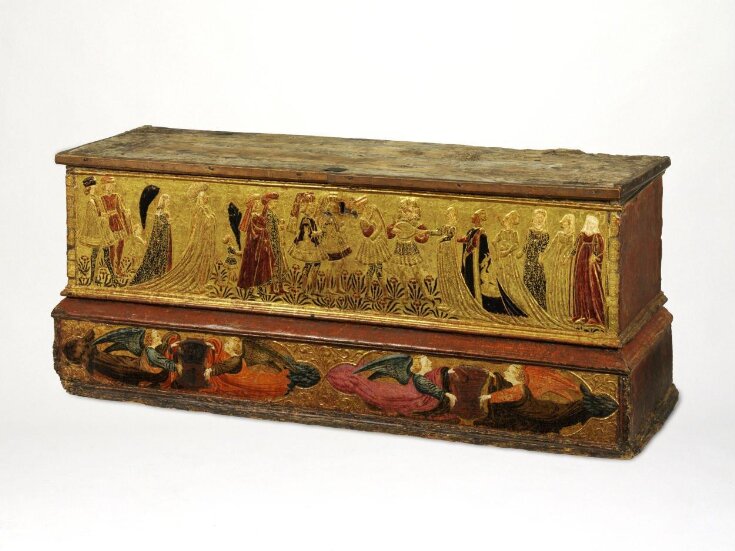
Marriage chests or cassoni were made in pairs. They were emblazoned with the coats of arms of the relevant families and often decorated with wedding scenes. A number of figures on this example wear Burgundian fashions, which were much in vogue in Florence between about 1425 and 1450. Early records do not tell us where this cassone came from, but it was bought by this museum for £40 in 1863, possibly from William Blundell Spence, a flamboyant English dealer based in Fiesole (just outside Florence), or from Giuseppe Baslini, a dealer from Milan, who in 1869 sold this museum the front panel (Museum No. 21 - 1869) of what could once have been its pair. This item is a rare example of a surviving cassone that almost certainly retains its original base, as well as remaining largely unaltered.
Object details
| Categories | |
| Object type | |
| Materials and techniques | Poplar and walnut, joined and nailed, decorated with modelling in gesso and gilding |
| Brief description | Cassone, Italian (Umbria), ca. 1450, with painted and gilded decoration; on its original stand |
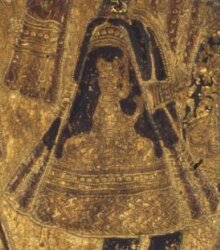
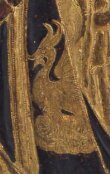
| Physical description | Rectangular cassone, decorated with a wedding scene in gilt modeled gesso and partly covered with red, blue and green glazes. The lid is flat, partly painted with black spots on an off-white background, and heavily worm-eaten. The back is decorated in the same way as the lid, the sides with a crimson ‘artichoke’ textile pattern, and the front with a wedding scene. The plinth is made up of three planks, forming the front and sides, and with a triangular bracket in each corner at the rear, forming the back feet. The sides of the plinth are decorated with a continuation of the textile pattern, and the front with two elongated quatrefoil frames, each containing two painted angels converging and holding an unidentified coat of arms. The upper part of the front is made up of figures, modeled in gesso, punched and gilded with red and dark blue glazes, similar to those on a cassone panel (Museum No. 21- 1869), which could well have formed its pair. The wedding scene itself consists of two processions, the one on the left taking up two thirds of the picture, converging either side of a lute-player: the one on the left is led by a harper, and the one on the right by the bride, who is followed by five women, three of which form a group, holding hands in a dance, at the back. Male attendants in the left-hand procession hold knotted handkerchiefs, which presumably have bridal connotations. The ground they stand on is decorated with stylized irises with red glazed petals and green glazed shoots. The bridegroom’s attendants wear a livery emblazoned with a leopard chained to a cushion on their cloaks, and the the bride’s mother (or nurse?) has large dragon on a turf emblazoned on hers. The families remain unidentified. Their headdresses would have been the latest Burgundian fashion, and very much in vogue in Florence between about 1425 and 1450. The bride is bare headed and wears a long plait, the sign of maidenhood. The plinth is made up of three planks overlapping at the front and sides, chamfered at the top and nailed to each other in the front corners. Immediately below the chamfering runs a narrow, grooved fillet, which gives the moulding an overhanging appearance. An identical fillet is nailed to the immediately below the lid. The floor of the cassone, mainly made up of one board, is nailed to the sides and front at the edges, and a narrow strip of the same wood, which fills the gap in the floor, is nailed to the back. The front, back and sides of the cassone are four boards joined together at the corners with dovetails cut into the sides. (Note that both the chest and stand, which appear to be joined, the chest not intended to be lifted from the stand - are dovetailed to hold the front and back in place, drawer-style, not in the usual manner of chests to hold the ends in place.) The corners are covered with canvas, and the front edges with a band of decorative gilt gesso punch marks. The lid is made up of two planks of poplar, with 19th century rails of walnut nailed to the front and side edges for extra support, and reinforced on the inside with three wooden slats, also added later. A bare, rectangular patch in the centre of the lid suggests that there was once a piece of moulding glued to the top. The dove-tail joinery of the front and sides of the main part of the cassone's is decorated from top to bottom with punch marks, consistent with those found on the clothes of figures on the front panel. This indicates that the sides, although of different decoration, do form part of the original cassone. The lock is off centre and must have been crudely inserted at a later date. However, this cassone is considered largely authentic and to date from about 1430. Conserved 2007 In addition to surface treatments, two nailed vertical battens (applied in the 19th or 20th century) were removed from the back, one at each end where they appear to have been intended to provide extra stability between chest and stand. In addition to the extensive removal of surface dirt, the painted stand, ends and back of the cassone were retouched. The front panel of the cassone was not retouched. |
| Dimensions |
|
| Style | |
| Production type | Limited edition |
| Marks and inscriptions | 8974-63 on top left corner of the proper left side.
'110' on a small octagonal label (19th c) on bottom proper right corner of the front panel. (Museum labels) |
| Gallery label |
|
| Object history | The cassone was bought for £40 in 1863. Its provenance is unknown. (The surviving panel of the twin cassone - Museum No. 21-1869 - was bought from Giuseppe Baslini, a leading dealer from Milan). This cassone could have been bought from either Baslini or William Blundel Spence, based in Fiesole. Note: Conserved 2009 Lent to the exhibition 'L'Autunno del Medievo in Umbria - Cofani nuziali in gesso durato e una bottega perugina dimenticata' at the Galleria Nazionale dell'Umbria, 21 Sept. 2019 - 6 January 2020 Historical significance: During the 19th century, most cassoni are altered particularly at the base, or stripped of their front panel. This object is rare because it seems to have had few alterations and seems remarkably intact. With the arms of Della Torre and Poccioli. Identification by Matteo Mazzalupi; information provided by Prof. Andrea De Marchi, Dipartimento SAGAS (Storia Archeologia Geografia Arte Spettacolo), Florence. |
| Historical context | During the 15th century, the cassone was the main form of storage, and these large box-like chests were associated with marriage. They were decorated with mythical or romantic themes and emblazoned with the coats of arms of the families linked in marriage. Although often associated with containing the bridal trusseau, both the bride's and the groom's families ordered them, and on occasions they were paraded through the streets, as the bride progressed to her new home. |
| Production | Attribution note: One of a pair. It is very similar to a cassone panel (Museum No. 21-1869), in which the bride and groom exchange rings. Reason For Production: Commission |
| Subjects depicted | |
| Summary | Marriage chests or cassoni were made in pairs. They were emblazoned with the coats of arms of the relevant families and often decorated with wedding scenes. A number of figures on this example wear Burgundian fashions, which were much in vogue in Florence between about 1425 and 1450. Early records do not tell us where this cassone came from, but it was bought by this museum for £40 in 1863, possibly from William Blundell Spence, a flamboyant English dealer based in Fiesole (just outside Florence), or from Giuseppe Baslini, a dealer from Milan, who in 1869 sold this museum the front panel (Museum No. 21 - 1869) of what could once have been its pair. This item is a rare example of a surviving cassone that almost certainly retains its original base, as well as remaining largely unaltered. |
| Bibliographic references |
|
| Collection | |
| Accession number | 8974-1863 |
About this object record
Explore the Collections contains over a million catalogue records, and over half a million images. It is a working database that includes information compiled over the life of the museum. Some of our records may contain offensive and discriminatory language, or reflect outdated ideas, practice and analysis. We are committed to addressing these issues, and to review and update our records accordingly.
You can write to us to suggest improvements to the record.
Suggest feedback
You can write to us to suggest improvements to the record.
Suggest feedback
| Record created | June 3, 2003 |
| Record URL |
Download as: JSONIIIF Manifest
