
St. Agnes
Photograph
1864 (photographed)
1864 (photographed)
| Artist/Maker | |
| Place of origin |
Julia Margaret Cameron looked to painting and sculpture as inspiration for her allegorical and narrative subjects. Some works are photographic interpretations of specific paintings by artists such as Raphael and Michelangelo. Others aspired more generally to create ‘Pictorial Effect’.
Cameron's harshest critics attacked her for using the supposedly truthful medium of photography to depict imaginary subject matter. Some suggested that at best her photographs could serve as studies for painters. The South Kensington Museum mainly acquired 'Madonnas' and 'Fancy Subjects', and exhibited them as pictures in their own right.
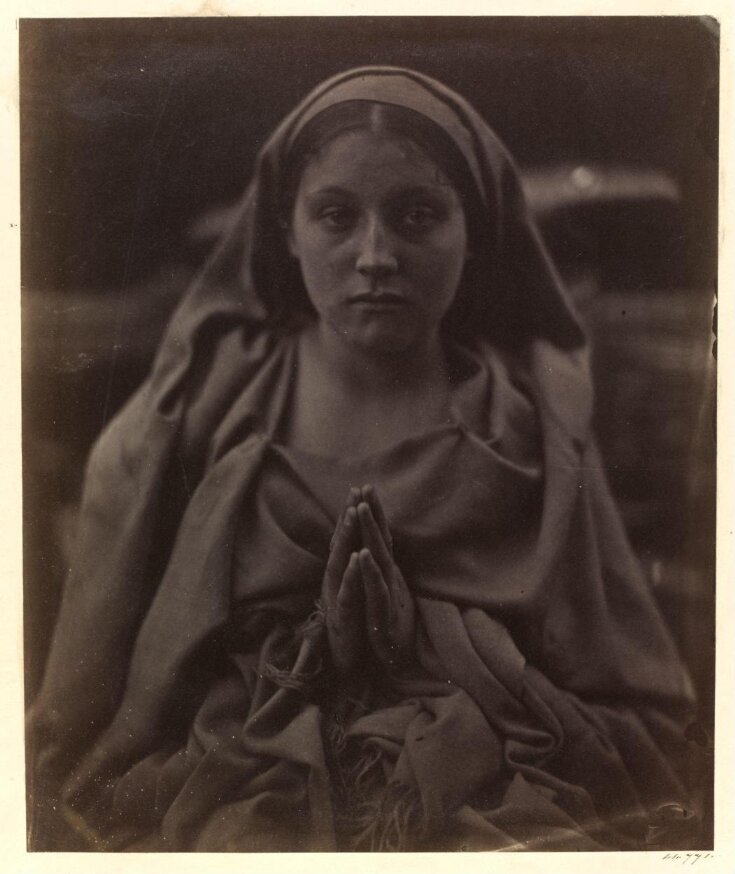
This image may have been inspired by poems by Alfred Tennyson and John Keats based on the legend that virgins dream of their future husbands on St Agnes Eve (20 January). To suggest the night, Cameron printed the photograph dark and added a moon by hand. The sitter is Mary Hillier, Cameron’s housemaid and one of her ‘most beautiful and constant’ models.
Cameron's harshest critics attacked her for using the supposedly truthful medium of photography to depict imaginary subject matter. Some suggested that at best her photographs could serve as studies for painters. The South Kensington Museum mainly acquired 'Madonnas' and 'Fancy Subjects', and exhibited them as pictures in their own right.
This image may have been inspired by poems by Alfred Tennyson and John Keats based on the legend that virgins dream of their future husbands on St Agnes Eve (20 January). To suggest the night, Cameron printed the photograph dark and added a moon by hand. The sitter is Mary Hillier, Cameron’s housemaid and one of her ‘most beautiful and constant’ models.
Object details
| Categories | |
| Object type | |
| Title | St. Agnes (assigned by artist) |
| Materials and techniques | Albumen print from wet collodion glass negative |
| Brief description | Photograph by Julia Margaret Cameron, 'St. Agnes' (sitter Mary Hillier), albumen print, 1864 |
| Physical description | Albumen photograph, mounted on card. Showing a woman (Mary Hillier, one of Julia Margaret Cameron's housemaids) dressed as a Madonna figure in the role of St. Agnes or the Virgin who dreams of a sacred union with Christ. The photograph is a frontal portrait and Hillier looks straight out at the viewer, her hands in prayer position. She wears a draped cloth and veil. |
| Dimensions |
|
| Style | |
| Marks and inscriptions |
|
| Credit line | Purchased from Julia Margaret Cameron, 17 June 1865 |
| Object history | Julia Margaret Cameron (1815–79) was one of the most important and innovative photographers of the 19th century. Her photographs were rule-breaking: purposely out of focus, and often including scratches, smudges and other traces of the artist’s process. Best known for her powerful portraits, she also posed her sitters – friends, family and servants – as characters from biblical, historical or allegorical stories. Born in Calcutta on 11 June 1815, the fourth of seven sisters, her father was an East India Company official and her mother descended from French aristocracy. Educated mainly in France, Cameron returned to India in 1834. In 1842, the British astronomer Sir John Herschel (1792 – 1871) introduced Cameron to photography, sending her examples of the new invention. They had met in 1836 while Cameron was convalescing from an illness in the Cape of Good Hope, South Africa. He remained a life-long friend and correspondent on technical photographic matters. That same year she met Charles Hay Cameron (1795–1880), 20 years her senior, a reformer of Indian law and education. They married in Calcutta in 1838 and she became a prominent hostess in colonial society. A decade later, the Camerons moved to England. By then they had four children; two more were born in England. Several of Cameron’s sisters were already living there, and had established literary, artistic and social connections. The Camerons eventually settled in Freshwater, on the Isle of Wight. At the age of 48 Cameron received a camera as a gift from her daughter and son-in-law. It was accompanied by the words, ‘It may amuse you, Mother, to try to photograph during your solitude at Freshwater.’ Cameron had compiled albums and even printed photographs before, but her work as a photographer now began in earnest. The Camerons lived at Freshwater until 1875, when they moved to Ceylon (now Sri Lanka) where Charles Cameron had purchased coffee and rubber plantations, managed under difficult agricultural and financial conditions by three of their sons. Cameron continued her photographic practice at her new home yet her output decreased significantly and only a small body of photographs from this time remains. After moving to Ceylon the Camerons made only one more visit to England in May 1878. Julia Margaret Cameron died after a brief illness in Ceylon in 1879. Cameron’s relationship with the Victoria and Albert Museum dates to the earliest years of her photographic career. The first museum exhibition of Cameron's work was held in 1865 at the South Kensington Museum, London (now the V&A). The South Kensington Museum was not only the sole museum to exhibit Cameron’s work in her lifetime, but also the institution that collected her photographs most extensively in her day. In 1868 the Museum gave Cameron the use of two rooms as a portrait studio, perhaps qualifying her as its first artist-in-residence. Today the V&A’s Cameron collection includes photographs acquired directly from the artist, others collected later from various sources, and five letters from Cameron to Sir Henry Cole (1808–82), the Museum’s founding director and an early supporter of photography. |
| Subjects depicted | |
| Association | |
| Summary | Julia Margaret Cameron looked to painting and sculpture as inspiration for her allegorical and narrative subjects. Some works are photographic interpretations of specific paintings by artists such as Raphael and Michelangelo. Others aspired more generally to create ‘Pictorial Effect’. Cameron's harshest critics attacked her for using the supposedly truthful medium of photography to depict imaginary subject matter. Some suggested that at best her photographs could serve as studies for painters. The South Kensington Museum mainly acquired 'Madonnas' and 'Fancy Subjects', and exhibited them as pictures in their own right. This image may have been inspired by poems by Alfred Tennyson and John Keats based on the legend that virgins dream of their future husbands on St Agnes Eve (20 January). To suggest the night, Cameron printed the photograph dark and added a moon by hand. The sitter is Mary Hillier, Cameron’s housemaid and one of her ‘most beautiful and constant’ models. |
| Associated object | 44:751 (copy) |
| Bibliographic references |
|
| Collection | |
| Accession number | 44771 |
About this object record
Explore the Collections contains over a million catalogue records, and over half a million images. It is a working database that includes information compiled over the life of the museum. Some of our records may contain offensive and discriminatory language, or reflect outdated ideas, practice and analysis. We are committed to addressing these issues, and to review and update our records accordingly.
You can write to us to suggest improvements to the record.
Suggest feedback
You can write to us to suggest improvements to the record.
Suggest feedback
| Record created | May 27, 2003 |
| Record URL |
Download as: JSONIIIF Manifest
