Please complete the form to email this item.

Oil painting - Le Malade Imaginaire
  • Le Malade Imaginaire
    Charles Robert Leslie, born 1794 - died 1859
  • Enlarge image

Le Malade Imaginaire

  • Object:

    Oil painting

  • Place of origin:

    Great Britain, UK (probably, painted)

  • Date:

    1843 (painted)

  • Artist/Maker:

    Charles Robert Leslie, born 1794 - died 1859 (artist)

  • Materials and Techniques:

    Oil on canvas

  • Credit Line:

    Given by John Sheepshanks, 1857

  • Museum number:

    FA.118[O]

  • Gallery location:

    Paintings, room 82, case EAST WALL

  • Download image

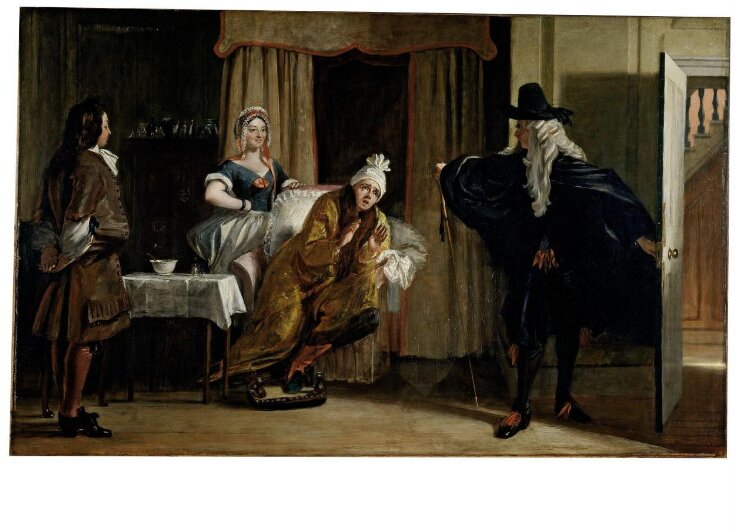
Critics admired this depiction of Molière's 1673 satirical comedy The Hypochondriac, particularly the figure of the fierce doctor Purgon. He has just listed the frightful diseases that the terrified Monsieur Argan will suffer, because Argan's sensible brother would not permit the horrible treatment prescribed.

Physical description

Oil painting depicting Act III, Scene 6 from Moliere's 'Le Malade Imaginaire'.

Place of Origin

Great Britain, UK (probably, painted)

Date

1843 (painted)

Artist/maker

Charles Robert Leslie, born 1794 - died 1859 (artist)

Materials and Techniques

Oil on canvas

Dimensions

Height: 61 cm estimate, Width: 97.7 cm estimate

Object history note

Given by John Sheepshanks, 1857

Descriptive line

Oil painting by Charles Robert Leslie depicting Act III, Scene 6 from Moliere's 'Le Malade Imaginaire'. Great Britain, 1843.

Bibliographic References (Citation, Note/Abstract, NAL no)

Catalogue of British Oil Paintings 1820-1860, Ronald Parkinson, Victoria and Albert Museum, London: HMSO, 1990, p. 168
The following is the full text of the entry:

"LESLIE, Charles Robert, RA (1794-1859)
Born London 19 October 1794, eldest son of American parents, with whom he went to Philadelphia 1799. Apprenticed to a publisher 1808, received a few lessons in painting from Thomas Sully. A subscription was raised to enable him to study art in Europe; returned.to London 1811, entered RA Schools and studied with Benjamin West and Washington Allston. Visited Paris 1817 with Allston and Wilkie Collins, met G S Newton, with whom he visited Brussels and Antwerp. Also friend and biographer (published 1843) of John Constable. Exhibited 76 works at the RA between 1813 and 1859, and 11 at the BI 1815-32. Some were portraits, but most were his much admired literary subjects, particularly drawn from Cervantes, Moliere, Shakespeare and Steme. Elected ARA 1821, RA 1826. Several of his works were engraved, and he made six illustrations for Sir WaIter Scott's Waverley novels 1824. Worked for six months as drawing master at West Point Military Academy, New York State, 1833. Professor of Painting at RA 1848-52; his lectures were published as a Handbook for Young Painters (1855). His Life of Reynolds was finished by Tom Taylor and published 1865. Died St John's Wood, London, 5 May 1859. An exhibition at the RA of 30 of his works was held winter 1870. His two sons, George Dunlop and Robert, were also artists. The Athenaeum critic (9 May 1846, p480) wrote that he was 'unrivalled for the certainty of his powers, the wit of his pencil, the deep knowledge of human nature as exhibited in the more ordinary scenes of life'.

LIT: Art JournaI1856, pp73-5 and 105-7, 1859, p187 (obit); C R Leslie Autobiographical Recollections ed T Taylor, 2 vols, 1860; J Dafforne Pictures by C R Leslie nd [1875]; Art ]ournaI1902, pp 144-8; J Constable The Letters of John Constable and C R Leslie 1931; ed R B Beckett John Constable's Correspondence III, Ipswich 1965

Le Malade Imaginaire
FAl18 Neg GA1194
Canvas, 61 X 97.7 cm (24 X 38½ ins)
Sheepshanks Gift 1857

Exhibited at the RA in 1843, and, according to Taylor (Leslie II, p269), painted for John Sheepshanks. The title given in the RA catalogue was 'Scene from Molière', together with the following quotation:

M Purgon: J'ai a vous dire que je vous abandonno a votre mauvaise condition, a l'intemperie de vos entrailles, a la corruption de votre sang, a l'acrete de votre bile et la feculance de vos humeurs.
Toinette: C'est fort bien fait.
Argan: Mon Dieu!
M Purgon : Et je veux qu'avanr qu'il soit quatre jours vous deveniez, dans un etat incurable.
Argan: Ah! misericorde.

The lines are from act 3 scene 6 of Molière's play Le Malade Irnaginaire.
Critical opinions seem to have differed. The Athenaeum thought it much inferior to Leslie's other exhibited work, 'A Scene from The Vicar of Wakefield': 'Monsieur Purgon is the best figure; but the Toinette is as far as possible from the clever, arch French soubrette, depicted by Molière'. The Art Union discussed the subject at some length:

This is the famous scene wherein M Purgon leaves his patient to the merciless course of a list of evils, sufficient to destory a frame of cast-iron. The figures are four, the principal of whom are the malade and his physician, who is quitting the room with the words, 'J'ai a vous dire ... ' M Purgon is an incomparable epigram in the characteristics of the peculiars of his class at the period Supposed. He is exquisitely dressed, and the bitter denunciation of his look says more than is expressed in the text. He speaks, through Leslie, in a strain of irate emotion, more deep than through Molière. The eye, and the lip, and the bursting fury of the manner say more than the written words. The patient seems already overwhelmed by the catalogue of diseases to which he is resigned; his look is powerfully depreciative of the doctor's wrath. Toinette stands behind his chair, and her phrase, 'C'est fort bien fait', is outdone by her countenance; indeed the picture is entirely one of character, and in the spirit in which it is painted has been very rarely equalled, and never surpassed.
The Redgraves and Waagen admired it, although Taylor, who found the figure of Toinette 'peculiarly successful', thought it 'not one of the pleasantest of its period in colour or execution'. He also records that there was little doubt that Leslie himself modelled for the face of the hypochondriac.

EXH: RA 1843 (416)

LIT: Leslie I, plxiii, II, p269

Ronald Parkinson"

Materials

Oil paint; Canvas

Techniques

Oil painting

Subjects depicted

Doctor; Bandages; Sickness; Patient

Categories

Paintings

Collection code

PDP

Download image
Qr_O80885
Ajax-loader