
'Henry Cole Tea Service'
Teapot
1846 (designed (process)), 1846 - 1890 (made)
1846 (designed (process)), 1846 - 1890 (made)
| Artist/Maker | |
| Place of origin |
Henry Cole, first director of the South Kensington Museum and an early campaigner for the improvement of British Design, designed the tea service, to which this teapot belongs, under the assumed name of Felix Summerly. Cole's aim was 'to obtain as much beauty and ornament as is comensurate with cheapness'. The design was based upon historical precedents combined with a concern for manufacturing techniques and utility. Cole paid particular attention to the application of ornament so that it did not interfere with the simplicity of outline of his design. The handles, in the form of vines, were derived from exmples of Greek earthenware in the British Museum, this form of ornament was simple and cheap to produce and did not in any way inhibit the function of the object. The service was awarded a silver medal by the Society of Arts, admired by the Prince Consort and sold in large numbers. This success encouraged Cole to found Summerly's Art Manufactures in order to commission designs for functional and attractive household objects from well-known artists for commercial production.
Object details
| Category | |
| Object type | |
| Parts | This object consists of 2 parts.
|
| Titles |
|
| Materials and techniques | Bone china, with slip-cast body and spout, and press-moulded handle, painted in enamels |
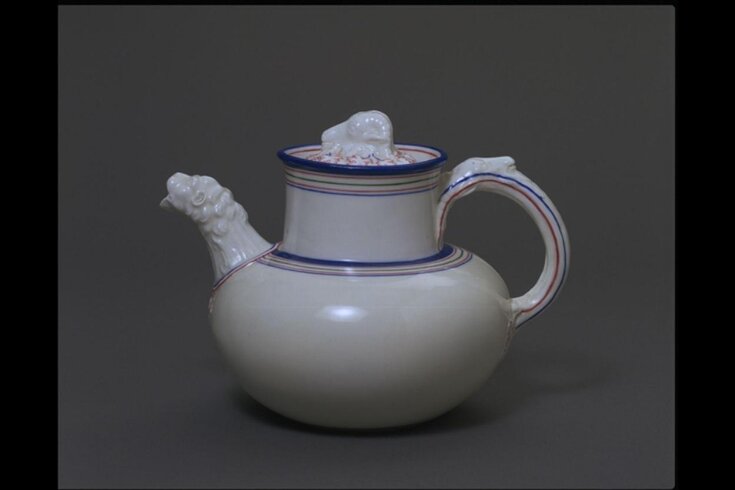
| Brief description | Porcelain teapot, decorated with blue, green and red enamel lines at the shoulder, rim, spout, base and handle. British (Stoke-on-Trent), 1846-1890. Part of a service designed by Henry Cole for the Society of Arts in 1846 and manufactured by Minton's. |
| Physical description | Rounded body, with cylindrical top. Spout in the form of a mediaeval lion, handle modelled with a goat's head, the recessed lid with a ram's head knob. Embellished with leaves at the base of the spout. Decorated with blue, green and red enamel lines at shoulder, rim, spout base and handle and outlining the leaves. |
| Dimensions |
|
| Marks and inscriptions |
|
| Object history | Historical significance: Henry Cole, first director of the South Kensington Museum and an early campaigner for the improvement of British Design, designed the tea service under the assumed name of Felix Summerly. Cole's aim was 'to obtain as much beauty and ornament as is comensurate with cheapness'. The design was based upon historical precedents combined with a concern for manufacturing techniques and utility. Cole paid particular attention to the application of ornament so that it did not interfere with the simplicity of outline of his design. The handles, in the form of vines, were derived from exmples of Greek earthenware in the British Museum, this form of ornament was simple and cheap to produce and did not in any way inhibit the function of the object. The service was awarded a silver medal by the Society of Arts, admired by the Prince Consort and sold in large numbers. This success encouraged Cole to found Summerly's Art Manufactures in order to commission designs for functional and attractive household objects from well-known artists for commercial production. |
| Historical context | Although it is said that the Henry Cole Tea Service was produced in large numbers into the 1890s this seems to refer only to the cups and saucers, as very few teapots survive. |
| Summary | Henry Cole, first director of the South Kensington Museum and an early campaigner for the improvement of British Design, designed the tea service, to which this teapot belongs, under the assumed name of Felix Summerly. Cole's aim was 'to obtain as much beauty and ornament as is comensurate with cheapness'. The design was based upon historical precedents combined with a concern for manufacturing techniques and utility. Cole paid particular attention to the application of ornament so that it did not interfere with the simplicity of outline of his design. The handles, in the form of vines, were derived from exmples of Greek earthenware in the British Museum, this form of ornament was simple and cheap to produce and did not in any way inhibit the function of the object. The service was awarded a silver medal by the Society of Arts, admired by the Prince Consort and sold in large numbers. This success encouraged Cole to found Summerly's Art Manufactures in order to commission designs for functional and attractive household objects from well-known artists for commercial production. |
| Associated objects |
|
| Bibliographic references |
|
| Collection | |
| Accession number | C.262:1, 2-1993 |
About this object record
Explore the Collections contains over a million catalogue records, and over half a million images. It is a working database that includes information compiled over the life of the museum. Some of our records may contain offensive and discriminatory language, or reflect outdated ideas, practice and analysis. We are committed to addressing these issues, and to review and update our records accordingly.
You can write to us to suggest improvements to the record.
Suggest feedback
You can write to us to suggest improvements to the record.
Suggest feedback
| Record created | June 23, 1998 |
| Record URL |
Download as: JSONIIIF Manifest
