
Artists Sketching among Antique Ruins
Oil Painting
ca. 1630 (painted)
ca. 1630 (painted)
| Artist/Maker | |
| Place of origin |
Jean Lemaire called le gros Lemaire (1601- 1659) was born in Danmartin-en-Goële, near Paris, and was first trained by Claude Vignon (1593-1670). He went to Rome around 1624 and met there Nicolas Poussin (1594-1665) and Jacques Stella (1596-1657). He became a close collaborator and friend of Poussin and returned to Paris in 1639. He was then appointed 'Garde du Cabinet de peinture de Sa Majesté et son Chasteau du Louvre et Thuilleries', which was to become the first collection of the future Louvre Museum.
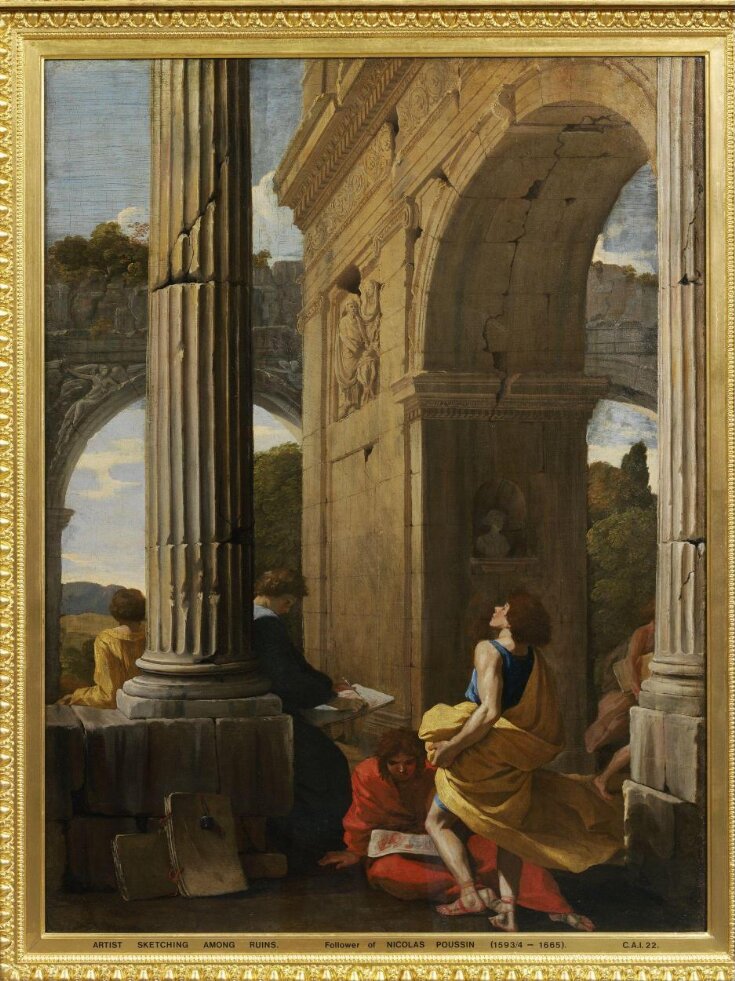
This painting is a fine example of Lemaire's production of landscape paintings, which combines imaginary and realistic architectural features in a picturesque setting. In this painting, five figures dressed all'antica draw antique Roman ruins, some of which have been identified. It illustrates the fascination for the Antique during the 17th century as well as the taste for idyllic landscapes often peopled with mythological figures.
This painting is a fine example of Lemaire's production of landscape paintings, which combines imaginary and realistic architectural features in a picturesque setting. In this painting, five figures dressed all'antica draw antique Roman ruins, some of which have been identified. It illustrates the fascination for the Antique during the 17th century as well as the taste for idyllic landscapes often peopled with mythological figures.
Object details
| Categories | |
| Object type | |
| Title | Artists Sketching among Antique Ruins |
| Materials and techniques | oil on canvas |
| Brief description | Oil on canvas, 'Artists sketching among antique ruins', Jean Lemaire, ca. 1630 |
| Physical description | Five figures dressed all'antica are sketching among antique ruins, two flutted columns are in the foreground framing a young man seen from the back, an archway on the right hand-side is seen in diagonal while another seen from the front in the background opens onto a wooded landscape. |
| Dimensions |
|
| Style | |
| Credit line | Bequeathed by Constantine Alexander Ionides |
| Object history | Peter Norton collection, sold Christie's London 29 January 1869 for £12, lot 914 (as attributed to Nicolas Poussin), bought by Cara for 12.10s. [for C.A.Ionides?]. In the collection of Constantine Alexander Ionides by November 1881, when he valued the painting for £600 (his inventory, private collection). Bequeathed by Constantine Alexander Ionides, 1900. |
| Historical context | Formerly attributed to Poussin, Walter Friedländer recognised this painting as an authentic work by Jean Lemaire (written communication, 1934), which was published as such by Andrea Busiri Vici in 1965. It depicts five artists sketching among antique ruins in the Roman countryside. The composition formula relies on an interesting play of vertical lines and superimposition of plans which provide the picture with a sense of grandeur. The right hand-side archway presented in diagonal derived partially from the Arch of Portugal, an archway in Rome destroyed in 1662, which recurs in other paintings by Lemaire (see View at dawn with a triumphal arch, Museo di Roma, Rome and View with a triumphal arch and the coliseum, Federico Zeri collection, Mentana). The low relief shows Septimius Severus and his wife Julia Domna attending a sacrifice and derives from the internal pilaster of the Arch of the Moneychangers erected in honour of the Imperial family by merchants and bankers of the Forum Boarium and later incorporated in the church of San Giorgio. The figures dressed all'antica may have been drawn in collaboration with Poussin such as in Landscape with the story of Theses and Etra, Musée Condé, Chantilly. The figure seen from the back shows a pentimento compared with the preparatory drawing, formerly attributed to Poussin, (Museum of Fine Arts, Budapest, Inv. 2885) in which the young man stretches his right arm to point out the column. The sketchbooks leaning against the column in the foreground may allude to the 'museo cartaceo', a compendium of about 7000 drawings, watercolours and prints of antiquities, architecture, fauna and flora commissioned by the Roman collector Cassiano del Pozzo and to which Lemaire most likely contributed (the publication of the catalogue raisonné of this 'museum of paper' is currently in progress). This painting is a good example of the taste for Arcadian vision of the Italian landscape, often peopled with dressed all'antica and mythological figures. Despite a few elements of realism such as the Roman monuments, this painting is really a 'fantaisie' which combines imaginary and realistic architectural features in a picturesque setting. This trend is particularly well represented by the oeuvre of Claude Lorrain and Nicolas Poussin, of whom Jean Lemaire appears to have been a close friend and collaborator, and would be further developed in the 18th century in such compositions called 'capriccio'. Although France and England became the new centres of landscape art in the 18th century, the Italian and Dutch traditions retained their authority. However the Arcadian vision of Italy increasingly tended towards a more precise observation of nature. Some of the most exciting developments took place in Venice, in the soft scenes of Francesco Zuccarelli (1702-1788), inspired by Claude Lorrain (1604-1682), and the fresh, spontaneous landscapes of Marco Ricci (1676-1730). Wealthy patrons, often accompanied by artists, on The Grand Tour, created a market for veduta and capriccio paintings, respectively topographical and fantasist landscape paintings. Landscape conventions were further enriched by foreign artists working in Italy, responding both to the beauty of Italian light and scenery celebrated by the Latin poets and vividly captured in the most popular landscapes of Claude Lorrain, Nicolas Poussin (1594-1665) and Gaspard Dughet (1615-1675). |
| Production | Formerly attributed to Nicolas Poussin |
| Subjects depicted | |
| Summary | Jean Lemaire called le gros Lemaire (1601- 1659) was born in Danmartin-en-Goële, near Paris, and was first trained by Claude Vignon (1593-1670). He went to Rome around 1624 and met there Nicolas Poussin (1594-1665) and Jacques Stella (1596-1657). He became a close collaborator and friend of Poussin and returned to Paris in 1639. He was then appointed 'Garde du Cabinet de peinture de Sa Majesté et son Chasteau du Louvre et Thuilleries', which was to become the first collection of the future Louvre Museum. This painting is a fine example of Lemaire's production of landscape paintings, which combines imaginary and realistic architectural features in a picturesque setting. In this painting, five figures dressed all'antica draw antique Roman ruins, some of which have been identified. It illustrates the fascination for the Antique during the 17th century as well as the taste for idyllic landscapes often peopled with mythological figures. |
| Bibliographic references |
|
| Collection | |
| Accession number | CAI.22 |
About this object record
Explore the Collections contains over a million catalogue records, and over half a million images. It is a working database that includes information compiled over the life of the museum. Some of our records may contain offensive and discriminatory language, or reflect outdated ideas, practice and analysis. We are committed to addressing these issues, and to review and update our records accordingly.
You can write to us to suggest improvements to the record.
Suggest feedback
You can write to us to suggest improvements to the record.
Suggest feedback
| Record created | May 12, 2003 |
| Record URL |
Download as: JSONIIIF Manifest
