Place of Origin
Great Britain, UK (probably, painted)
Date
ca. 1842 (painted)
Artist/maker
Richard Redgrave, born 1804 - died 1888 (artist)
Materials and Techniques
oil on canvas
Dimensions
Height: 106.7 cm estimate, Width: 142.2 cm estimate, Weight: 60 kg with frame
Object history note
Given by John Sheepshanks, 1857
Descriptive line
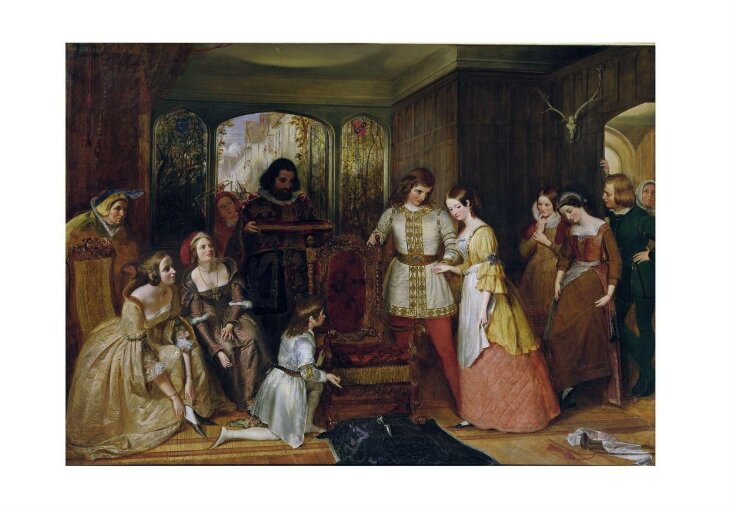
Oil painting, 'Cinderella About to Try on the Glass Slipper', Richard Redgrave, ca. 1842
Bibliographic References (Citation, Note/Abstract, NAL no)
Catalogue of British Oil Paintings 1820-1860, Ronald Parkinson, Victoria and Albert Museum, London: HMSO, 1990, pp. 236-37
This is the full text for the catalogue entry:
"REDGRAVE, Richard, CB, RA (1804-1888)
Born Pimlico, London, 30 April 1804, the son of an engineer and manufacturer, in whose office he first worked as draughtsman and designer. Entered RA Schools 1826. Worked as a drawing master in the 1830s. Exhibited 141 works at the RA between 1825 and 1883, 17 at the BI 1832-59, and 20 (including four watercolours) at the SBA 1829-35 and 1870-9. Early works were landscapes and costume pieces, mainly l8thcentury and in the manner of C R Leslie; from the 1840s he specialised in modem genre and social comment, before returning to landscape, particularly around his home in Abinger, Surrey, relieving the pressure of his administrative duties. Elected ARA 1840, RA 1851; Secretary of the Etching Club 1837-42. In 1847 he began his official career in art education as Master at the Government School of Design, becoming Head Master in 1848, Art Superintendent 1852, Inspector General 1857, and Director 1874. He was Inspector of the Queen's Pictures, compiling a catalogue of the Royal Collection, 1857-79. As he wrote in 1856: 'I regret to find that I am so identified with office work that it is almost forgotten that I am a painter'
(F M Redgrave Richard Redgrave: A Memoir. . . p l 71 ). He published An Elementary Manual of Colour ... (1853), The Sheepshanks Gallery (1870), and, most famously, with his brother Samuel, A Century of Painters of the English School ... (2 vols, 1866). He was offered a Knighthood in 1869, which he declined; created Companion of the Bath 1880. Died Kensington, London, 14 December 1888. His daughters Frances (who compiled the Memoir of her father) and Evelyn were also exhibiting artists.
LIT: Art Journal 1850, pp48-9 (referred to below as the 'autobiography'), with engr portrait; Art JournaI1859, p206; Athenaeum 22 December 1888, pp854-5 (obit); F M Redgrave Richard Redgrave, CB, RA: A Memoir compiled from his diary 1891 (referred to below as Memoir); F G Stephens in Magazine of Art XV, 1891-2, pp26-9; ed S Casteras and R Parkinson Richard Redgrave 1804-1888 1988, V &A and Yale Center for British Art, New Haven, USA, exhibition catalogue
Cinderella About to Try on the Glass Slipper
FA167 Neg 37940
Canvas, 106.7 X 142.2 cm (42 X 56 ins) Sheepshanks Gift 1857
Exhibited at the RA in 1842 and bought from the artist by John Sheepshanks. The title given in the RA catalogue was 'Cinderella', accompanied by the quotation (presumably from a translation of Charles Perrault's story): 'That minx, said the step-sister, to think of trying on the slipper'. Redgrave wrote to his sister Margaret 4 October 1840:
I also am trying out a subject which I think will make a good picture it is Cinderella - where the disguised prince is leading her up to the chair to try drawing on the slipper which the herald holds on a cushion the other 2 sisters all envy and hatred just replacing their shoes with the aid of a page, after having tried and failed, & a pert attendant at the other end of the picture looking at her own foot thinking that perhaps she might be able to get on the slipper - of course the point of the picture is the contrast between the meekness & modesty of Cinderella, and the scorn & envy of the handsome but proud sisters - I think it will make a good subject but I wish to paint it without anyone knowing that I am about it if I can ... (letter in National Art Library).
The Art Union critic admired it:
We find here an exertion of those powers which so eminently distinguish this artist. . . We read in this work the fairy tale over again, - not only in its main incident, but all the by-play, in the description of which the imagination of this painter is so rich. The sneer which curls on the features of the envious sisters is rendered with much power, as is also the retiring demeanour of Cinderella, In colour the picture is rich, and in effect most successful.
The Athenaeum, however, criticised the drawing: 'Clearly made out as is the story, and attractively handled as are its details, the draftsman's correcting hand is wanted. The enamoured youth, for instance, (to go no further for blemishes) does all but squint. These things must be amended, or we shall have no Age of Cartoons' (presumably a reference to the fresco competitions for the Palace of Westminster in the 1840s, in which Redgrave participated).
The setting and costumes, particularly the tunics and hose and pointed shoes, are intended to give a medieval flavour, the women's clothes are more 18th-century in style, and their hairstyles are contemporary and fashionable for about 1840 (see for example Landseer's 1839 sketch portrait of Queen Victoria in the Royal Collection). Although some 19th-century artists such as Millais used sources like Bonnard's Costume Historique on which to base their costume design, no specific borrowings have been identified for Redgrave. The chair in the foreground is Victorian-Jacobethan in style. The model for the bearded servant may have been the artist's brother Samuel Redgrave, whom he closely resembles; the artist used the same model in other paintings. Prince Charming may be the artist himself (see the self-portrait of about 1827 in the Yale Center for British Art, New Haven),
There are studies for various figures in the V&A collections; the small oil sketch is in the Bankfield Museum, Wakefield.
EXH: RA 1842 (244); Victorian Narrative Painting Bristol Cathedral 1977 (11 ); Richard Redgrave 1804-1888, V&A and Yale Center for British Art, New Haven, 1988 (24)
LIT: Athenaeum 14 May 1842, p434; Art Union 1842, p123; Art Journal 1857, p240, 1859, p206; Memoir p44; Casteras and Parkinson pp108, 110
Ronald Parkinson."
Vikutoria & Arub?to Bijutsukan-z? : eikoku romanshugi kaigaten = The Romantic tradition in British painting, 1800-1950 : masterpieces from the Victoria and Albert Museum / selected by Mark Evans [Japan : Brain Trust], 2002. 185 p. : ill. (chiefly col.) ; 30 cm.
Exhibition History
The Romantic Tradition in British Painting 1800-1950: Masterpieces from the Victoria and Albert Museum (Prefectural Museum of Art, Hyogo, Kobe, Japan 28/01/2003-06/04/2003)
The Romantic Tradition in British Painting 1800-1950: Masterpieces from the Victoria and Albert Museum (Koriyama City Museum of Art 22/11/2002-27/12/2002)
The Romantic Tradition in British Painting 1800-1950: Masterpieces from the Victoria and Albert Museum (Matsuzakaya Museum, Nagoya, Japan 19/10/2002-11/11/2002)
The Romantic Tradition in British Painting 1800-1950: Masterpieces from the Victoria and Albert Museum (Chiba Prefectural Museum of Art, Japan 24/08/2002-06/10/2002)
Materials
Oil paint; Canvas
Techniques
Oil painting
Subjects depicted
Prince; Cinderella; Shoe
Categories
Paintings
Collection code
PDP