
Waste Not Want Not
Bread Plate
ca. 1850 (made)
ca. 1850 (made)
| Artist/Maker | |
| Place of origin |
Object Type
This bread plate was one the most celebrated designs for domestic wares by Augustus Welby Northmore Pugin (1812-1852), and is widely accepted as an icon of Gothic Revival design. It is one of a small group of ceramics produced by Minton using the encaustic technique of inlaying coloured clays which was primarily associated with the production of tiles. The basic three-colour version was the most common, but a six-colour variant was also made, as was a version which instead was decorated with opaque maiolica glazes.
Design & Designing
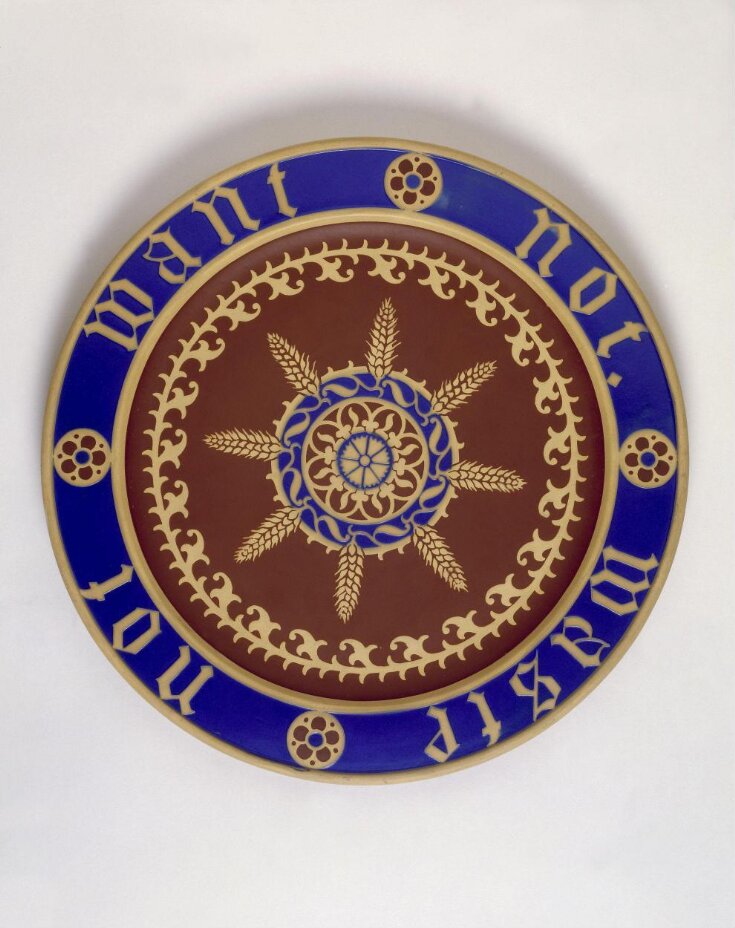
The decoration of the bread plate typifies the kind of flat patterning favoured by Pugin. Indeed the technique of inlaying clay is particularly well suited to formulating this type of design. The pattern incorporates elements of stylised Gothic foliage, as well as a series of wheat-sheaves, which provide a reference to the plate's function. The inscription, 'Waste not want not', adds an appropriately moralising touch to the design.
Materials & Making
The production of floor tiles decorated with inlaid clay of a contrasting colour became established in Britain during the second quarter of the 13th century, and was widely practised throughout the Medieval period. In the 19th century the technique was revived. Herbert Minton was instrumental in this, and refined the technique to allow more than one colour of inlay to be used. Inlaid (or encaustic) tiles were produced by Minton in vast quantities. The application of the technique to other wares was limited, however, and of those that were produced, the bread plate is by far the best known.
This bread plate was one the most celebrated designs for domestic wares by Augustus Welby Northmore Pugin (1812-1852), and is widely accepted as an icon of Gothic Revival design. It is one of a small group of ceramics produced by Minton using the encaustic technique of inlaying coloured clays which was primarily associated with the production of tiles. The basic three-colour version was the most common, but a six-colour variant was also made, as was a version which instead was decorated with opaque maiolica glazes.
Design & Designing
The decoration of the bread plate typifies the kind of flat patterning favoured by Pugin. Indeed the technique of inlaying clay is particularly well suited to formulating this type of design. The pattern incorporates elements of stylised Gothic foliage, as well as a series of wheat-sheaves, which provide a reference to the plate's function. The inscription, 'Waste not want not', adds an appropriately moralising touch to the design.
Materials & Making
The production of floor tiles decorated with inlaid clay of a contrasting colour became established in Britain during the second quarter of the 13th century, and was widely practised throughout the Medieval period. In the 19th century the technique was revived. Herbert Minton was instrumental in this, and refined the technique to allow more than one colour of inlay to be used. Inlaid (or encaustic) tiles were produced by Minton in vast quantities. The application of the technique to other wares was limited, however, and of those that were produced, the bread plate is by far the best known.
Object details
| Categories | |
| Object type | |
| Title | Waste Not Want Not (popular title) |
| Materials and techniques | Earthenware, inlaid in the encaustic technique and decorated with coloured glazes |
| Brief description | Earthenware bread plate with encaustic decoration, a motto, 'waste not want not', running around the rim. British (Stoke-on-Trent), ca.1849. Designed by Augustus Welby Northmore Pugin and manufactured by Minton's. |
| Physical description | The circular design incorporates wheat-ears, formalised leaf scrolls and geometric reliefs in red brown and blue slip. It is inscribed 'Waste Not, Want Not' in gothic letters on the rim. |
| Dimensions |
|
| Gallery label | British Galleries:
This is one of the best-known commercial designs by the architect A.W.N. Pugin. He believed that the Gothic style could provide for all life's needs, from objects for the domestic breakfast table to those for grand church interiors. This plate was made using the encaustic tile process developed by the ceramic manufacturer Minton & Co.(27/03/2003) |
| Object history | Designed by A.W.N. Pugin (born in London, 1812, died in Ramsgate, Kent, 1852); and made by Minton & Co., Stoke-on-Trent, Staffordshire Historical significance: This is the best known of Pugin's designs for ceramics and widely accepted as an icon of Gothic Revival design. Designed in 1849 and shown in the Birmingham Exhibition of that year it is the most important in a small group of domestic wares made using the encaustic tile process developed by Minton's. It is known in three versions, the basic and most common three colour version, a six colour encaustic variant and an earthenware version with majolica glazes. Despite the status of the Pugin bread plate today it was not always so admired. One contemporary critic wrote, 'The bread plate is made on the encaustic tile principle, very dark and massive in colouring, and disagreeably associating with the bread. The design might do well for a pavement, but is rude and coarse, and unfit for an object immediately close to the eye on the table.' |
| Summary | Object Type This bread plate was one the most celebrated designs for domestic wares by Augustus Welby Northmore Pugin (1812-1852), and is widely accepted as an icon of Gothic Revival design. It is one of a small group of ceramics produced by Minton using the encaustic technique of inlaying coloured clays which was primarily associated with the production of tiles. The basic three-colour version was the most common, but a six-colour variant was also made, as was a version which instead was decorated with opaque maiolica glazes. Design & Designing The decoration of the bread plate typifies the kind of flat patterning favoured by Pugin. Indeed the technique of inlaying clay is particularly well suited to formulating this type of design. The pattern incorporates elements of stylised Gothic foliage, as well as a series of wheat-sheaves, which provide a reference to the plate's function. The inscription, 'Waste not want not', adds an appropriately moralising touch to the design. Materials & Making The production of floor tiles decorated with inlaid clay of a contrasting colour became established in Britain during the second quarter of the 13th century, and was widely practised throughout the Medieval period. In the 19th century the technique was revived. Herbert Minton was instrumental in this, and refined the technique to allow more than one colour of inlay to be used. Inlaid (or encaustic) tiles were produced by Minton in vast quantities. The application of the technique to other wares was limited, however, and of those that were produced, the bread plate is by far the best known. |
| Bibliographic references |
|
| Collection | |
| Accession number | C.46-1972 |
About this object record
Explore the Collections contains over a million catalogue records, and over half a million images. It is a working database that includes information compiled over the life of the museum. Some of our records may contain offensive and discriminatory language, or reflect outdated ideas, practice and analysis. We are committed to addressing these issues, and to review and update our records accordingly.
You can write to us to suggest improvements to the record.
Suggest feedback
You can write to us to suggest improvements to the record.
Suggest feedback
| Record created | June 23, 1998 |
| Record URL |
Download as: JSONIIIF Manifest
