Place of Origin
Great Britain, United Kingdom (probably, painted)
Date
1842 (painted)
Artist/maker
Richard Redgrave, born 1804 - died 1888 (artist)
Materials and Techniques
oil on panel
Marks and inscriptions
'Richd Redgrave 1842'
Dimensions
Height: 76.2 cm estimate, Width: 63.5 cm estimate
Object history note
Given by John Sheepshanks, 1857
Descriptive line
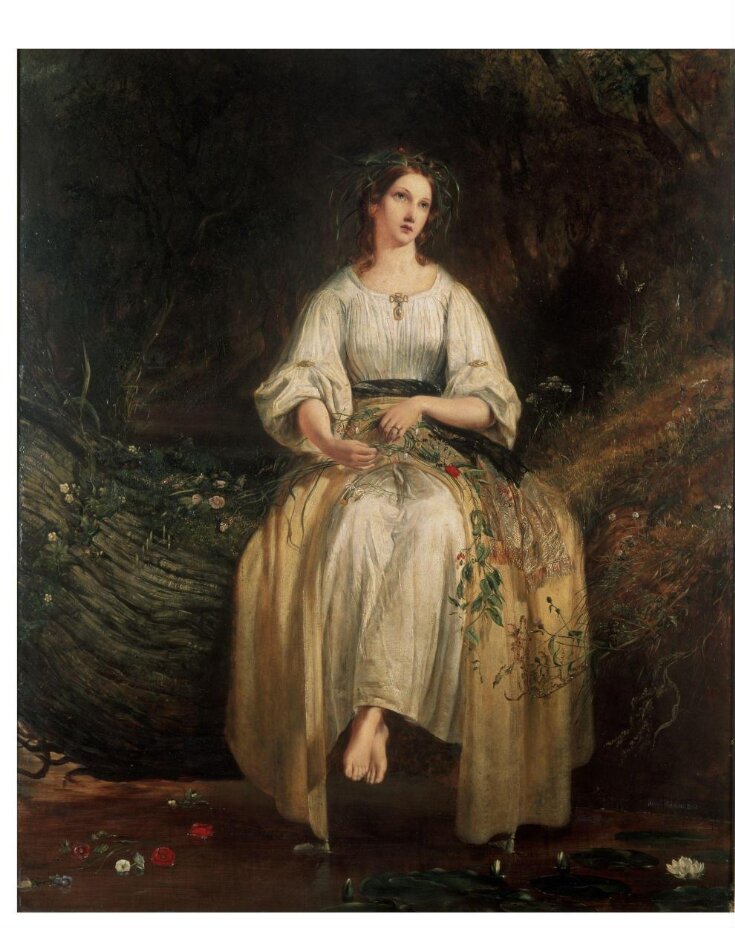
Oil painting entitled 'Ophelia Weaving her Garlands' by Richard Redgrave. Great Britain, 1842.
Bibliographic References (Citation, Note/Abstract, NAL no)
Catalogue of British Oil Paintings 1820-1860, Ronald Parkinson, Victoria and Albert Museum, London: HMSO, 1990, pp. 243-44
This is the full text form the catalogue entry:
"REDGRAVE, Richard, CB, RA (1804-1888)
Born Pimlico, London, 30 April 1804, the son of an engineer and manufacturer, in whose office he first worked as draughtsman and designer. Entered RA Schools 1826. Worked as a drawing master in the 1830s. Exhibited 141 works at the RA between 1825 and 1883, 17 at the BI 1832-59, and 20 (including four watercolours) at the SBA 1829-35 and 1870-9. Early works were landscapes and costume pieces, mainly l8thcentury and in the manner of C R Leslie; from the 1840s he specialised in modem genre and social comment, before returning to landscape, particularly around his home in Abinger, Surrey, relieving the pressure of his administrative duties. Elected ARA 1840, RA 1851; Secretary of the Etching Club 1837-42. In 1847 he began his official career in art education as Master at the Government School of Design, becoming Head Master in 1848, Art Superintendent 1852, Inspector General 1857, and Director 1874. He was Inspector of the Queen's Pictures, compiling a catalogue of the Royal Collection, 1857-79. As he wrote in 1856: 'I regret to find that I am so identified with office work that it is almost forgotten that I am a painter'
(F M Redgrave Richard Redgrave: A Memoir. . . p l 71 ). He published An Elementary Manual of Colourr ... (1853), The Sheepshanks Gallery (1870), and, most famously, with his brother Samuel, A Century of Painters of the English School ... (2 vols, 1866). He was offered a Knighthood in 1869, which he declined; created Companion of the Bath 1880. Died Kensington, London, 14 December 1888. His daughters Frances (who compiled the Memoir of her father) and Evelyn were also exhibiting artists.
LIT: Art Journal 1850, pp48-9 (referred to below as the 'autobiography'), with engr portrait; Art JournaI1859, p206; Athenaeum 22 December 1888, pp854-5 (obit); F M Redgrave Richard Redgrave, CB, RA: A Memoir compiled from his diary 1891 (referred to below as Memoir); F G Stephens in Magazine of Art XV, 1891-2, pp26-9; ed S Casteras and R Parkinson Richard Redgrave 1804-1888 1988, V &A and Yale Center for British Art, New Haven, USA, exhibition catalogue
Ophelia Weaving her Garlands
FA171 Neg 74357
Panel, 76.2 X 63.5 cm (30 X 25 ins)
Signed and dated 'Richd Redgrave 1842' in white br
Sheepshanks Gift 1857
Exhibited at the RA in 1842 and, according to the Memoir, bought by John Sheepshanks. The title given in the RA catalogue was simply 'Ophelia', with the following lines (slightly adapted) from Shakespeare's Hamlet, act 4 scene 7:
There is a willow grows ascaunt the brook,
That shews his hoar leaves in the glossy stream;
There with fantastic garland did she make
Of crow-flowers, nettles, daisies, and long purples.
The Memoir records that Redgrave's work for the 1842 exhibition was
behindhand and further delayed by his brother Samuel's illness; he wrote to
his sister Margaret that 'I shall finish "Cinderella" and leave the others if I
have not time - "Ophelia" and "Bad News from the Sea".'
The Memoir also indicated that 'Ophelia' 'has been considered to be one of his best figure-pieces'. After an admiring description, particularly of the 'mournful sweetness' of the face, the Athenaeum critic 'could but think of the incomparable snatches of melody which Shakespeare has put into her mouth, while standing before this attractive figure; which is all the more welcome, as displaying a substantial advance made by the painter'. The reviewer also noted how the disordered clothing, strange 'light in the eyes and a quivering of the lip ... declare that Sorrow has done its worst work'. The Art Union would
not have recognised Mr Redgrave in this picture; not, be it understood from a want of excellence, but from its inconsonance with all our impressions of its author ... She is pale - woe-begone - and her restless, fevered eyes, bespeak a mind diseased. The painting of her dress, which is white, resembles the manner of some of the old masters, a feeling which is extended to the banks of the brook, this part of the work being enamelled on the canvas [sic] like the foreground of Giorgione's garden scenes.
Redgrave recorded in his diary on 20 June 1857 that, on a visit to the South Kensington Museum, Queen Victoria 'seemed really to like my picture of "Ophelia"', and two years later the Art Journal commented that 'the figure is an admirable embodiment of the poet's character, and the landscape is painted with a finish and attention to detail which, in our day, would be called "Pre-Raffaellism'''.
Redgrave follows the description of the 'crowflowers, nettles, daisies, and long purples' in Queen Gertrude's account of Ophelia's death, and Joanna Dean has kindly identified for the present author no fewer than 30 different flowers in the painting. The flowers around Ophelia refer to constancy, love, extinguished hopes and thoughts, purity of heart, ingratitide and mourning; she wears a garland on her head of reeds, rosehip, nettle and field scabious, symbolising similar qualities and emotions; in her hands are various other symbolic plants, notably the poppy bud indicating death. The garland is presumably also the head-dress of a bride, and she has evidently fashioned for herself a wedding ring by tying grasses around her finger, relating to her longing for Hamlet.
The subject of Ophelia for painting was not as popular as might be supposed, probably because of its difficulty. There were two in the 1831 RA exhibition (by John Wood and Lilburne Hicks), and later in 1852 the more famous works by Millais and Arthur Hughes. Redgrave himself painted another Ophelia (sold Christie's 15 June 1973 (65), size given as 20 by 16 inches), which scarcely even suggests the subject's derangement of mind. He also made an etching of a similar subject to illustrate Desdemona's 'Poor Barbara's Song' from Othello for the Songs and Ballads by Shakespeare Illustrated by the Eching Club published in 1843 (repr Casteras and Parkinson 1988, p25).
There are three small sketches and a chalk and watercolour study for the painting in the British Museum; a study for Ophelia's head, and a cartoon in reverse in black and red chalks and squared for transfer to the panel, are in the V&A collections.
EXH: RA 1842 (71); Exposition Universelle Paris 1855 (925, as 'Ophelia', lent by J Sheepshanks); Richard Redgrave 1804-1888, V&A and Yale Center for British Art, New Haven, 1988 (23)
ENGR: Butterworth and Heath, for Art Journal 1859, p206
LIT: Athenaeum 7 May 1842, p41O; Art Journal 1842, pl2l, 1859, p206; W Sandby The History of the Royal Academy of Arts 1862, II, p294; Memoir pp44, 171, 175; R Altick Paintings from Books: Art and Literature in Britain 1760-1900 1985, p115; Casteras and Parkinson, ppl07-8
Ronald Parkinson."
Vikutoria & Arub?to Bijutsukan-z? : eikoku romanshugi kaigaten = The Romantic tradition in British painting, 1800-1950 : masterpieces from the Victoria and Albert Museum / selected by Mark Evans [Japan : Brain Trust], 2002. 185 p. : ill. (chiefly col.) ; 30 cm.
Exhibition History
The Romantic Tradition in British Painting 1800-1950: Masterpieces from the Victoria and Albert Museum (Prefectural Museum of Art, Hyogo, Kobe, Japan 28/01/2003-06/04/2003)
The Romantic Tradition in British Painting 1800-1950: Masterpieces from the Victoria and Albert Museum (Koriyama City Museum of Art 22/11/2002-27/12/2002)
The Romantic Tradition in British Painting 1800-1950: Masterpieces from the Victoria and Albert Museum (Matsuzakaya Museum, Nagoya, Japan 19/10/2002-11/11/2002)
The Romantic Tradition in British Painting 1800-1950: Masterpieces from the Victoria and Albert Museum (Chiba Prefectural Museum of Art, Japan 24/08/2002-06/10/2002)
Materials
Oil paint; Panel
Techniques
Oil painting
Subjects depicted
Flowers; Woman; Water; Ophelia; Insanity
Categories
Paintings
Collection code
PDP